John Salter’s Blog
Follow my ruminations
Get new content delivered directly to your inbox.
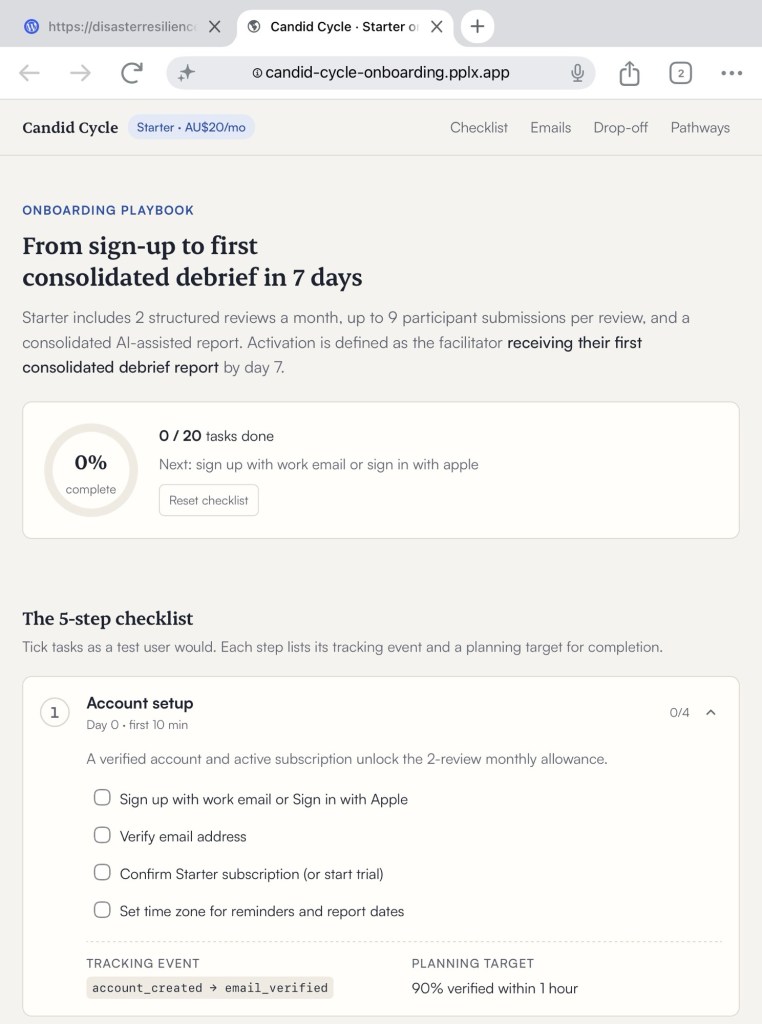
- Playbook for Candid Cycle Starter: Your First Review
Turn team experience into clear findings, priorities and practical next steps.
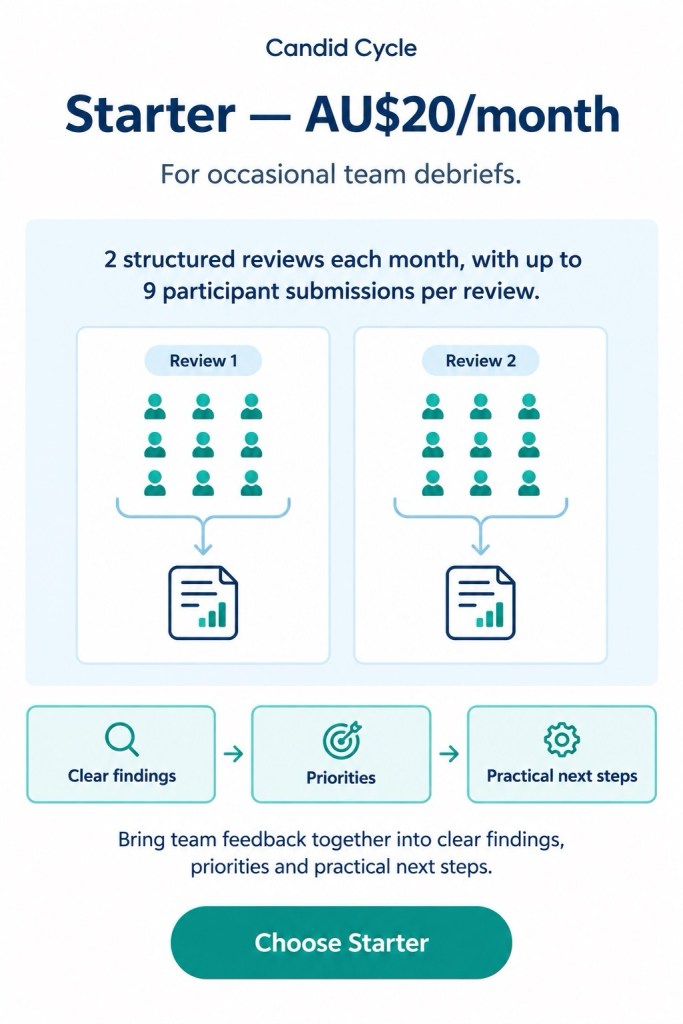
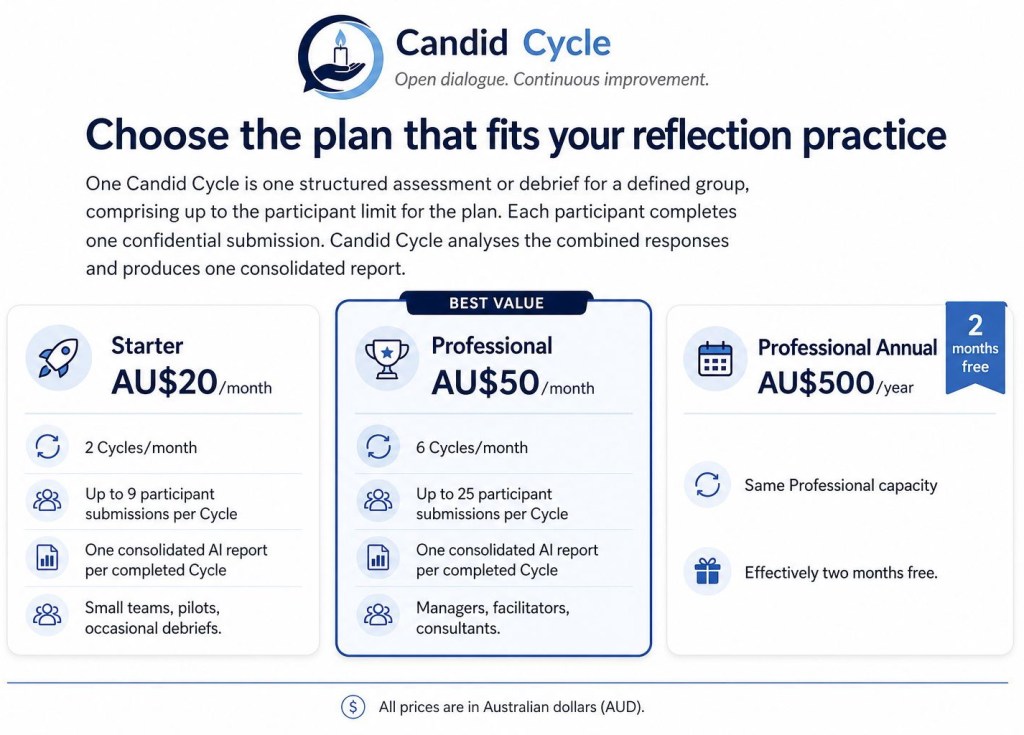
Your Starter plan includes 2 structured reviews each month, with up to 9 participant submissions per review.
1. Choose what to review
[ ] Select a recent project, activity, event or period of work.
[ ] Give the review a clear title and define the period it covers.
[ ] Describe the intended outcome: what was the work meant to achieve?
2. Set up your review
[ ] Create your first review in Candid Cycle.
[ ] Choose who should contribute, within your allowance of 9 participant submissions.
[ ] Set a deadline for contributions.
[ ] Explain the purpose: learn from the experience, recognise strengths and identify improvements—not assign blame.
3. Invite thoughtful contributions
[ ] Send participants the review invitation and deadline.
[ ] Ask them to reflect on:
- What worked well—and why?
- What could have been more effective?
- What did we learn?
- What actions should we take next?
- Encourage specific examples rather than broad statements.
4. Check the input
[ ] Check which contributions have arrived before preparing the consolidated report.
[ ] Follow up on missing input where appropriate.
[ ] Note any gaps that could affect the findings, such as limited participation or missing perspectives.
5. Review your consolidated report
[ ] Prepare the AI-assisted consolidated report.
[ ] Check that the findings accurately reflect the contributions.
[ ] Check that distinct concerns or differing views have not been lost.
[ ] Review proposed priorities and actions before sharing.
[ ] Check for sensitive or identifying information and confirm who should receive the report.
6. Agree what happens next
[ ] Share the report with the appropriate people.
[ ] Confirm what should continue and what needs to change.
[ ] Agree a manageable set of actions.
[ ] Assign each agreed action an owner, target date and intended outcome.
[ ] Decide how you will check progress.
7. Plan the follow-up
[ ] Schedule a follow-up review after there has been time to act.
[ ] Record what you want to revisit: completed actions, unresolved issues and changes in results.
[ ] Check your remaining monthly review allowance before starting another cycle.
Your first review is complete when:
You have checked the report, shared the findings with the right people and agreed who will do what next.
Electronic Onboarding Checklist
- Start with … “Starter”

- Beer and Immunity
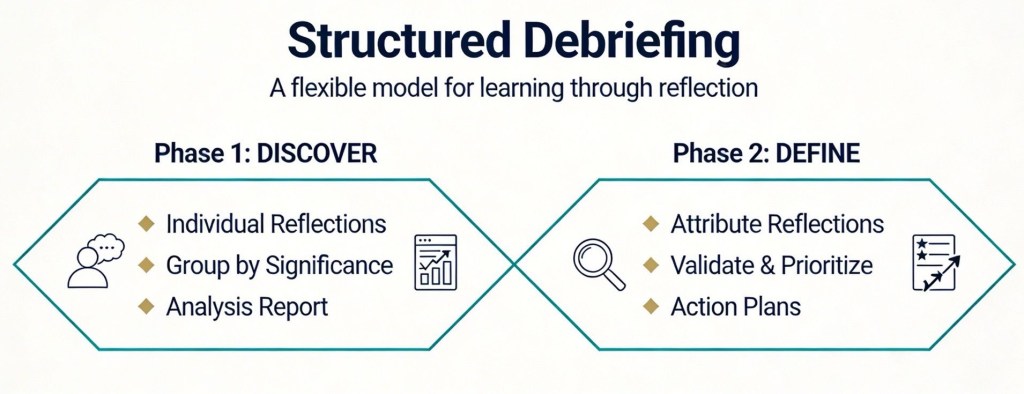
Old School
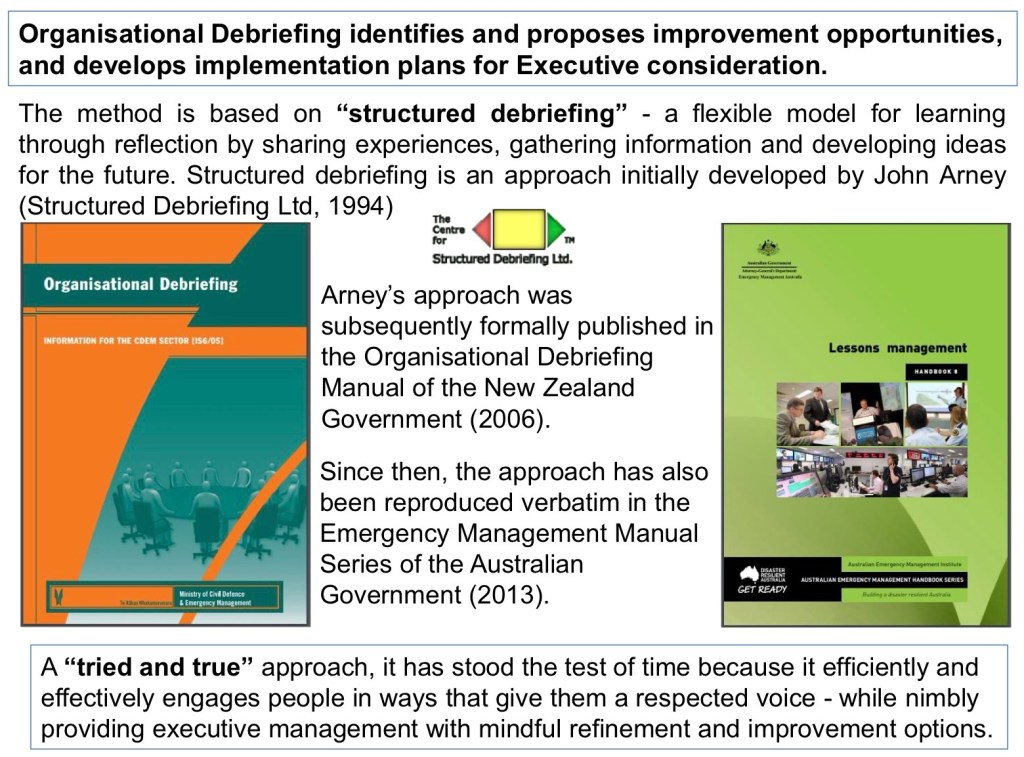
The “manual model” has significant limitations around candour Old hands used to be cynical about debriefs – a “search for the guilty, punishment of the innocent, and praise and honours for the non-participants.”
New School

“Beer and immunity” is a phrase popularized by JPMorgan Chase CEO Jamie Dimon to describe how he gathers honest feedback from frontline employees 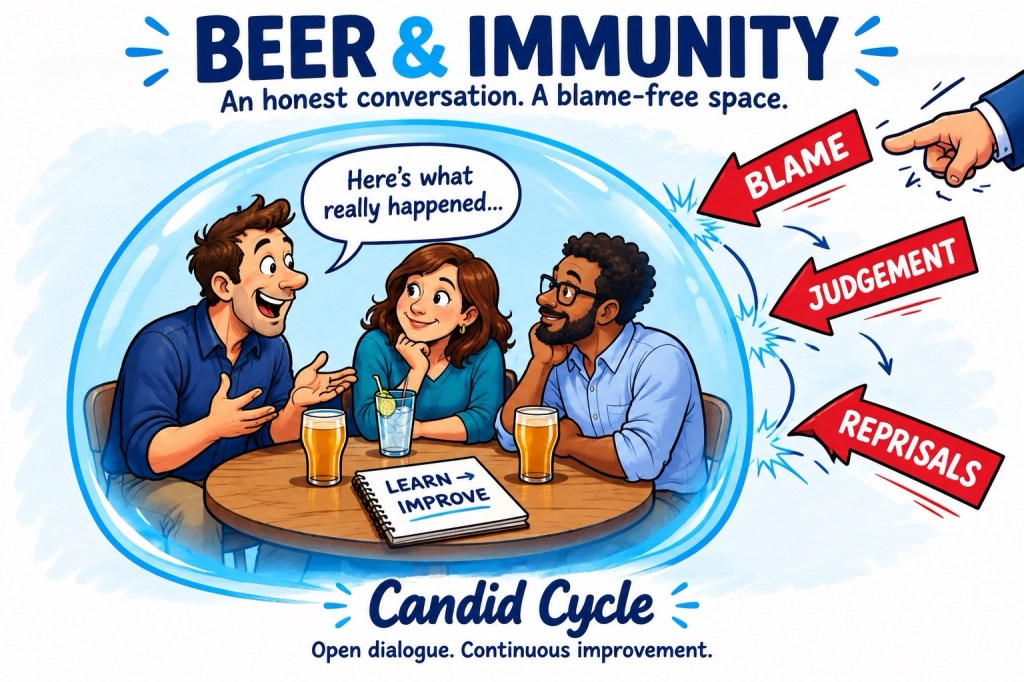
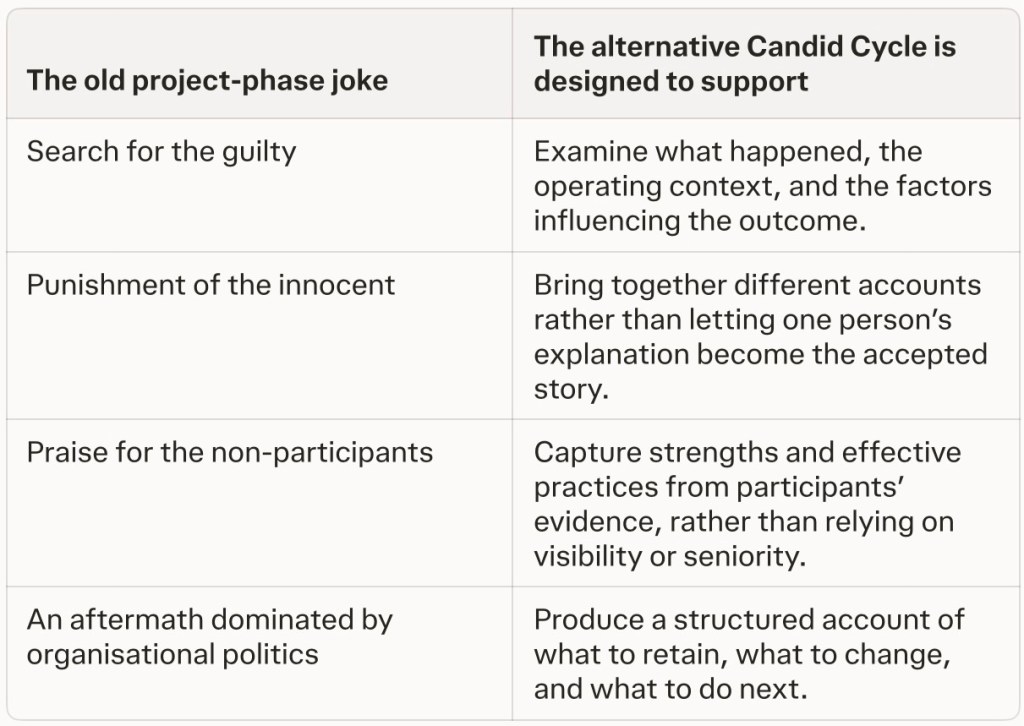
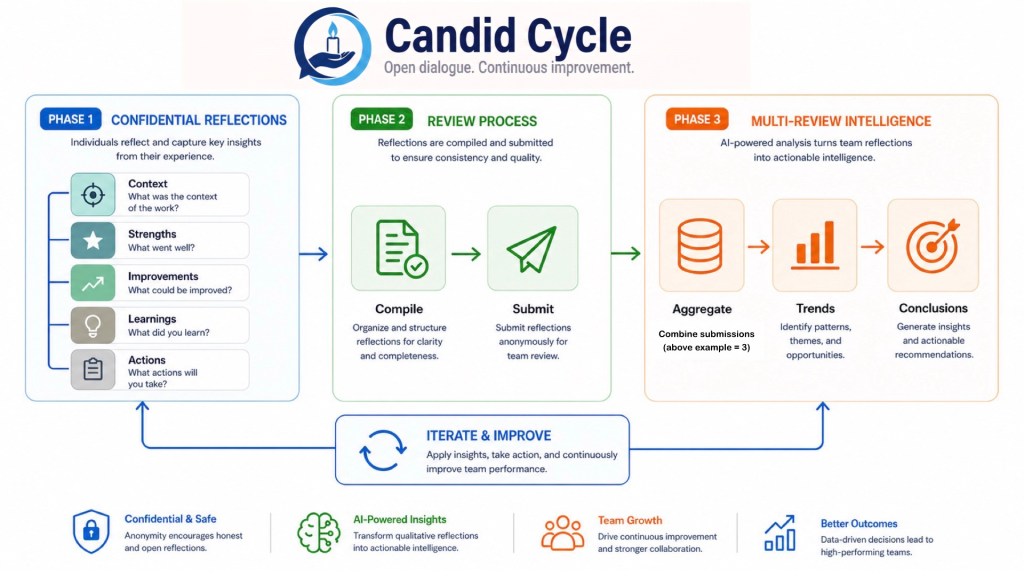
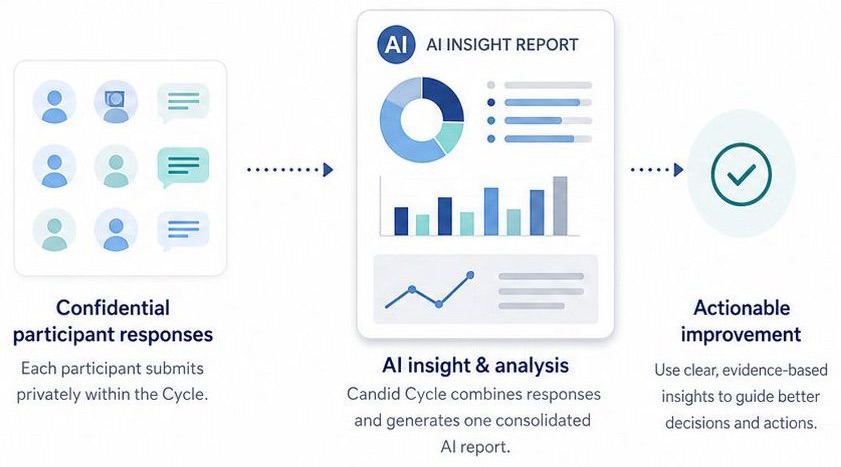
Candid Cycle uses human experience and structured questions to understand what happened, what it means and what should change. AI strengthens a human-led inquiry rather than becoming the authority on organisational experience or capability.
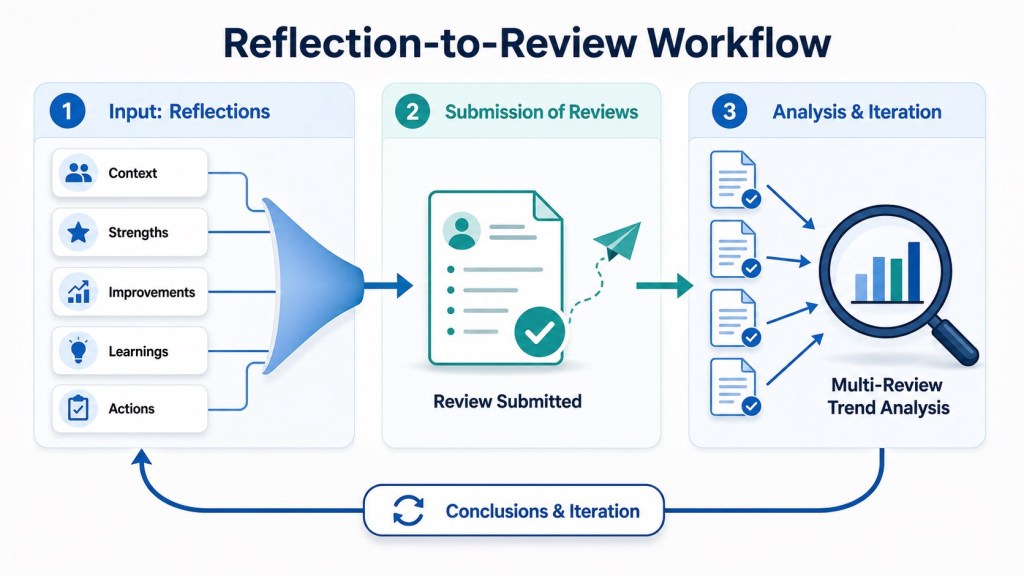
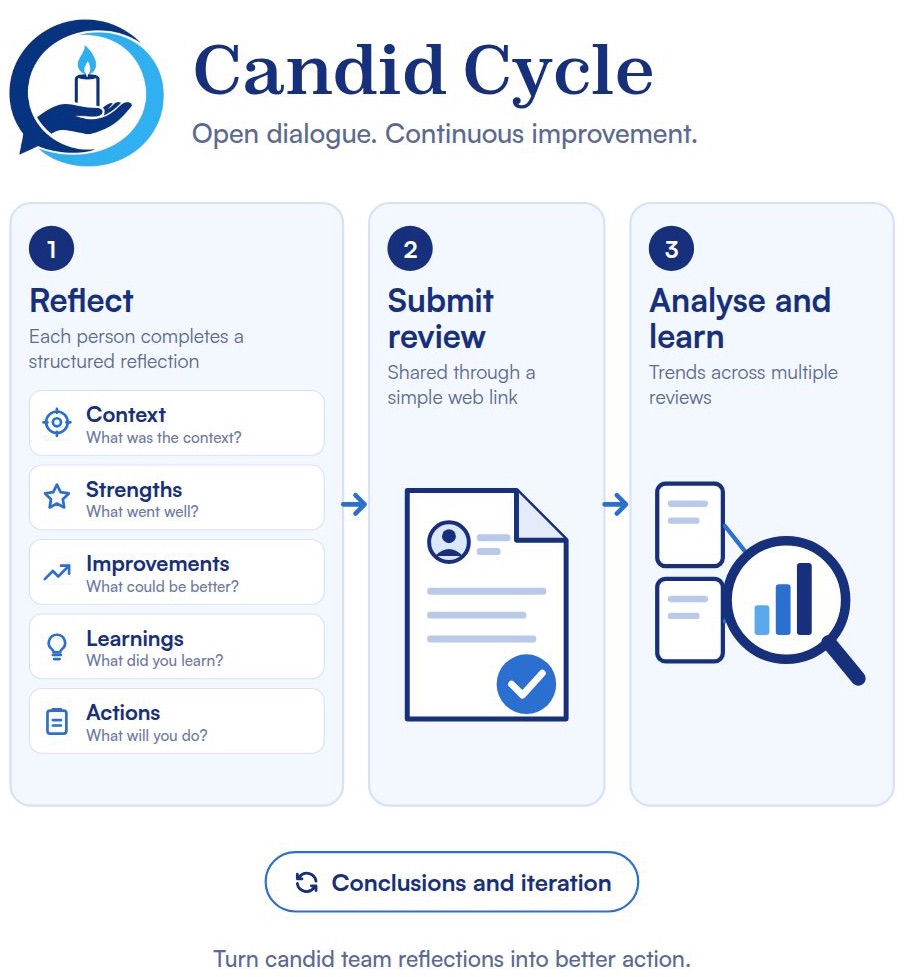
The Candid Cycle structure – Context, Strengths, Improvements, Learnings and Actions already embodies the proposition. The methodology determines the questions; participants supply contextual experience; AI supports analysis across their submissions.
There are three distinct human contributions:
- The methodology designer establishes a useful structure for reflection. (John Salter Consulting Services via the Candid Cycle)
- The cycle organiser defines the event, activity, objectives and boundaries of the inquiry. (You)
- Participants explain (anonymously) what they experienced, including circumstances that may not appear in formal records. (Your people, or clients)
- Learning from history
Margaret MacMillan opens The Uses and Abuses of History (2009) with this warning, and it’s worth sitting with.
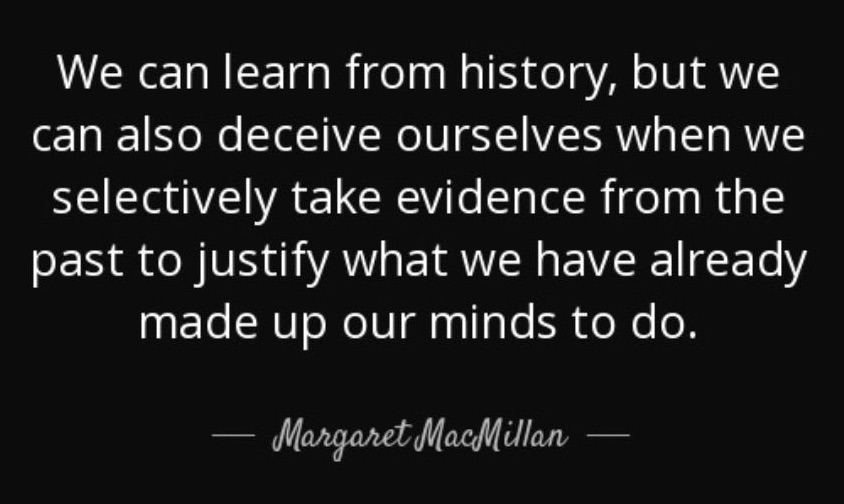
History doesn’t offer clean lessons; it offers material, and material can be shaped to fit almost any conclusion someone has already reached. MacMillan is careful to distinguish between using history and abusing it. Using it means treating the past as a source of evidence that might contradict you. Abusing it means treating the past as a quarry – mining it for the quotes, precedents, and analogies that flatter a decision already made.
She’s not the first to notice this. Georg Hegel’s often-misquoted line – “We learn from history that we learn nothing from history” – makes a harsher version of the same point: knowing the past doesn’t automatically inoculate anyone against repeating its mistakes, because the failure isn’t ignorance, it’s motivated selectivity. George Santayana’s more famous formulation (“those who cannot remember the past are condemned to repeat it”) assumes memory is the problem. MacMillan and Hegel suggest something closer to the opposite: people remember plenty of history – they just remember the parts that suit them.
Barbara Tuchman’s The March of Folly (1984) gives this failure mode a name and a body count. She studied governments that pursued policies contrary to their own interests – the Trojans dragging the horse inside their walls, the Vietnam War planners ignoring the French experience a decade earlier – and found the common thread wasn’t a lack of available warning. The evidence was there. What was missing was the will to look at it honestly, because the people in the room had already committed, publicly or privately, to a course of action.
Richard Neustadt and Ernest May took a more constructive angle in Thinking in Time: The Uses of History for Decision Makers (1986), a book written explicitly for policymakers. Their contribution was a simple diagnostic: before treating a historical analogy as guidance, ask what’s actually similar and what’s different between the past case and the present one. Most bad uses of history, they argued, skip that step entirely – leaders reach for “this is just like 1938” or “this is just like Vietnam” because the analogy is emotionally satisfying, not because anyone checked whether it holds up.
Why This Isn’t Just a History Problem
MacMillan is describing individual and institutional discipline, but the same failure shows up at a much smaller scale, inside a single organization’s reflection process. Chris Argyris, writing on organizational learning, distinguished between single-loop learning (fixing the symptom without questioning the underlying assumption) and double-loop learning (going back and interrogating the assumption itself). Most after-action reviews, he found, never leave single-loop mode — they identify what went wrong operationally but leave the governing beliefs that produced the decision untouched, because touching them is uncomfortable and politically costly.
Daniel Kahneman’s work on confirmation bias explains the mechanism at the individual level: people don’t experience themselves as cherry-picking evidence. The selective search feels like due diligence because the brain treats confirming evidence as more relevant and more memorable than disconfirming evidence. Nobody sits down thinking “I will now ignore the inconvenient facts.” They simply notice the convenient ones first, weight them more heavily, and stop looking once they’ve found enough.
Candid Cycle is exposed to exactly this failure risk, because a reflection review runs on exactly that mechanism – people writing down what they believe happened, at multiple points, with multiple people, before it gets synthesized into “actionable intelligence.” Nothing about being a structured product makes it immune to motivated reasoning. If anything, a system that produces confident-looking conclusions can make the problem worse by giving self-deception the appearance of data. A well-formatted report with five clean fields and a synthesized action plan can look more objective than a messy conversation, even when it was shaped by the same selective instincts MacMillan and Tuchman describe.
What Candid Cycle Has Going For It
The design includes some direct countermeasures, though none of them are a complete cure:
- Anonymity in Phase 1 is a partial counter to avoiding truth. Amy Edmondson’s research on psychological safety shows that people withhold uncomfortable observations not because they lack them, but because naming a structural problem carries a social cost — someone has to own the criticism, and someone else has to hear it. Confidential submission removes that cost at the point where honesty matters most.
- Five distinct reflection fields (Context, Strengths, Improvements, Learnings, Actions) force some evidence-gathering before a conclusion, rather than jumping straight to “here’s what we should do.” That’s a structural defense against a pre-decided Action, echoing Neustadt and May’s discipline of separating “what happened” from “what it means” before reaching for a course of action.
- An Iterate & Improve loop means there’s no single terminal verdict to defend. Findings get revisited next cycle rather than locked in once. That reduces the incentive to force a narrative, since there’s less riding on any one review being “right” — closer to Argyris’s double-loop model, where conclusions stay open to revision rather than hardening into institutional fact.
Keeping the Traps in View
None of these features work automatically; they lower the odds of self-deception, they don’t eliminate it.
- Look at the whole picture: accept facts that challenge your views, not just the ones you like – this is the discipline MacMillan is ultimately asking for.
- Question motives: ask yourself if you’re searching for truth or looking for an excuse, the distinction Tuchman found missing in every case of institutional folly she studied.
- Handle history with care: acknowledge that past events, and past reviews, are complex and rarely provide simple answers – and check, as Neustadt and May insisted, whether this situation actually resembles the last one before you treat it as precedent.
Put This to the Test
The point of raising MacMillan’s warning isn’t to make reflection reviews sound futile – it’s to make the case for building the discipline into the process rather than trusting individual willpower to supply it. That’s what the Phase 1 anonymous submission step is actually for. It’s not a nicety; it’s the mechanism that gets the uncomfortable, structurally inconvenient observation onto the page before anyone has had the chance to align it with a preferred conclusion.
If your last review or debrief produced a tidy set of findings that confirmed exactly what everyone already suspected going in, that’s worth a second look – not because the findings are wrong, but because a review that never surfaces a genuine surprise may be doing less work than it appears to. Run your next reflection cycle through Candid Cycle’s structured fields and see whether the anonymous inputs disagree with the synthesized narrative. That gap, if it exists, is usually where the real learning is.
- Candid Cycle Released
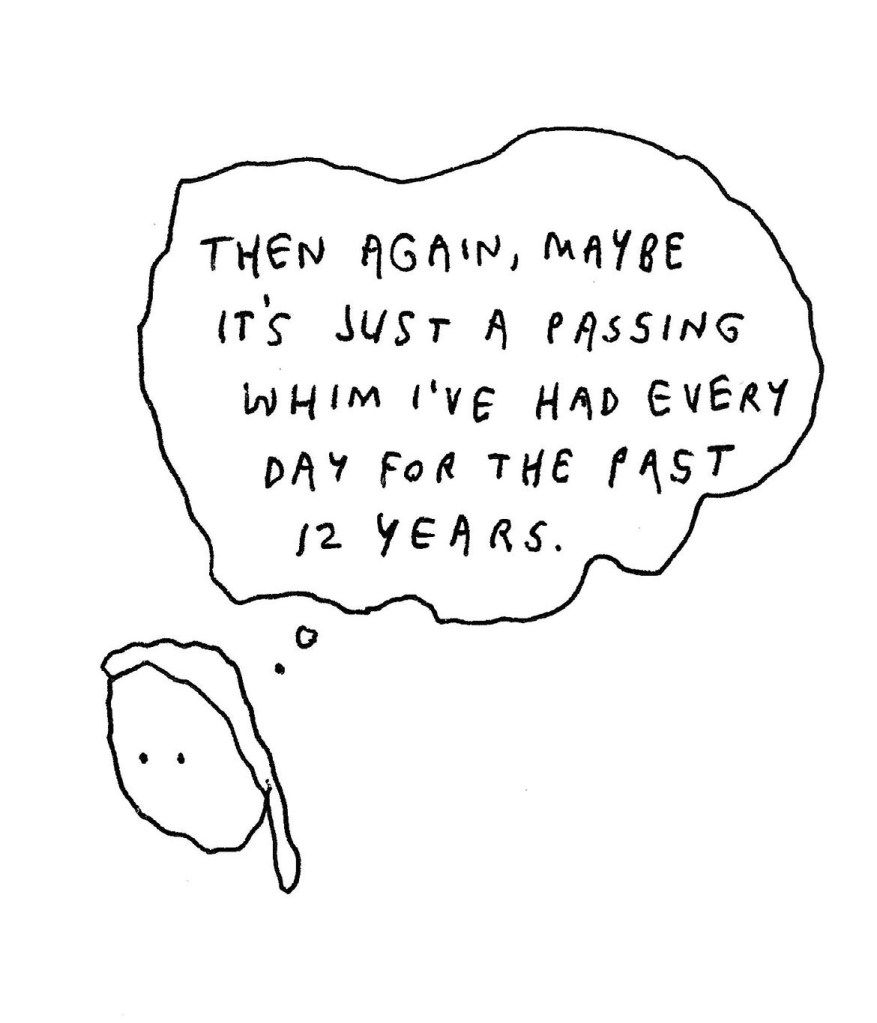
A reflection from Liana Fink that resonated 😆 Quite chuffed to share a notification from Apple – Candid Cycle, an app that neatly replaces “old school” ( https://disasterresilience.consulting/structured-debriefing-2/ ) which many of my chums will recognize.
If interested, check https://apps.apple.com/au/app/candid-cycle/id6780116127 or explore https://disasterresilience.consulting/candid-cycle/
- The Candid Cycle Report
Every Candid Cycle review cycle ends the same way: submissions that were reflected on and reviewed anonymously get revealed back as a polished, ready-to-use report.
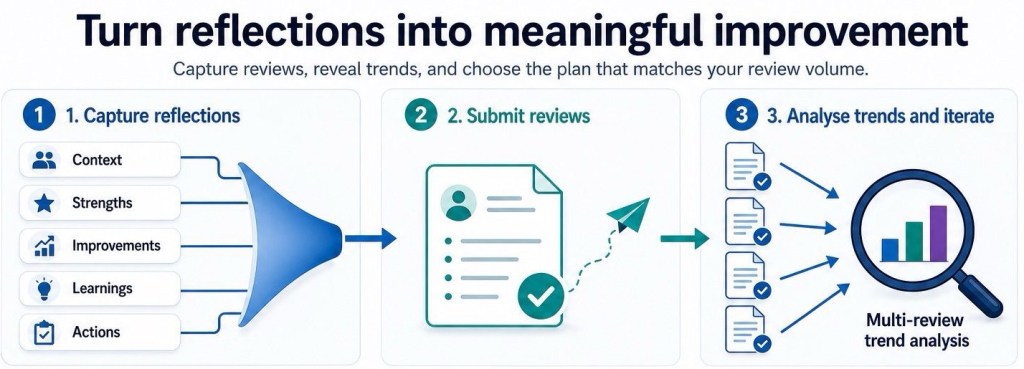
Subscribers receive two editions from every cycle, generated from the same underlying data so nothing gets lost in translation between them.
The Team / Full Report
The complete picture, built section by section from every Context, Strength, Improvement, Learning, and Action submitted that cycle:
- Executive Summary – the headline story of the cycle in one page
- Review Context & Participation – what was reviewed, who took part, and a completion rate so the team can see engagement at a glance
- Strengths – what went well, grouped by theme with supporting anonymised evidence
- Improvement Areas – the same treatment for what needs to change
- Key Learnings – the insights worth carrying into the next cycle
- Actions & Priorities – a deduplicated action register (owner, target date, priority) so overlapping suggestions from different contributors become one clear task, not five
- Cross-Cutting Trends – pattern and frequency analysis across all themes, surfaced automatically
- Recommendations & Next Steps – concrete, forward-looking guidance
- Appendix – the anonymised evidence base, for anyone who wants to trace a theme back to its source submissions
The Executive Leadership Briefing
A tightened version of the same analysis – same themes, same actions, same trends – scoped down to what a leadership group needs to make decisions quickly, without wading through the full evidence appendix.
What makes it trustworthy, not just tidy:- Anonymous by design – no names or identifying roles anywhere in the report; every quote is labeled “Anonymised submission excerpt,” never attributed
- Evidence grouped by theme, never by person – so patterns are visible without anyone’s individual submission being singled out
- A front-of-report confidentiality statement on every cycle, so participants always know the rules were followed
- Honest metrics – no inflated single “percentage achieved” headline unless the data genuinely supports one; a Yes/Partially/No breakdown is used instead where that’s more accurate
The Reveal, automated
This isn’t a template someone fills in by hand after each cycle – it’s generated straight from your submissions using AI-assisted pattern detection, so the same rigor and structure apply every single cycle, at whatever pace your team runs them.In short: subscribers get a consistent, professional, board-ready report every cycle – built on candid input, protected by anonymity, and turned into clear direction without anyone having to do the analysis themselves.
- Candid Cycle – A screenshots introduction
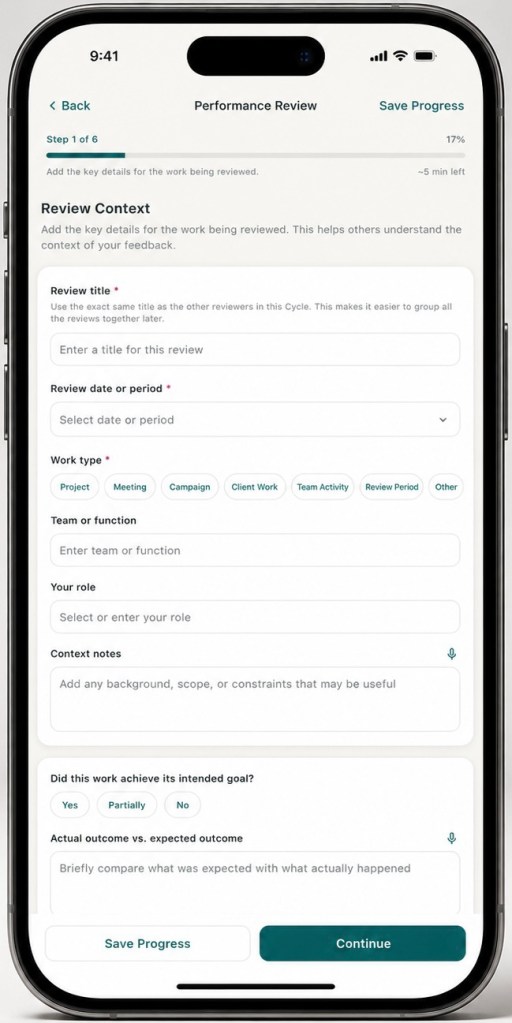
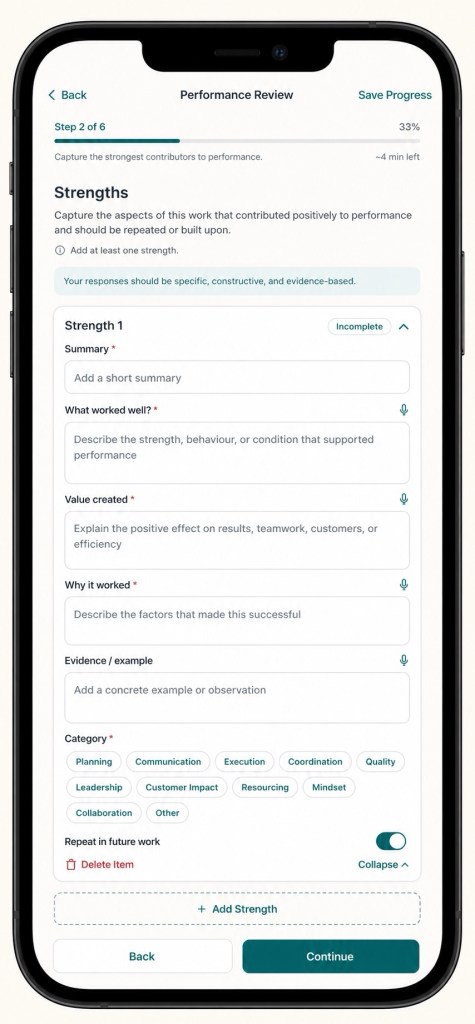
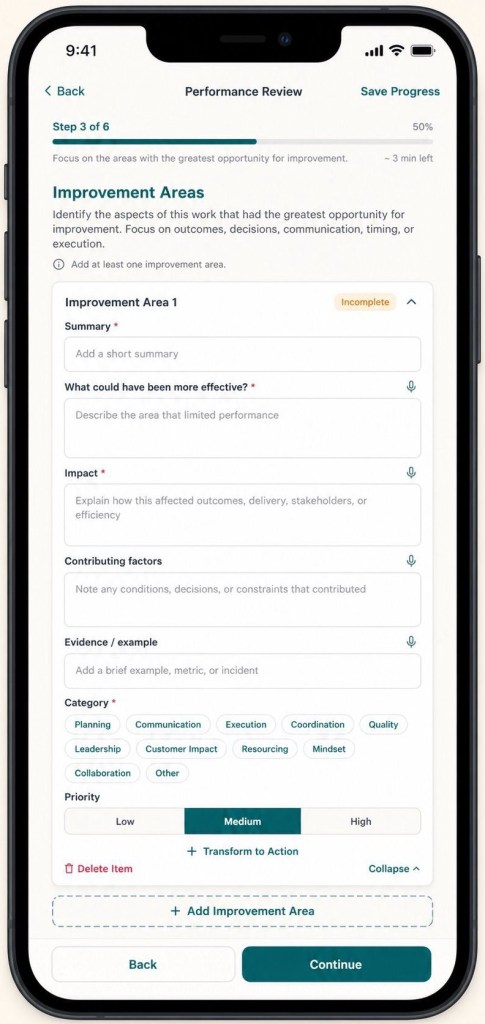
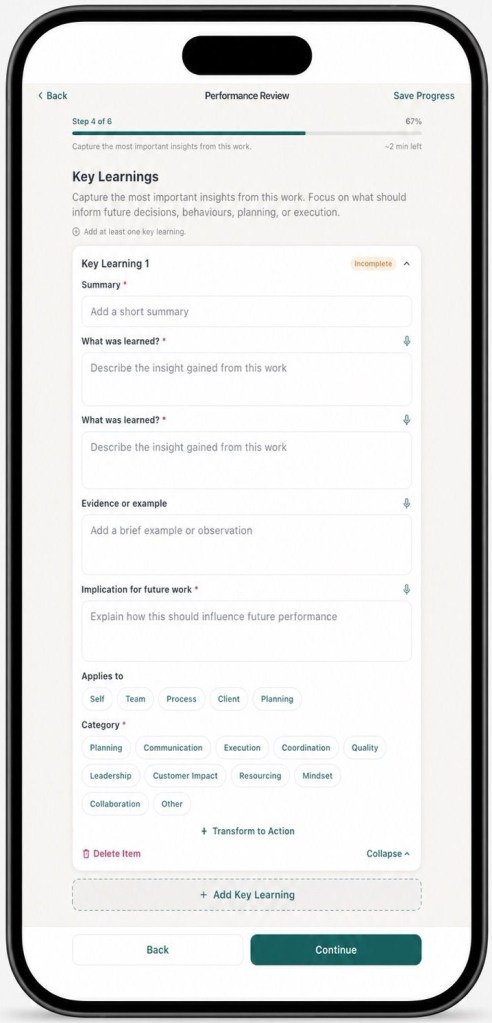
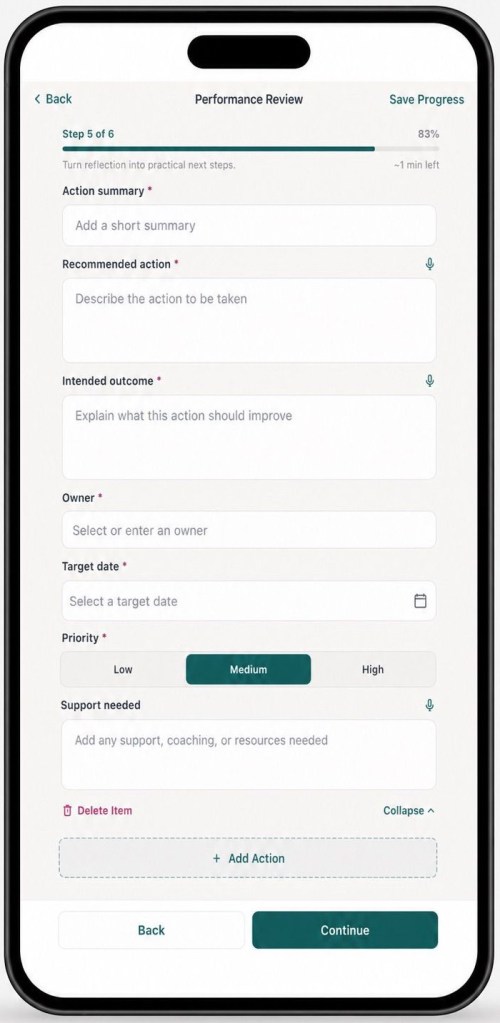
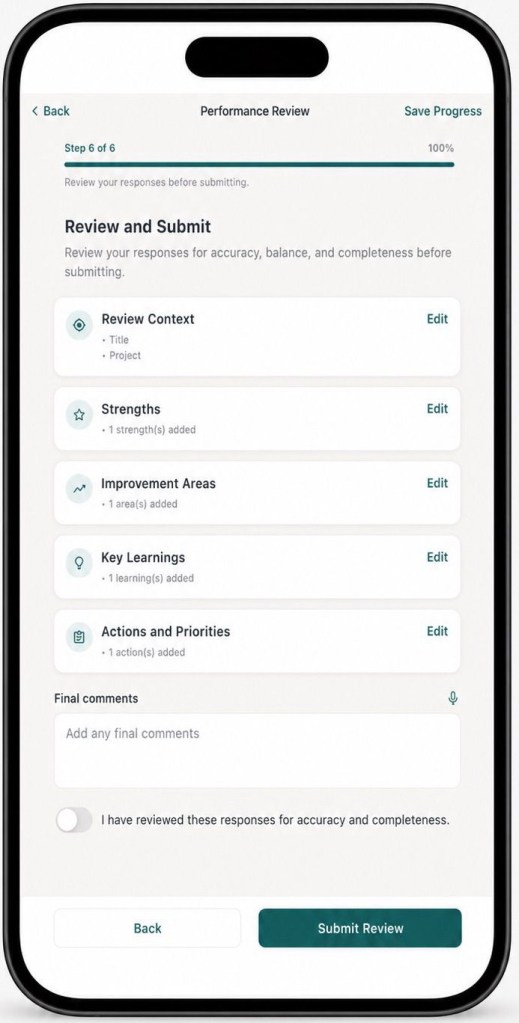
Candid Cycle is designed for project reviews, team retrospectives, meeting reviews, and broader conversations across the business.
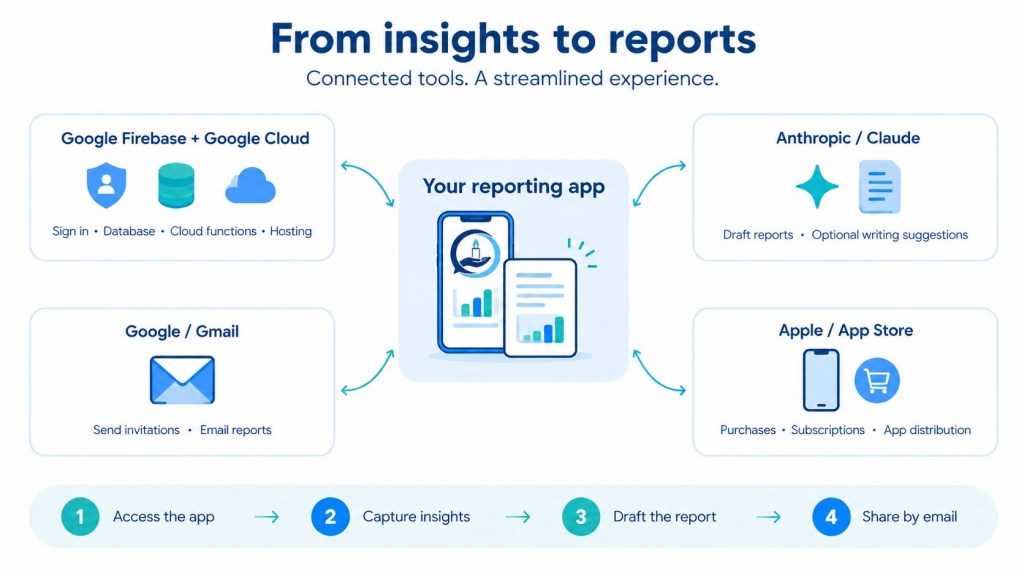
Candid Cycle helps teams and managers run structured reviews, debriefs, and post-project reflections in one clear workflow.

A one minute video of the six screenshots
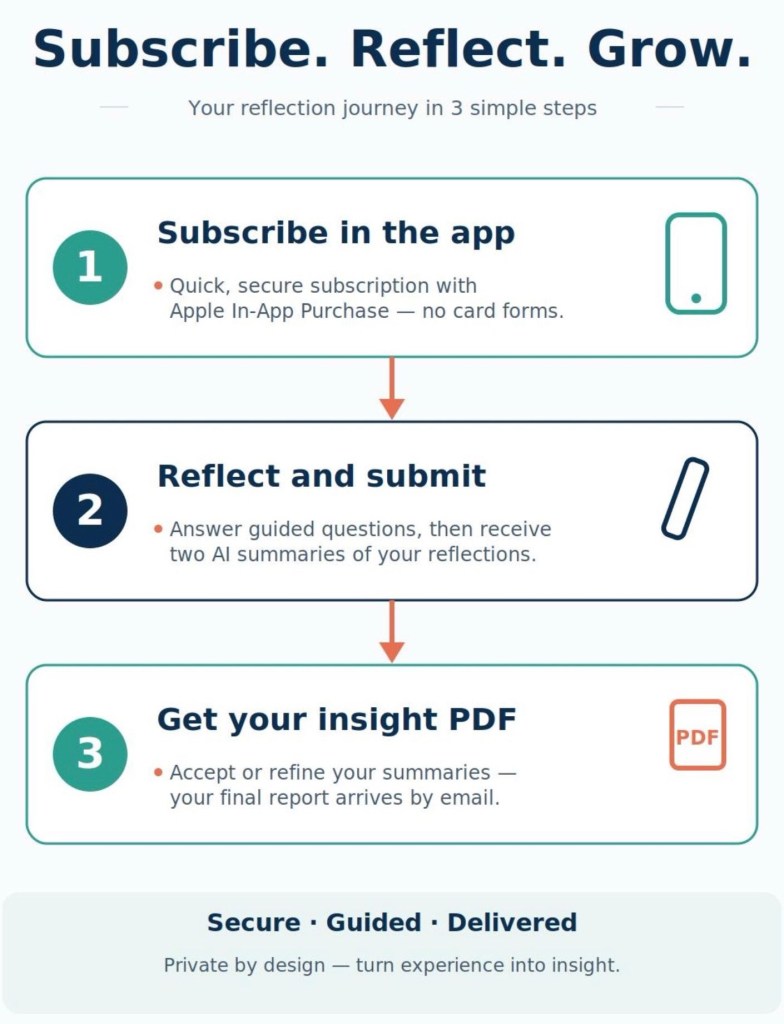
Use the Candid Cycle app across six steps:
Capture strengths, improvement areas, key learnings, and follow-up actions so reviews are more consistent, useful, and easier to act on.
- Review and improve the seven A.I. Prompts
These seven prompts have strong underlying intentions: strategic planning, critical thinking, synthesis, expert reasoning, iterative improvement, adaptive learning, and self-critique. Their main weakness is that they leave too much discretion to the model—especially around output structure, evidence standards, prioritisation criteria, and how to handle missing information.
Overall improvements
To make the prompts more reliable and useful in consulting, product, and decision-support work, I would add five recurring controls:
- Define the role, but also the decision context and expected level of expertise.
- Require the model to distinguish facts, assumptions, inferences, and recommendations.
- Specify a fixed output structure, ideally including tables where comparison or prioritisation matters.
- Ask for uncertainties and the information most likely to change the conclusion.
- Require practical next actions, not merely analysis.
Below are revised versions that preserve the purpose of the original prompts while making them more rigorous and reusable.^1
1. Turn an idea into an executable plan
Original strength: It starts by understanding the problem before jumping to a solution, then prioritises high-impact, low-effort actions.
Main limitation: It does not force a clear definition of success, validation of demand, constraints, sequencing, ownership, or measurable milestones.
Improved prompt
Act as a pragmatic strategy and execution adviser.
I have this idea:
[Describe the idea]
My context, constraints, and available resources are:
[Budget, time, skills, team, market, technology, existing assets, constraints]
Before recommending a solution, analyse:
- The problem this idea is intended to solve.
- The target users or customers, including their most important unmet need.
- The proposed value proposition and why users would choose it over alternatives.
- The assumptions that must be true for the idea to work.
- The main risks, dependencies, constraints, and likely failure modes.
- The simplest evidence or experiment that could validate or disprove the key assumptions.
Then create an executable plan with:
- A one-sentence definition of success.
- The smallest viable first version or pilot.
- Actions ordered by impact, effort, urgency, and dependency.
- A 30-, 60-, and 90-day roadmap.
- Suggested owners or required capabilities for each action.
- Decision gates: what evidence would justify proceeding, changing direction, or stopping.
- Metrics to track, including one leading indicator and one outcome indicator.
Present the action plan in a table with these columns:
| Priority | Action | Why it matters | Effort | Expected impact | Dependency | Evidence of progress | Timing |
Do not assume demand, technical feasibility, or commercial viability without stating the assumption. Be concise, practical, and direct.
Why this is better
It turns an idea into a testable commercial or operational proposition rather than a generic task list. The explicit decision gates are particularly useful for SaaS, consulting offers, and new digital-product concepts where the cost of building before validating is high.
2. Find what you are overlooking
Original strength: It explicitly asks the model not to agree automatically, which is valuable.
Main limitation: It does not require the model to distinguish major risks from minor observations, challenge the framing, or state confidence.
Improved prompt
Act as an independent critical consultant. Your role is to improve the quality of my thinking, not to validate my preferred answer.
Here is my situation:
[Describe the context, objective, proposed decision, current evidence, constraints, and alternatives considered]
Analyse the situation rigorously. Separate your response into:
- Problem framing: Is the question I am trying to answer the right question?
- Assumptions: What am I treating as true without sufficient evidence?
- Reasoning errors: Where may I be using weak logic, false comparisons, unsupported causation, confirmation bias, sunk-cost thinking, or overconfidence?
- Risks: What strategic, commercial, operational, financial, legal, reputational, technical, or human risks may I be underestimating?
- Opportunities: What alternatives, partnerships, market segments, capabilities, or simpler approaches might I be missing?
- Disconfirming evidence: What facts, outcomes, or stakeholder views would most seriously challenge my current position?
- Information gaps: What additional information would most improve the analysis?
For each issue, provide:
| Issue | Why it matters | Likelihood | Impact | Confidence | What would validate or disprove it |
Then identify:
- The three most consequential blind spots.
- The one assumption I should test first.
- The decision I should avoid making until further evidence is available.
- The most practical next step I should take this week.
Be candid. Do not manufacture criticism where the reasoning is sound; explain why it is sound instead.
Why this is better
This makes the prompt useful as a structured “red team” review. It also prevents the output becoming a long, unprioritised list of hypothetical concerns.
3. Turn disordered information into clarity
Original strength: It requests organisation, pattern recognition, and separation of facts, hypotheses, and conclusions.
Main limitation: It does not define how conflicting information should be treated, nor does it convert the analysis into decisions, questions, and actions.
Improved prompt
I will provide unstructured information about [topic]. It may include notes, emails, observations, data, opinions, ideas, decisions, quotations, and incomplete information.
Do not merely summarise it. Analyse and reorganise it into a decision-ready briefing.
First:
- Group related information into clear themes.
- Identify recurring patterns, relationships, contradictions, gaps, and dependencies.
- Separate statements into:
- Verified facts or evidence
- Reported claims or observations
- Assumptions
- Hypotheses
- Interpretations
- Conclusions or proposed decisions
- Open questions
- Flag statements that conflict, lack evidence, or appear ambiguous.
- Identify information that is important but missing.
Then produce the following output:
### 1. Executive overview
A concise explanation of what the information collectively indicates.
### 2. Thematic analysis
| Theme | Key evidence | What it may mean | Confidence | Issues or gaps |
### 3. Facts, hypotheses, and conclusions
| Type | Statement | Supporting evidence | Confidence | What needs verification |
### 4. Decisions and actions
| Decision or question | Why it matters | Recommended next step | Owner or stakeholder | Priority |
### 5. Five key messages
State the five most important ideas to retain, in plain language.
Do not convert uncertain claims into facts. Clearly label where you are inferring rather than relying on direct evidence.
Why this is better
This format is particularly useful for debriefs, governance reviews, workshop notes, client discovery, product research, and incident or exercise observations. It produces a usable evidence base rather than a polished but potentially misleading summary.
4. Make it think like an expert
Original strength: It asks for the variables an expert would consider before analysing the case.
Main limitation: “Senior expert” is too broad unless the prompt defines the decision being made, the standards of evidence, and the trade-offs between options.
Improved prompt
Act as a senior [profession / domain] with substantial practical experience in [specific context or industry].
I need help making this decision:
[Describe the decision, case, options, objectives, constraints, stakeholders, and available evidence]
Do not give a generic answer. Use the reasoning process an experienced practitioner would use.
First, define the expert decision framework:
- The key variables that should be assessed.
- The relevant trade-offs and constraints.
- The stakeholders affected and their likely priorities.
- The risks that would be unacceptable or difficult to reverse.
- The evidence, benchmarks, standards, or thresholds an expert would rely on.
Then apply that framework to my case.
Present your analysis in this format:
| Decision variable | What an expert would assess | My current position | Assessment | Evidence gap | Implication |
Then provide:
- Your recommended course of action.
- The strongest alternative option and when it would be preferable.
- The key assumptions underpinning your recommendation.
- The information that could materially change your conclusion.
- A confidence rating: high, medium, or low, with a brief explanation.
- The three most important next actions.
Be explicit about where expert judgement is being used versus where the conclusion is supported by evidence.
Why this is better
The prompt encourages genuine decision analysis, rather than merely requesting a more authoritative tone. It is useful where recommendations have material consequences, such as governance design, resilience investments, pricing, architecture choices, product-market positioning, or capability assessment.
5. Improve something without destroying what works
Original strength: It protects existing strengths and discourages unnecessary reinvention.
Main limitation: It does not require the model to identify the purpose, audience, performance criteria, or safeguards against creating new problems while improving the old ones.
Improved prompt
Review and improve the following [text / project / product / code / strategy / process]:
[Paste or describe the material]
Its intended audience, purpose, and success criteria are:
[Audience, objective, constraints, current performance, non-negotiables]
Do not redesign it from scratch unless the underlying approach is fundamentally unworkable. Preserve what is effective and improve only where the evidence supports change.
Analyse it in this order:
- What works: Identify the strongest elements, why they work, and what should be preserved.
- What limits performance: Identify weaknesses, friction points, inconsistencies, risks, missed opportunities, and likely causes.
- What should not change: List the essential qualities, decisions, or constraints that improvements must respect.
- Improvement options: Recommend specific changes, each linked to the problem it solves.
- Prioritisation: Rank improvements by expected impact, effort, confidence, cost, and risk of unintended consequences.
Use this table:
| Area | What currently works | Limitation | Recommended change | Expected benefit | Effort | Risk | Priority |
Then provide:
- A “minimum-change” version: the smallest set of improvements likely to create meaningful benefit.
- An “ambitious” version: a more substantial improvement path.
- A before-and-after example for the highest-priority change, where relevant.
- A short validation plan explaining how to test whether the improvements actually worked.
Avoid vague advice such as “make it clearer” or “improve engagement.” State exactly what should change and why.
Why this is better
This prompt is especially strong for refining product copy, website pages, assessment frameworks, reports, user flows, pricing pages, and technical specifications—where preserving a coherent existing structure is often more valuable than starting again.
6. Learn anything in a personalised way
Original strength: It uses assessment, progressive learning, exercises, common mistakes, and mastery checks.
Main limitation: It asks five questions but does not specify whether the learner’s goals, available time, learning preferences, or practical application should shape the course.
Improved prompt
Act as an adaptive tutor and curriculum designer for [topic].
I want to learn it from my current level to this practical outcome:
[Describe the goal—for example, “build and launch a simple subscription app,” “interpret financial statements,” or “hold basic conversations while travelling”]
Before teaching, ask me no more than five diagnostic questions to assess:
- My current knowledge and experience.
- My practical goal and intended application.
- The time I can commit each week.
- Relevant tools, resources, or constraints.
- My preferred learning style, if it matters.
After I answer, create a personalised learning roadmap divided into progressive modules.
For each module, provide:
| Module | Outcome | Core concepts | Practical example | Exercise | Common mistakes | Mastery test | Estimated time |
Teaching rules:
- Start with the smallest set of concepts that creates useful practical capability.
- Use examples relevant to my stated goal.
- Give me an exercise that requires active use, not passive reading.
- Check my understanding before moving to the next module.
- If I make an error, explain the misconception and give a targeted corrective exercise.
- Periodically revisit earlier concepts using spaced review.
- At the end, give me a practical capstone task and assess it against clear criteria.
Do not proceed to the next module until I demonstrate sufficient understanding of the current one. Adapt the pace and difficulty based on my responses.
Why this is better
It preserves the original mastery-learning approach, while ensuring the learning plan is anchored to a real-world goal and adjusts as the learner progresses.
7. Make it question its own response
Original strength: It encourages self-critique rather than presenting an answer with unjustified certainty.
Main limitation: A vague self-review can produce generic caveats. It needs to target factual, logical, contextual, and practical weaknesses—and distinguish minor uncertainty from conclusion-changing uncertainty.
Improved prompt
After producing your main response, conduct a rigorous self-review as an independent subject-matter expert and critical editor.
Do not repeat the answer. Instead, assess it against the following checks:
- Factual reliability: Which claims need verification, current sources, data, or domain-specific evidence?
- Assumptions: What assumptions did you make about my objectives, context, constraints, users, or available resources?
- Reasoning quality: Where could the logic be incomplete, overly simplified, biased, or based on a weak inference?
- Alternatives: What credible alternative interpretations, options, or recommendations did you not fully consider?
- Practicality: Which recommendations may be difficult to implement, and what dependencies or trade-offs may have been overlooked?
- Risk: What could go wrong if I act on this advice?
- Conclusion sensitivity: What new information would most likely change the recommendation?
Present the self-review in this format:
| Review area | Potential weakness or uncertainty | Severity | What should be verified or clarified | Effect on the recommendation |
Then state:
- The one part of the response you are least confident about.
- The one assumption most worth testing.
- Whether the main recommendation still stands after review: yes, yes with caveats, or no.
- A revised recommendation if the review materially changes it.
Be specific. Do not add generic disclaimers merely to sound cautious.
Why this is better
This version turns “question your own response” into a compact quality-assurance stage. It is particularly useful when using AI to support decisions, client-facing material, research synthesis, technical specifications, or high-stakes recommendations.
Recommended combined instruction
For the strongest results, append this short instruction to any of the seven prompts:
Use clear headings and concise tables where useful. Distinguish verified facts, assumptions, interpretations, and recommendations. State uncertainty plainly. Do not invent evidence, sources, market facts, technical details, or stakeholder views. If essential information is missing, identify it and explain how it affects the conclusion. Prioritise practical next actions over generic commentary.
Best use in your work
For your consulting and digital-product work, prompts 1, 2, 3, 4, and 7 are likely to be the highest-value set:
- Use Prompt 1 to turn an assessment, debrief insight, or product concept into a pilot and rollout plan.
- Use Prompt 2 before committing to a pricing model, architecture, service offer, partnership, or strategic recommendation.
- Use Prompt 3 to turn interviews, workshop notes, survey comments, exercise observations, or incident-review evidence into structured findings.
- Use Prompt 4 to obtain a disciplined domain-specific decision analysis, such as from the perspective of a resilience practitioner, governance adviser, SaaS product manager, or security architect.
- Use Prompt 7 as a required final check before relying on AI-generated analysis in an executive report, methodology, proposal, or client deliverable.^1
- When the Horn Is in the Picture: A Fable About Capability and Blind Spots
Every organisation sees itself through a lens. The question is whether it can recognise what that lens leaves out – and across which domains.
A rhinoceros stood every evening on the edge of the savanna with an easel, a palette and a great sense of purpose.
He loved to paint the landscape: the gold of the grass, the distant hills, the flat-topped acacias, the red sun sinking into the horizon. When he had finished, he invited the other animals to admire his work.
“Magnificent,” said the zebra.
“Very true to life,” said the wildebeest.
“Such a clear picture of the savanna,” said the warthog.
The rhinoceros beamed.
Yet every painting contained the same curious feature: a large, pale triangle stood in the middle of the scene. It rose from the foreground, cutting through trees, grasslands, rivers and sunsets alike.

One day, an elephant studied the latest canvas for a long time.
“Rhino,” she said gently, “that is not a hill.”
“Of course it is,” replied the rhino. “I see it every time I paint.”
“It is your horn,” said the elephant.
The rhinoceros laughed. From where he stood, his horn was always there: large, familiar and impossible to ignore. Because it had always been in his line of sight, he had stopped seeing it as an obstruction. He had begun to mistake it for part of the landscape.
One Painting, Seven Missing Views
The heron, who had been circling above, landed beside the easel.
“You keep painting the same triangle,” she said, “because you only ever look from one place, in one direction. What if you painted seven views of the savanna instead of one?”
The rhino was doubtful, but he listened as the animals described what each of them could see that he could not.
The elephant described the strategy of the herd – where the migration was heading, and why. The zebra described the quality of decisions made at the water’s edge, when predators were near and there was no time to deliberate. The heron, from above, described risk and resilience – the flood plains that looked safe from the ground but flooded every wet season. The warthog described execution and control – the burrows and root systems that either held firm or gave way underfoot. The lion described leadership of the pride – who actually got followed when danger came, regardless of who held the title. The tortoise, who had outlived them all, described learning and improvement – the patterns that repeated because no one had written them down. And the old baobab, rooted at the centre of the plain for a hundred years, represented governance and accountability – the one who could say, with evidence, whether all the other six views actually held together.
Seven views. One triangle had never shown any of them.
Painting With Evidence, Not Just Confidence
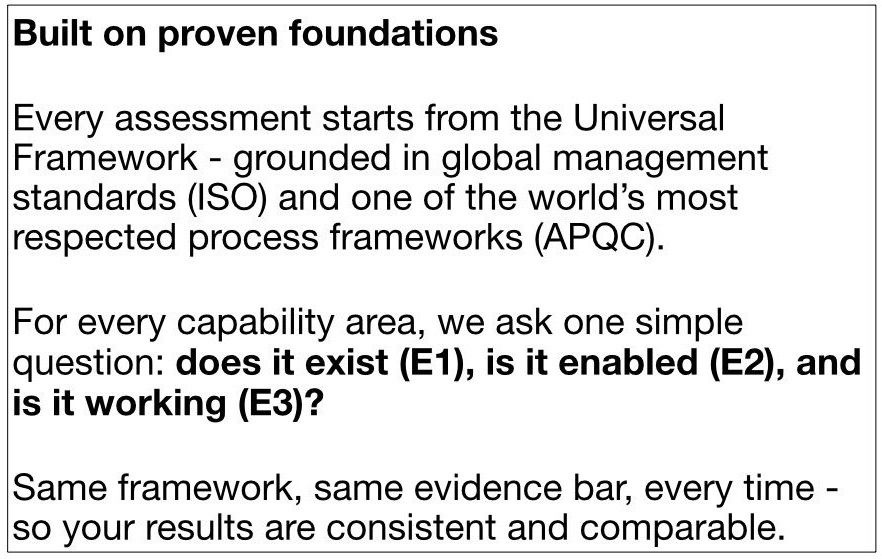
The rhino wanted to argue that his single painting had already captured the savanna. But the animals asked him a harder question, one domain at a time:
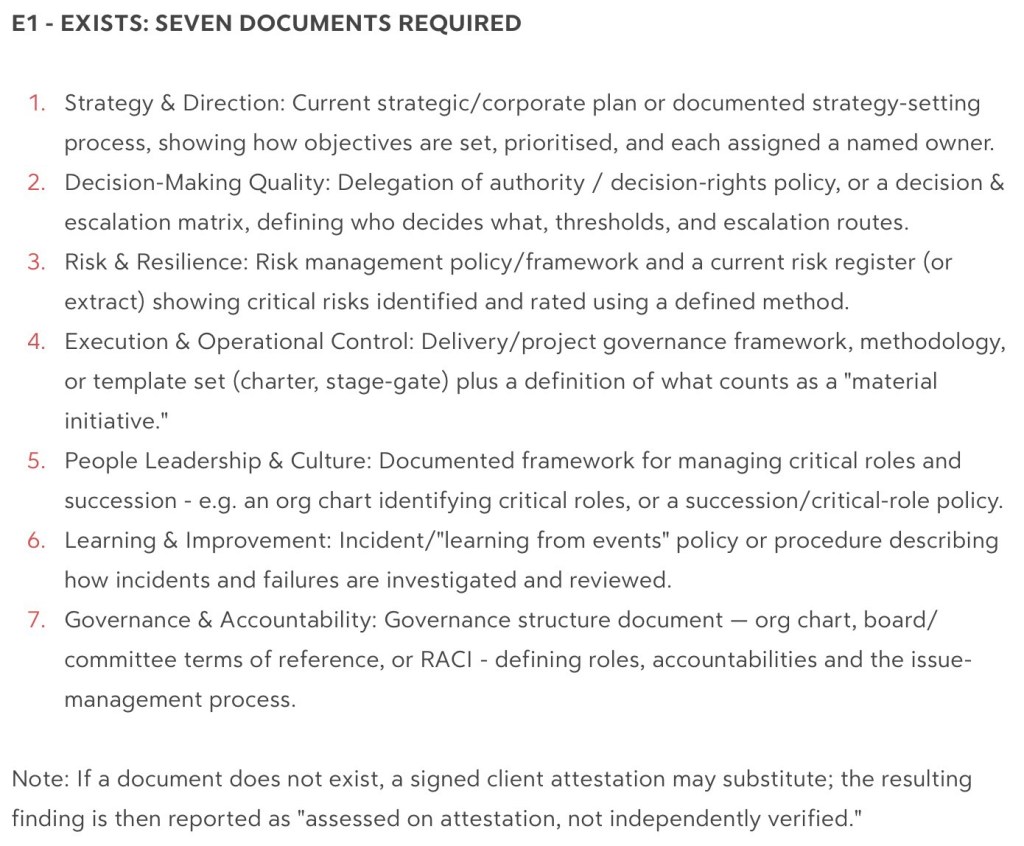
- Does this actually exist – is there a real path, a real plan, a real arrangement? (E1)
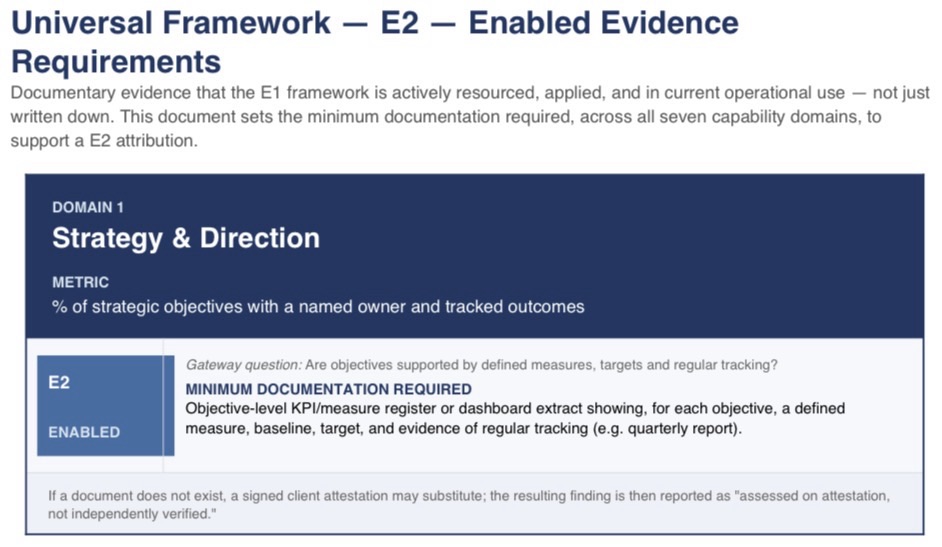
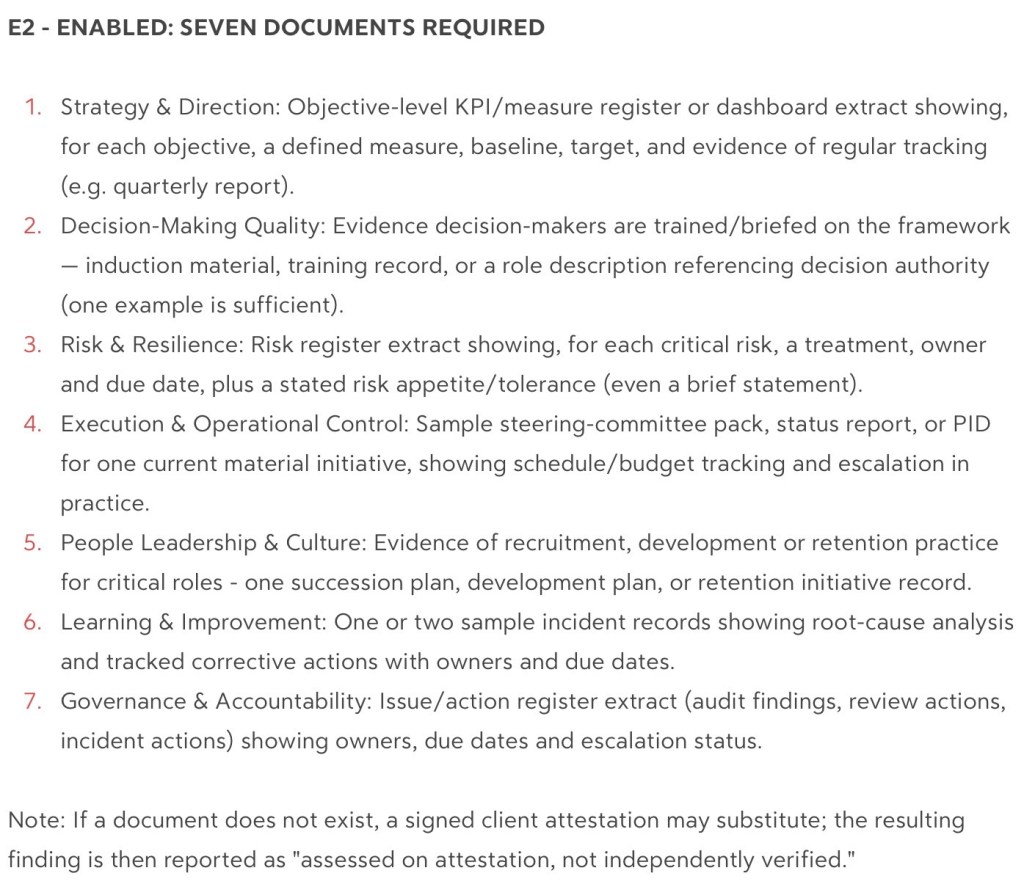
- Is it enabled – does it have what it needs to function: resources, authority, information, people who know their role? (E2)
- Is it executed – has it actually worked, been tested, been used under real pressure, not just described on paper? (E3)
The rhino realised his triangle had never been tested against any of these three questions. It was simply what he saw, repeated with confidence.
So the animals gathered evidence, domain by domain, and rated what they found: None, Partial, Limited, or Full. Some domains – like the warthog’s execution and control – turned out to be strong: well tested, reliably repeated. Others – like the baobab’s governance – existed on paper but had barely been exercised. The picture that emerged was not one triangle but seven honest panels, each showing where the herd genuinely stood.
The Moral
We all see the world through subjective lenses: our roles, incentives, habits and past successes. These lenses are not inherently bad – the rhino’s horn protected him and helped him survive. But a single, familiar vantage point can never show all seven domains that determine whether a herd, or an organisation, is truly capable.
“Not seeing something is not the same as it not being there.”
Confidence is easy to paint. Capability – demonstrated with evidence, across every domain that matters – is harder, and far more valuable.
See Your Own Seven Domains Clearly
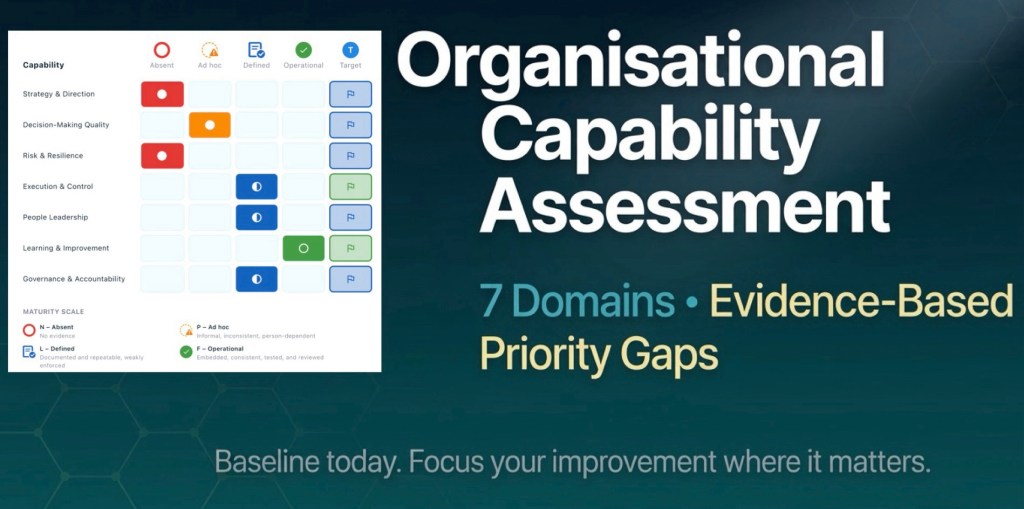
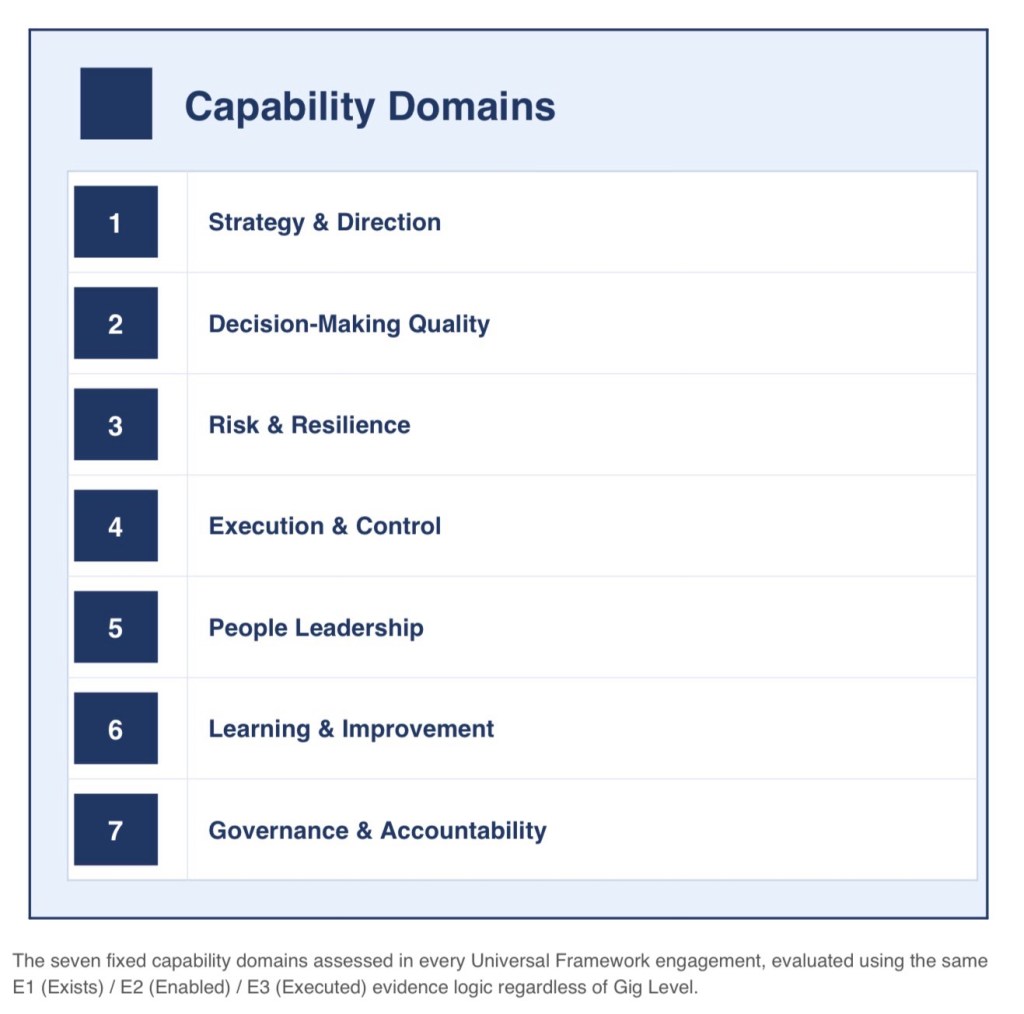
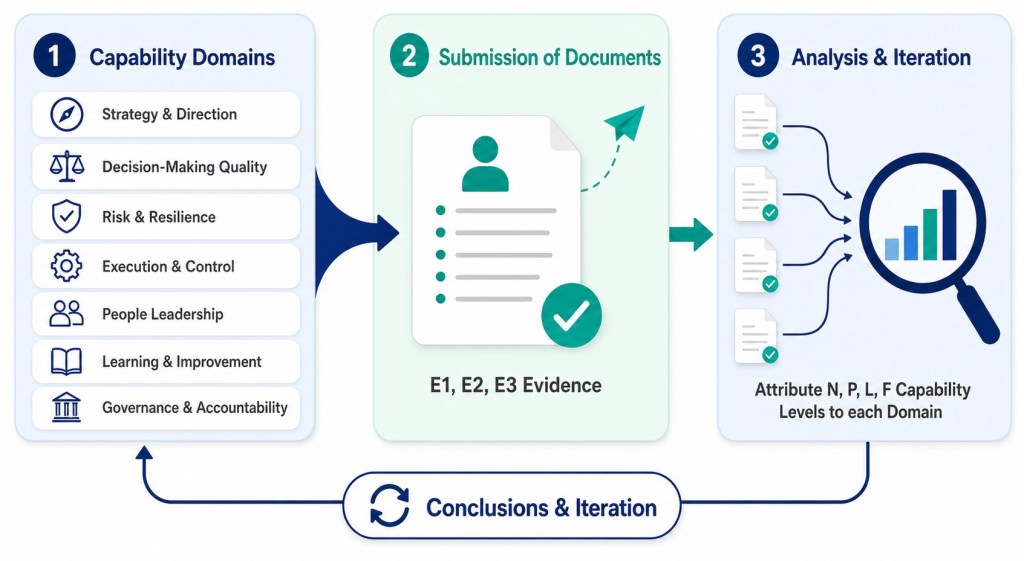
If your organisation’s picture of itself has been painted from one vantage point for too long, the Universal Framework offers a structured way to look again – across the same seven domains the animals uncovered together: Strategy \& Direction, Decision-Making Quality, Risk \& Resilience, Execution \& Control, People Leadership, Learning \& Improvement, and Governance \& Accountability. Every engagement, regardless of scope, is assessed against the same E1 (Exists) / E2 (Enabled) / E3 (Executed) evidence logic – so the result reflects what can be demonstrated, not just what is believed.
Three ways to start:
The rhino didn’t become wiser because he stopped having a horn. He became wiser because he finally saw all seven views – and could show what was true, not just what he assumed.
How capable are you, really – across all seven domains?
- How capable are you?
Is your organization currently capable of performing, governing, and learning at the right level?
Know how well your organisation is going?
Confident of your view?
What evidence do you rely on?
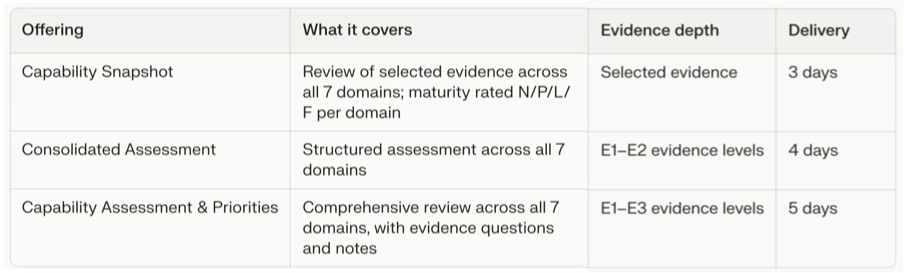
If you need assurance or you’re looking to identify improvement opportunities, check which of our three service levels best suits you.
Capability Assessment Methodology
Three evidence tests (E1–E3)
For each domain we look for three levels of evidence:
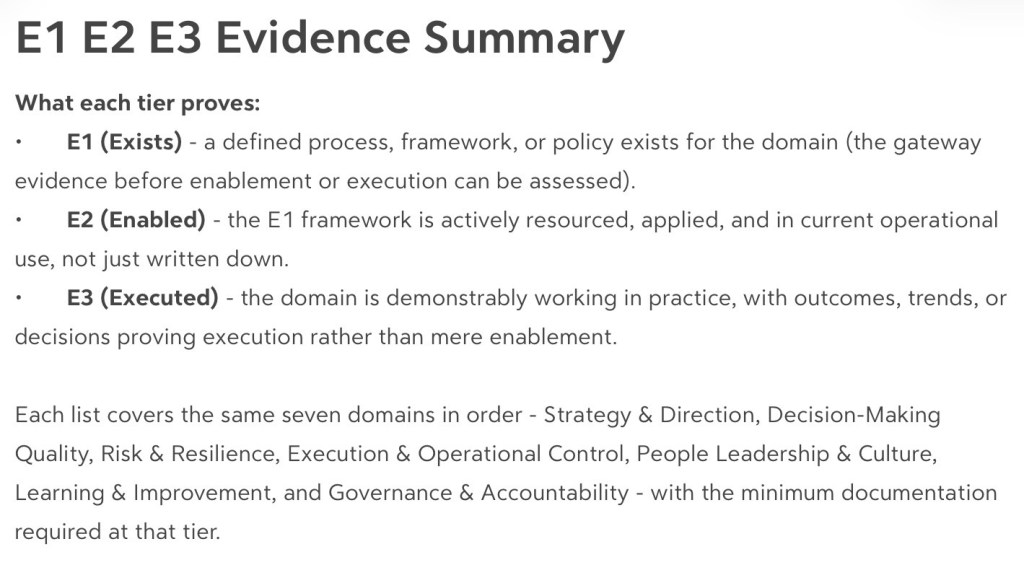
- E1 – Exists
Do the core structures and processes exist?
(Policies, frameworks, processes, roles, plans, registers, documented approaches.) - E2 – Enabled
Are they supported and usable?
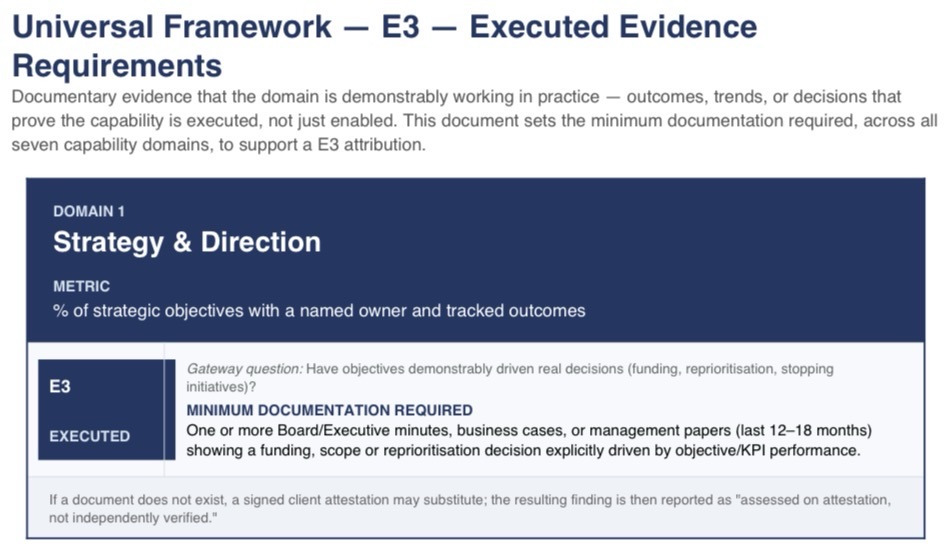
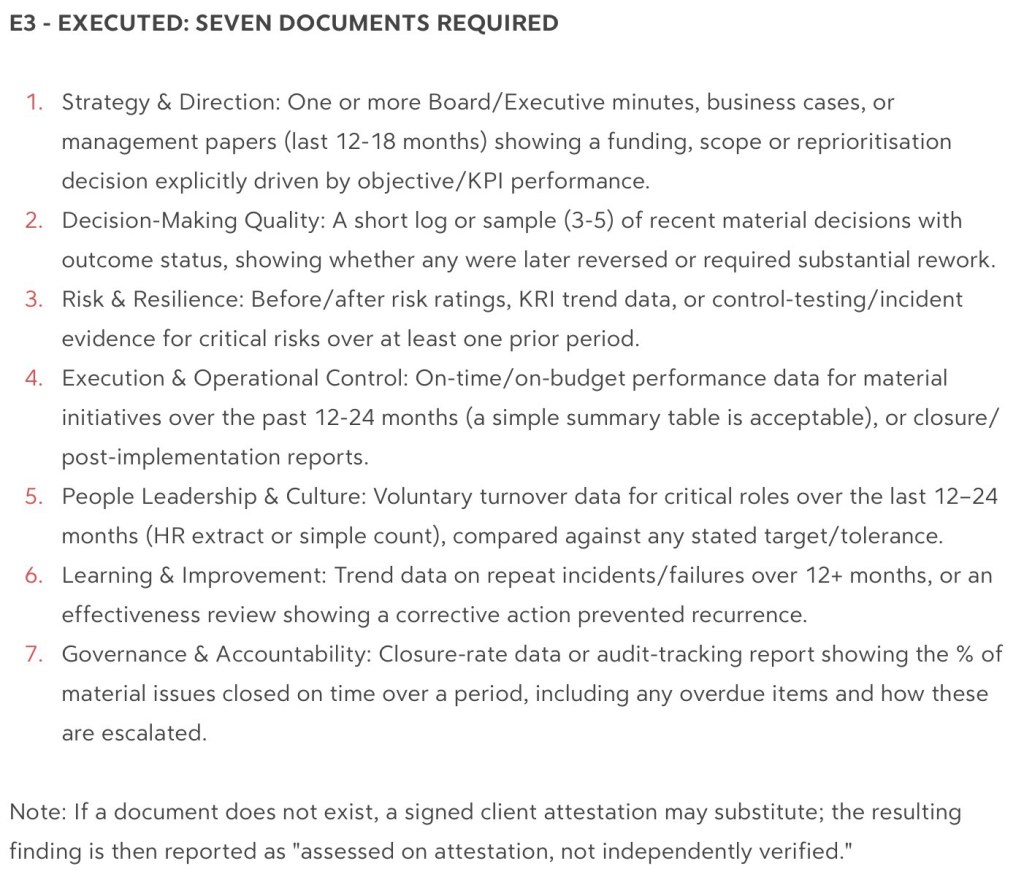
(Clear owners, resources, training, tools, data, and regular review cycles.) - E3 – Executed
Are they actually used and making a difference?
(Real examples where they shape decisions, behaviours, investments, and outcomes.)
In practical terms, E1/E2 tell you “have we built the system?” and E3 asks “does the system change what happens?”
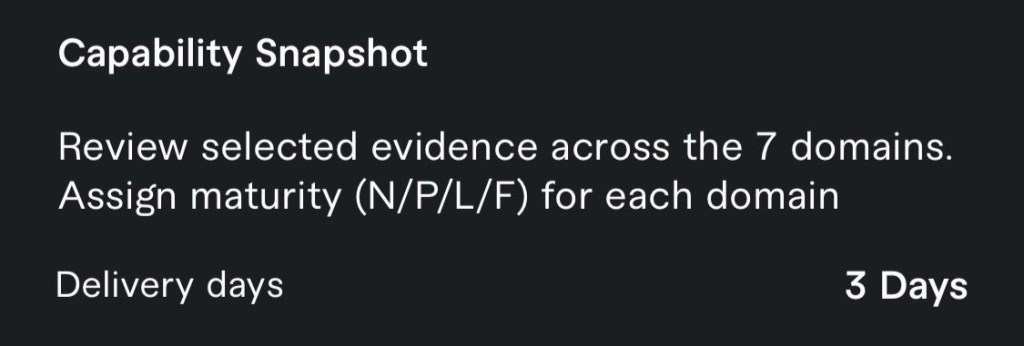
Maturity scale (N–P–L–F)
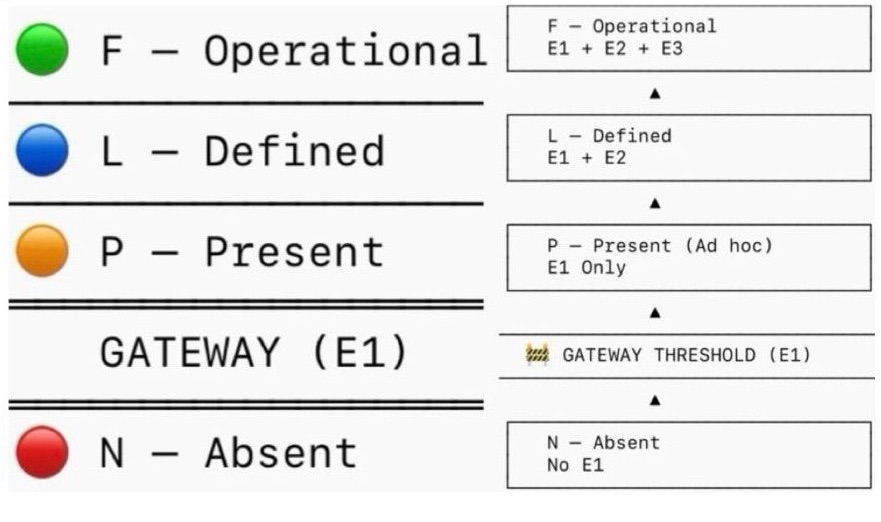
Evidence across E1–E3 is then converted into a four‑step maturity rating for each domain:
- N – Absent
No meaningful evidence; capability does not meet current needs. - P – Ad hoc
Informal, person‑dependent, inconsistent; pockets of good practice but not reliable.
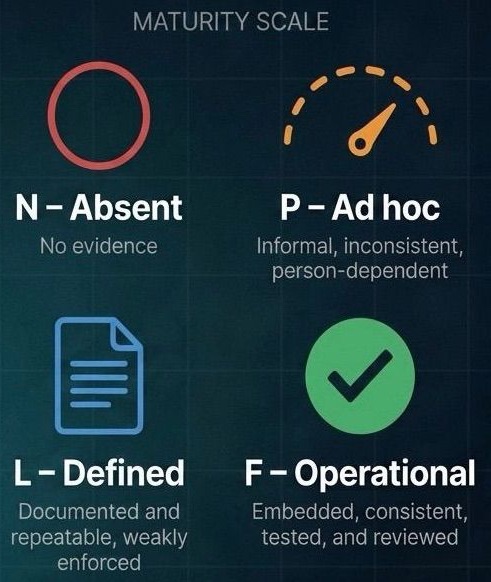
- L – Defined
Documented and repeatable, but weakly enforced; often strong on design, weaker on routine use. - F – Operational
Embedded, consistent, tested, and reviewed; good evidence that it works in practice.
You decide on the Assessment Level you need to test
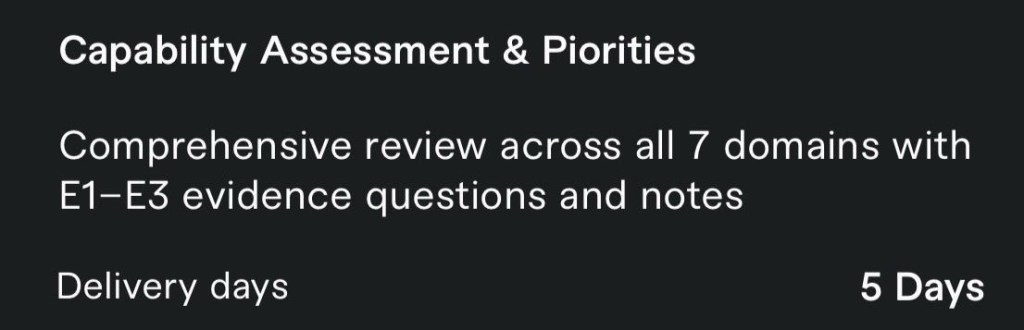
Capability Assessment & Priorities
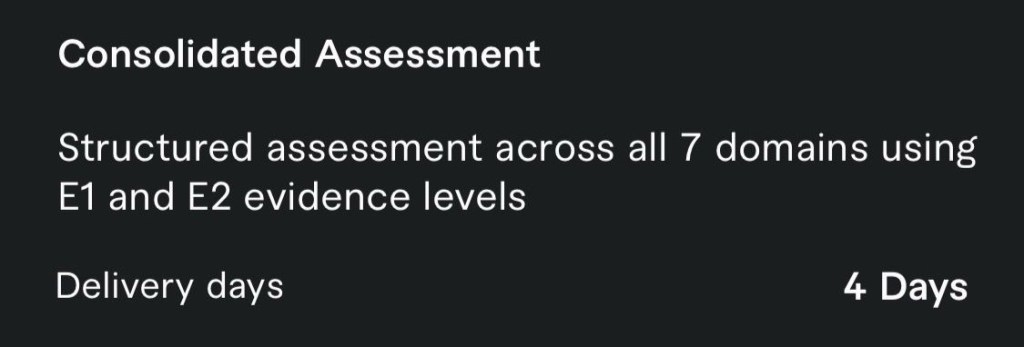
Consolidated Assessment
Capability Snapshot
US$100 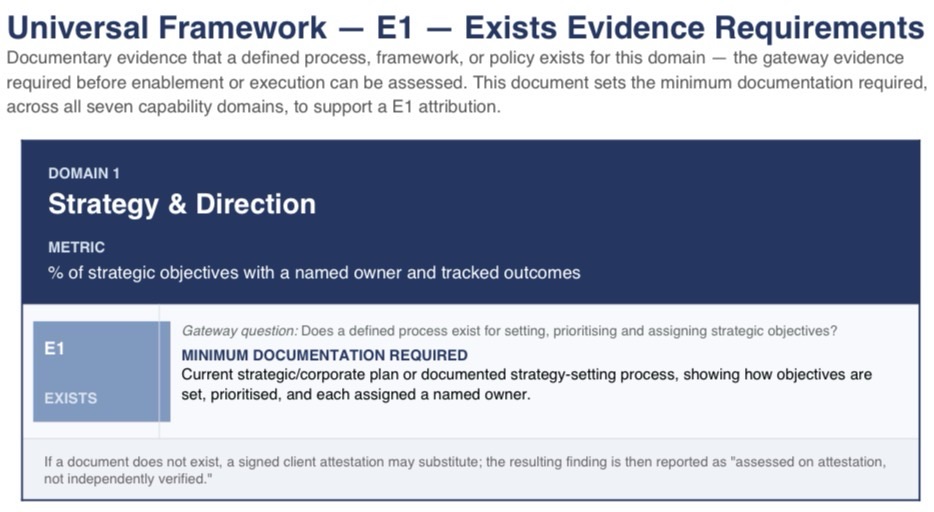
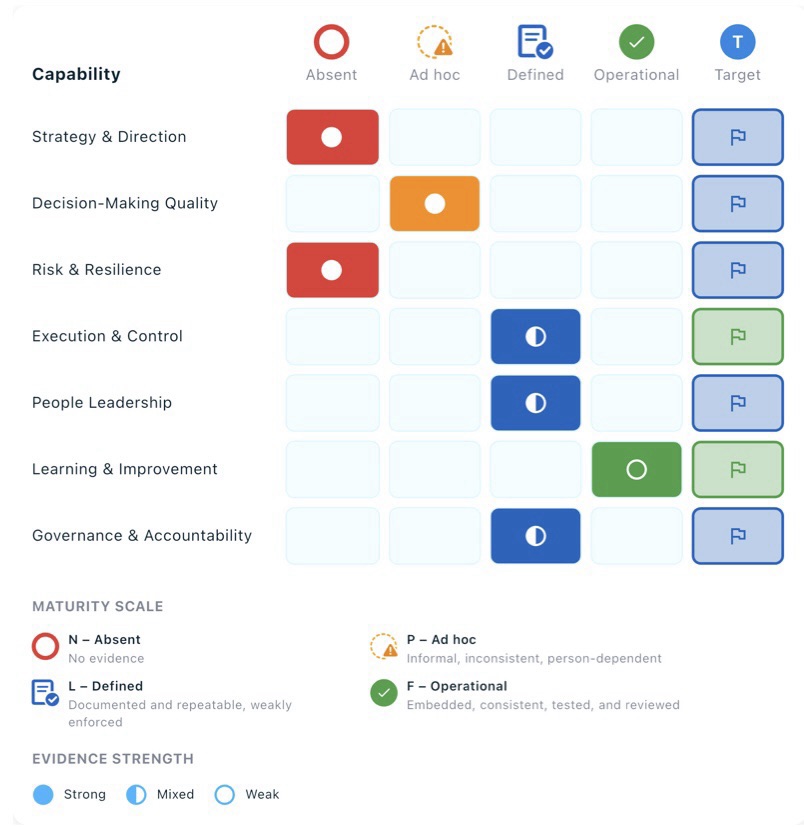
Heat map is included in each report
Start with a short conversation
We will discuss your current situation, and what “good” would look like over the next 12 months.
From there, we can decide the right place to begin.

Or email John directly johnsalter@me.com
- E1 – Exists