
In Hand in Glove I described how Candid Cycle and Calibrate Capability fit together. Candid Cycle tells you what people experienced. Calibrate Capability tells you whether the organisation can actually deliver. Each answers the question the other leaves open.
That raises a fair question: is the pairing a silver bullet for continuous improvement? The answer is no. But it can still do something useful.
What the pairing does well
Its real strength is joining two things that usually sit apart. Organisational learning asks “What did we learn?” Capability assurance asks “What can we demonstrate?” The pairing connects them, and keeps them connected over time.
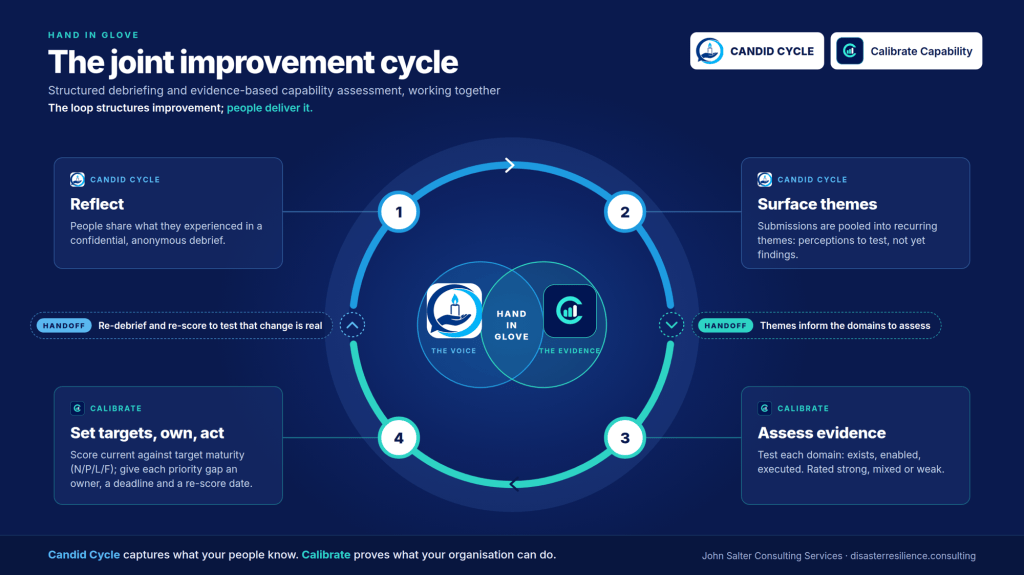
In practice:
• Themes inform the scope. The assessment starts from what people raised, not from leadership’s assumptions.
• Perceptions get tested. A debrief theme is checked against documents, practice and outcomes.
• Evidence gets context. A weak rating shows where a gap is; the reflections help explain why.
• Change gets checked twice. A re-score shows whether capability has improved; a fresh debrief shows whether people feel the difference.
Why it isn’t a silver bullet
The loop is reflect, surface themes, assess evidence, set targets and act, then repeat. The word that matters most is “act”. Every other stage produces insight. Only that stage produces change, and software can support it but cannot carry it out.
Fifteen shorthand warnings
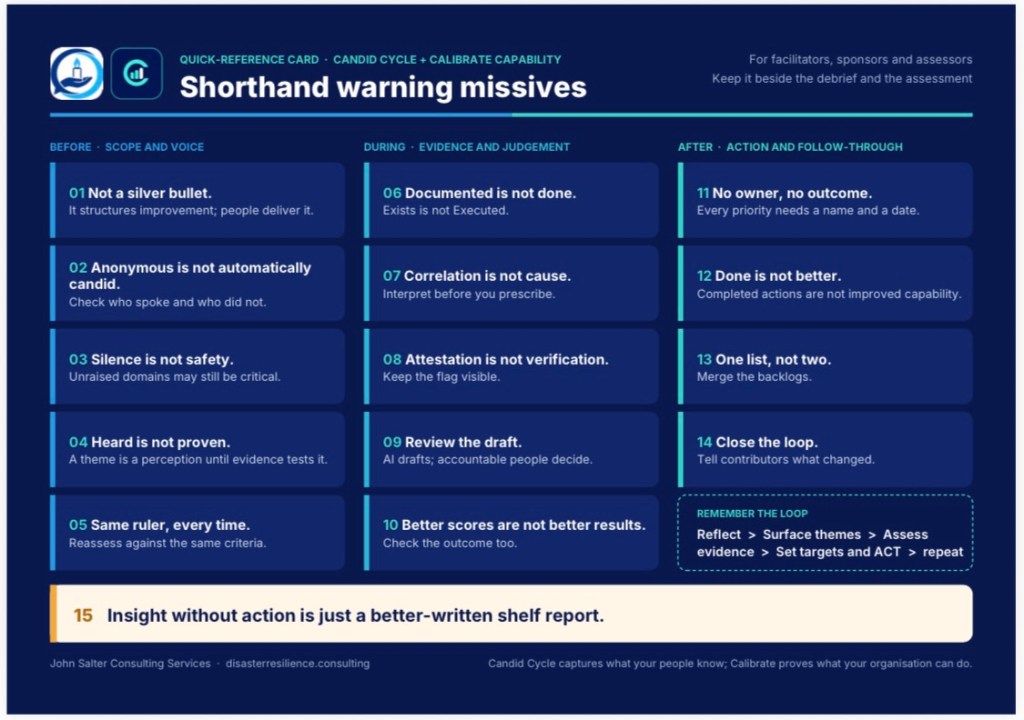
The pairing can also be weakened by:
• Shared blind spots, when the same people frame the questions, supply the evidence and judge the results.
• Missing voices. Anonymity supports candour; it does not guarantee it.
• Hasty interpretation. “Decisions took too long” has more than one possible cause.
• Narrow coverage. A critical capability may never come up in a debrief simply because it hasn’t been tested recently.
• No capacity to act. The tools don’t supply budget, authority, time or skills.
• Mistaking scores for results. A completed action is not improved capability, and improved capability is not yet a better outcome.
So, not a silver bullet but …
… a disciplined way to turn experience into evidence-informed action, and to test whether that action makes a lasting difference. It works best when findings are tested rather than simply recorded, and when every priority has an owner, a deadline and a re-score date.


Free download
Using Candid Cycle and Calibrate Capability together, an eight-page advisory reference covering when to use each tool, ten practice principles, caveats and signs the pairing is working.
Thinking of running the pairing in your organisation?

Book a conversation
or email johnsalter@me.com


