

Figure: Organisational resilience in the Universal Framework.
The ‘Universal Framework’ doesn’t name one list of “resilience capabilities”. It treats resilience as a result of all seven domains working together, with Domain 3 (Risk & Resilience) as the core.
Domain 3: Risk & Resilience
Domain 3 (Risk & Resilience) is the direct home of resilience, measured by the share of critical risks whose treatments reduce risk to target. The test is whether those treatments actually bring the risk down to target, not whether a risk register exists. The other six domains supply the conditions that let it hold. Resilience is evidenced at E3 (Executed), where controls have reduced exposure in practice, not merely at E1 (Exists) or E2 (Enabled).
Supporting domains
Resilience also depends on the other six domains:
Strategy & Direction: Objectives have clear owners, so the organisation knows what it must protect and pursue.
Decision-Making Quality: Decisions hold up under pressure. Our metric is the decision reversal rate.
Execution & Control: Material initiatives are delivered and controlled, so planned treatments get implemented.
People Leadership: Critical roles stay staffed. Our metric is voluntary turnover in critical roles.
Learning & Improvement: Debriefs and after-action reviews check that change was real, which is where Candid Cycle fits.
Governance & Accountability: Ownership and oversight make sure the controls above are held to account.
How you test each capability – Each capability is tested on three levels of evidence:
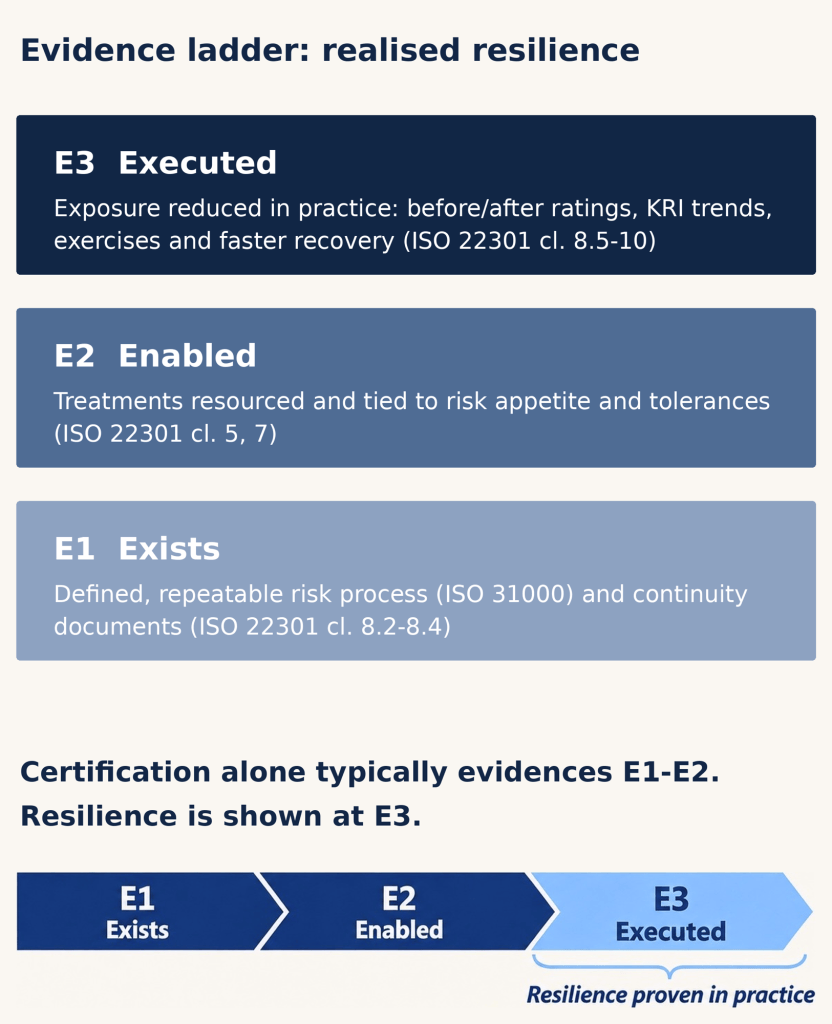
A resilient organisation therefore shows E3 evidence, not just documents. If a document can’t be supplied, the report records “assessed on attestation, not independently verified”.
Domain 3: Risk & Resilience and ISO 22301
Domain 3 and ISO 22301 (the international standard for Business Continuity Management Systems (BCMS), providing a framework to prepare for, respond to, and recover from disruptive incidents) overlap heavily, but they cover different ground.
ISO 22301 is a management system for business continuity, and its core is clause 8, “Operation”. Domain 3 of the Universal Framework checks whether risk and resilience controls work in practice. In effect, Domain 3 tests the outcomes that a compliant ISO 22301 system should produce. The mapping below is my own reading, not an official crosswalk, and the evidence criteria are our framework’s.
Where they line up
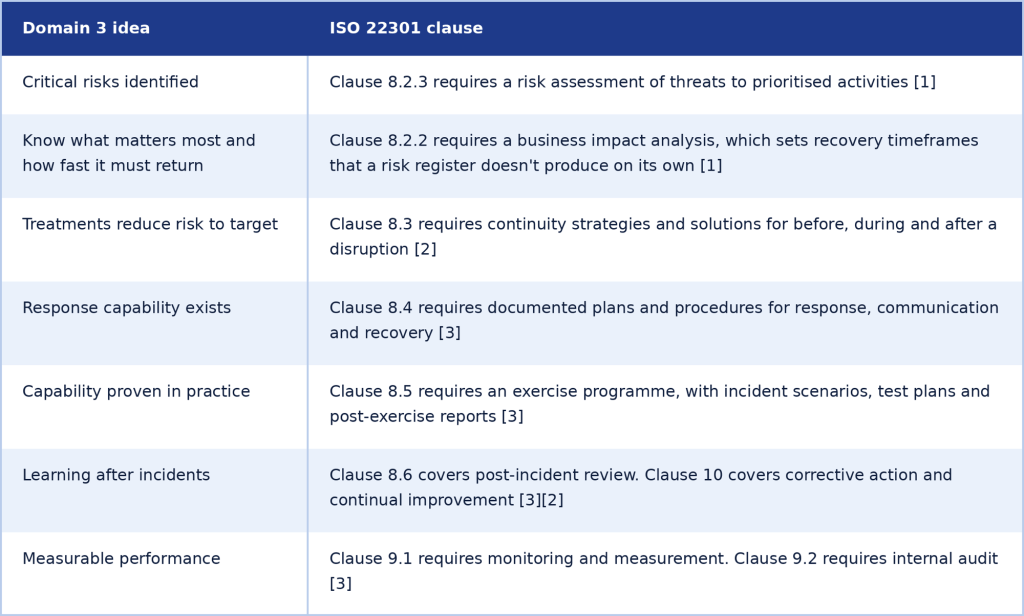
The risk assessment asks what could stop an activity and how likely that is. The BIA asks what happens over time if the activity stops. Together they decide which strategies are needed.[4][5]
Linking to our E1, E2 and E3 criteria
E1 Exists: The mandatory documents are there. These include the continuity policy, objectives, BIA and risk assessment results, strategies and plans.[3]
E2 Enabled: Resources and competence are in place. ISO 22301 covers this in clause 5 (leadership commitment and resourcing) and clause 7 (competence and roles).[2]
E3 Executed: Exercises have been run, real incidents were handled, and the risk treatments reduced exposure to target. This is the tier where an organisation can hold a certificate and still be weak.
The main difference
ISO 22301 mostly asks for a documented system that is audited against the standard. Our metric, the percentage of critical risks whose treatments reduce risk to target, goes further. It asks whether the treatments worked, which is an outcome and not just compliance. Domain 3 can also reach beyond continuity into wider risk treatment, such as incident-style cases we’ve analysed.
Our guidebook and the wider research agree that resilience isn’t a single capability. It shows up when several capabilities work together and have been tested in practice. Our framework covers most of what the research describes. The main gaps are anticipation of external change and shared purpose.
What our guidebook says about resilience
Domain 3 holds the direct resilience test. Its metric is the percentage of critical risks with treatments that reduce risk to target. It is assessed at three levels:
E1: a defined, repeatable risk process exists, typically aligned to ISO 31000.
E2: treatments are resourced and tied to risk appetite and tolerances.
E3: treatments have reduced exposure in practice, shown by before/after ratings, KRI trends, control testing and faster recovery from events.
The other six domains supply what resilience depends on:
Domain 1 (Strategy): objectives are owned and drive real decisions.
Domain 2 (Decisions): decisions stick and aren’t reversed or reworked.
Domain 4 (Execution): initiatives deliver on time and on budget.
Domain 5 (People): critical-role turnover is controlled and succession plans work.
Domain 6 (Learning): repeat incidents fall.
Domain 7 (Governance): material issues close on time, with consequences when they don’t.
The guidebook doesn’t use the word “resilience” outside of Domain 3. Describing the other domains as resilience enablers is my synthesis and not the guidebook’s wording.
What the research adds
ISO 22316 (international guidance standard on organizational resilience) defines organisational resilience as the ability to absorb and adapt in a changing environment so the organisation can deliver its objectives and survive and prosper.
It sets out nine attributes:[1]
- shared vision and purpose
- understanding context
- effective leadership
- a supportive culture
- shared information and knowledge
- availability of resources
- coordination of management disciplines
- support for continual improvement
- ability to anticipate and manage change[2]
The standard also names good governance, diverse skills and leadership, and effective risk management as principles. It treats resilience as an emergent property of the organisation and not as a function.[1][2]
Academic work frames resilience as a capability set. Resilient organisations can adapt, integrate and reconfigure resources to match changing conditions, which the literature calls dynamic capabilities.
That work puts anticipation first. This means observing developments, identifying threats and preparing for unexpected events. It describes this as resilience potential, meaning resilience that isn’t yet realised, because anticipation alone gives only limited control once an event starts. This matches the E1/E2/E3 logic, where E3 shows resilience that has actually been realised.[3]
How the two compare

Why evidence-based assessment matters
Other resilience assessment models also test for proof and not just policy. The cyber resilience maturity model (CR-CMM) requires demonstrable evidence at each checkpoint and describes its aim as moving beyond policy checks. The UNDRR Resilience Maturity Assessment Tool takes a pillar approach for enterprises of all sizes. Those sources support our E3 emphasis, but they are not a validation of our framework.[4][5]
Practical implications
Positioning: Domain 3 is the resilience test and the other six domains are the conditions that make it hold. That fits both our guidebook and ISO 22316.
Sources
[1] INTERNATIONAL ISO STANDARD 22316 https://cdn.standards.iteh.ai/samples/50053ccd8eadab54e4bdb837c8eb47525fc74/ISO-22316-2017.pdf
[2] Organizational resilience – Principles and attributes https://continuity-resilience.com/en/referentiels/iso-22316
[3] Organizational resilience: a capability-based conceptualization https://link.springer.com/article/10.1007/s40685-019-0085-7
[4] Cyber Resilience Capability Maturity Model https://cr-cmm.org/
[5] Resilience Maturity Assessment Tool https://www.undrr.org/media/96281/download? startDownload=20261015
[6] universal-framework-e28094-domain-evidence-guidebook-1.pdf
[7] ISO 22316:2017 – Security and resilience — Organizational … https://www.iso.org/standard/50053.html
[8] ISO 22316:2017 (en), Security and resilience — Organizational … https://www.iso.org/obp/ui/en/
[9] Capability Maturity Model | Cyber Resilience Manifesto https://www.cyberresiliencemanifesto.org/capability-maturity-model
[10] ISO 22316. Organizational Resilience | GlobalSuite https://www.globalsuitesolutions.com/iso-22316-organizational-resilience/
[11] ISO 22316:2017: Organizational Resilience | AGSkits https://agskits.com/blogs/guides/iso-22316-2017-security-and-resilience
[12] ISO 22316 Security and Resilience https://www.scribd.com/document/615127687/ISO-22316-Security-and-Resilience
[13] About | CR-CMM https://cr-cmm.org/about
[14] From emergency preparedness to organisational maturity: A … https://www.sciencedirect.com/science/article/pii/S2211883726001668
[15] Developing cyber-resistivity maturity and scoring framework … https://link.springer.com/article/10.1007/s10207-025-01154-5
[16] Capability Maturity Model Fact Sheet – Homeland Security https://www.dhs.gov/science-and-technology/publication/capability-maturity-model-fact-sheet
Supplementary Sources
[1] How BIA Results Inform Your Risk Assessment: A Practical … https://www.thebci.org/news/how-bia-results-inform-your-risk-assessment-a-practical-guide-for-dora-and-iso-22301.html
[2] The ISO 22301 Requirements Explained https://www.schellman.com/blog/iso-certifications/what-are-the-iso-22301-requirements
[3] ISO 22301 mandatory documents | Complete updated checklist https://advisera.com/27001academy/knowledgebase/mandatory-documents-required-by-iso-22301/
[4] Business Impact Analysis: A Clear, Essential 2026 Guide https://governancedocs.com/iso-22301-business-impact-analysis/
[5] ISO 22301 Risk Assessment: A Clear Guide to Clause 8.2 https://governancedocs.com/iso-22301-risk-assessment/
[6] ISO 22301 Business Impact Analysis Guide https://iso-toolkits.com/iso-22301-business-impact-analysis/
[7] ISO 22301 Requirements Overview: Clauses 4-10 https://www.glocertinternational.com/resources/articles/iso-22301-requirements-overview/
[8] ISO 22301 Risk Assessment: Process, Steps & Best Practices https://www.novelvista.com/blogs/quality-management/iso-22301-risk-assessment
[9] ISO 22301:2019 Security and resilience — Business continuity management systems https://www.iso.org/standard/22301
[10] ISO 22301 – Business Continuity – Clause 4 – Context has 4 sub-clauses https://imsipro.org/wp-content/uploads/2022/09/Workbook-ISO-22301-Clause-4-220721.pdf
[11] Guide to ISO 22301 – Business Continuity Management – NQA https://www.nqa.com/en-gb/resources/knowledge-hub/Guide-To-ISO-22301
[12] ISO22301 Update: What are the Mandatory Document? https://blog.bcm-institute.org/blog/iso22301-update-what-are-the-mandatory-document?hs_amp=true
[13] ISO 22301: The Complete Guide to Business Continuity Management https://igerasolutions.com/en/blog/iso-22301-business-continuity-guide-clauses-4-to-10
[14] Business Impact Analysis for ISO 22301: 2026 Steps https://oneclickcomply.com/blog/how-to-conduct-a-business-impact-analysis-for-iso-22301/
[15] ISO 22301 Risk Assessment — Threats to Recovery https://www.normgrid.com/iso/22301/risk-assessment/


