
These seven prompts have strong underlying intentions: strategic planning, critical thinking, synthesis, expert reasoning, iterative improvement, adaptive learning, and self-critique. Their main weakness is that they leave too much discretion to the model—especially around output structure, evidence standards, prioritisation criteria, and how to handle missing information. Overall improvements To make the prompts more reliable and… Read More
Author: John Salter & Associates Consulting Services
John Salter - specialising in the facilitation of risk-based capability reviews; needs-based training; business continuity planning; crisis management exercises; and organisational debriefing. Recognised for “preventing disasters, or where that is not possible, reducing the potential for harm” Ref: Barrister H Selby, Inquest Handbook, 1998. Distracted by golf, camping, fishing, reading, red wine, movies and theatre.
When the Horn Is in the Picture: A Fable About Capability and Blind Spots
If your organisation’s picture of itself has been painted from one vantage point for too long, the Universal Framework offers a structured way to look again – across the same seven domains the animals uncovered together: Strategy \& Direction, Decision-Making Quality, Risk \& Resilience, Execution \& Control, People Leadership, Learning \& Improvement, and Governance \& Accountability. Every engagement, regardless of scope, is assessed against the same E1 (Exists) / E2 (Enabled) / E3 (Executed) evidence logic – so the result reflects what can be demonstrated, not just what is believed. Read More
How capable are you?
Three evidence tests (E1–E3)
For each domain we look for three levels of evidence:
E1 – Exists
Do the core structures and processes exist?
(Policies, frameworks, processes, roles, plans, registers, documented approaches.)
E2 – Enabled
Are they supported and usable?
(Clear owners, resources, training, tools, data, and regular review cycles.)
E3 – Executed
Are they actually used and making a difference?
(Real examples where they shape decisions, behaviours, investments, and outcomes.)
In practical terms, E1/E2 tell you “have we built the system?” and E3 asks “does the system change what happens?”
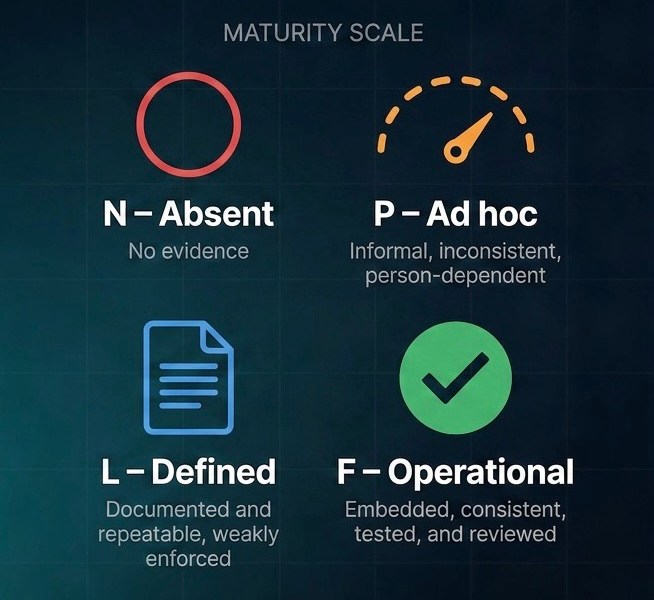
Maturity scale (N–P–L–F)
Evidence across E1–E3 is then converted into a four‑step maturity rating for each domain:
N – Absent
No meaningful evidence; capability does not meet current needs.
P – Ad hoc
Informal, person‑dependent, inconsistent; pockets of good practice but not reliable.
L – Defined
Documented and repeatable, but weakly enforced; often strong on design, weaker on routine use.
F – Operational
Embedded, consistent, tested, and reviewed; good evidence that it works in practice.y Read More
The Cartographer’s Lantern
In a valley often swallowed by fog, the village of Bellmere chose a new warden each year to keep its people safe from flood, fire, and storm. One autumn, a clever merchant arrived with a polished brass lantern. “This lantern,” he announced, “measures the village’s readiness. Hold it near your granaries, bridges, wells, and watchtowers.… Read More
Minimum Client Evidence Requirements
Built on proven foundations, not guesswork
The road ahead for the Sydney Swans
A comparison which treats Ms Ley’s quoted line “accountability must be extended to anyone who was aware of what was happening and had the power to act” as given and compares it against the well-documented legal/coronial “ought to have known” standard. Read More
How to avoid the normalization of deviance in organizations
Avoiding normalization of deviance means treating every recurring workaround, unexplained anomaly, or missed control as evidence to investigate—not proof that the underlying risk is acceptable. The core discipline is simple: past success must not redefine the standard. NASA’s safety guidance expressly warns against using prior successful outcomes to redefine acceptable performance and calls for evidence-based… Read More
How could a Capability Assessment have helped the Sydney Swans
Given this is a live, real, and highly sensitive situation – an active police investigation into alleged sexual assault, real named individuals, and potential legal action, I’ll reflect on the organisational-capability question responsibly: focusing on the governance/culture/risk lessons in the abstract, grounded in what’s publicly reported, without speculating on guilt, criminal outcomes, or unverified claims.… Read More
How could Candid Cycle have helped the Sydney Swans?
“If this needs explaining tomorrow, it needs challenging tonight.” Candid Cycles could not guarantee that the Sydney Swans avoided an alleged incident, nor should it replace police processes. But it could help a club make its behavioural standards real in high-risk settings—especially away trips, alcohol, group dynamics and team hotels—through reflection, peer challenge, early intervention… Read More
How Could Candid Cycle have helped KPMG?
Candid Cycle could not guarantee that misconduct never occurred, but it could have made it harder to normalise, conceal, and mishandle. Its greatest value would be as a structured, evidenced learning-and-escalation system around sensitive engagements, bid decisions, and whistleblower concerns. KPMG Australia’s crisis reportedly centres on alleged misuse of confidential client material to pursue other… Read More
Push the envelope





“Missed it by that much” …
is an old joke from the TV series ‘Get Smart”https://youtube.com/shorts/PmMjifK0L5A?is=tO52zmmDYGT3cxcV This week I missed a connecting flight in Frankfurt. Having come from Australia I needed to clear the new border entry requirements. I appreciate the strategy of needing to check at the first point of entry. I did not appreciate how poorly the integration of… Read More
Capability Assessment Method – Overview
Combines a practical business lens with proven public‑sector and private‑sector capability models. Read More

Which risk metrics matter most?
We analyze risk so that we can better manage it. Read More
Capability is more than potential
Walking the Talk: Why Theory Must Meet Practice We’ve all met someone who can explain things perfectly – quote the books, name the principles, cite the research. But when it comes to putting those ideas to work, the magic fades. The truth is that theory without practice is like a plan without a journey; neat… Read More
Capability Assessments and Context
Context is critical for capability assessments. Read More
Consolidated Assessment
Executive Summary Exemplar (Basic Package) The report shows a solid management-system foundation, with no domains rated Absent or Ad hoc, but the overall maturity is 59.1%, so the organisation is stronger in design than in consistent operational proof of use. Four domains are at Operational maturity and seven are at Defined maturity, which means the… Read More
Consolidated Capability Assessment (Health Check) Framework
Understand whether your organisation is capable, not just compliant. Read More
How capable is your organisation?
Understand whether your organisation is capable, not just compliant. Read More
Alignment of the Universal Framework with the American Productivity & Quality Center’s Process Classification Framework®
Understand whether your organisation is capable, not just compliant Read More

