
Candid Cycle protects people who offer candour by separating what they say from who said it. Its published design gives the person running a review a consolidated account of themes—not access to individual responses. That is a materially stronger safeguard than simply asking people to “speak freely”. Read More
Tag: planning
The Town That Retired Its Watch
Anonymous team debriefs bring scattered concerns into view. Explore what is working, what is weakening and what needs to change. Agree actions and responsibilities, then return to learn whether the safeguards—and people’s confidence in them—have improved. Candid Cycle: reflect honestly, learn together, act. Read More
The King and the Silent Signal Towers
The value of Candid Cycle Read More
The Blind Man and The Lame Man
A classic parable supporting synergy – the Candid Cycle and Calibrate Capability work hand in glove for Continuous Improvement. Read More
The King Who Dammed the River
A classic parable supporting synergy – the Candid Cycle and Calibrate Capability work hand in glove for Continuous Improvement. Read More
Calibrate Capability Guidebook
The “How to use Capability Assessment Guidebook” a seventeen page pdf available for free download Read More
The Emperor’s New Clothes
A classic parable supporting synergy – the Candid Cycle and Calibrate Capability work hand in glove for Continuous Improvement. Read More
Every Line Is a Conversation: How Candid Cycle Supports Effective Communication
As teams grow, the number of communication lines grows faster than the headcount. Here is how structured, anonymous debriefing with Candid Cycle helps teams of any size hear what really matters. Read More
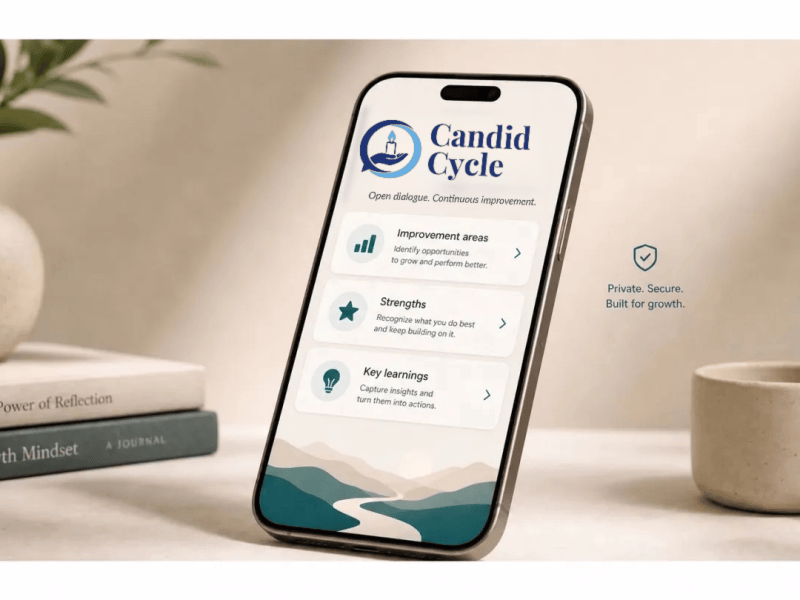
Candid Cycle Client User Manual
Candid Cycle client user manual – a downloadable 1.8 MB PDF (5 pages). Read More
Separate what you controlled from what the environment gave or took away.
Republicans would be diagnosing a defeat, and Democrats would be stress-testing a win. Read More
Search for the guilty, punish the innocent, and praise the non-participants
what a structured debrief provides – a safe way to articulate the experience, an analysis that turns it into lessons, and practical next steps Read More
Playbook for Candid Cycle Starter: Your First Review
Turn team experience into clear findings, priorities and practical next steps. Your Starter plan includes 2 structured reviews each month, with up to 9 participant submissions per review. 1. Choose what to review [ ] Select a recent project, activity, event or period of work. [ ] Give the review a clear title and define… Read More
Beer and Immunity
Old School Old hands used to be cynical about debriefs – a “search for the guilty, punishment of the innocent, and praise and honours for the non-participants.” New School Candid Cycle uses human experience and structured questions to understand what happened, what it means and what should change. AI strengthens a human-led inquiry rather than… Read More
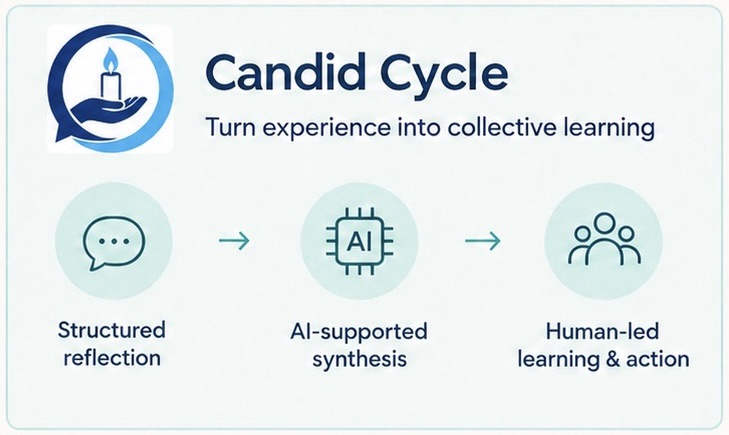
Candid Cycle Released
Candid Cycle – debriefing and review app released. Read More
Candid Cycle – A screenshots introduction
Candid Cycle is a review and improve app which integrates and analyses confidential review submissions. Read More
How capable are you?
Three evidence tests (E1–E3)
For each domain we look for three levels of evidence:
E1 – Exists
Do the core structures and processes exist?
(Policies, frameworks, processes, roles, plans, registers, documented approaches.)
E2 – Enabled
Are they supported and usable?
(Clear owners, resources, training, tools, data, and regular review cycles.)
E3 – Executed
Are they actually used and making a difference?
(Real examples where they shape decisions, behaviours, investments, and outcomes.)
In practical terms, E1/E2 tell you “have we built the system?” and E3 asks “does the system change what happens?”
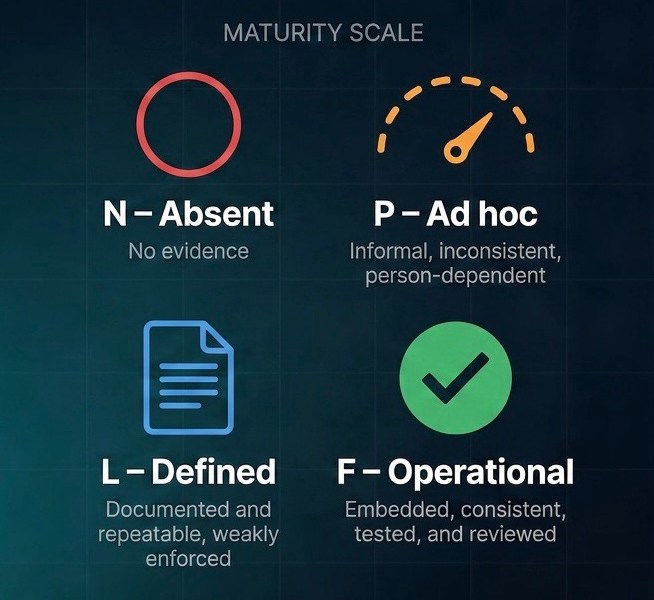
Maturity scale (N–P–L–F)
Evidence across E1–E3 is then converted into a four‑step maturity rating for each domain:
N – Absent
No meaningful evidence; capability does not meet current needs.
P – Ad hoc
Informal, person‑dependent, inconsistent; pockets of good practice but not reliable.
L – Defined
Documented and repeatable, but weakly enforced; often strong on design, weaker on routine use.
F – Operational
Embedded, consistent, tested, and reviewed; good evidence that it works in practice.y Read More
Consolidated Capability Assessment (Health Check) Framework
Understand whether your organisation is capable, not just compliant. Read More
How capable is your organisation?
Understand whether your organisation is capable, not just compliant. Read More

Unveiling a range of Gigs to meet your needs
We are pleased to launch a range of solutions which aim to meet various resilience needs by asking the right questions Read More

Sound on paper but …
You have a sound framework on paper (in several domains), but resilience is not yet embedded in how the organisation runs day to day. Read More

