
For each domain, “necessary and sufficient” evidence means: the minimum concrete artefacts and observations that prove the criterion is in place (E1), enabled (E2), and working in practice (E3).
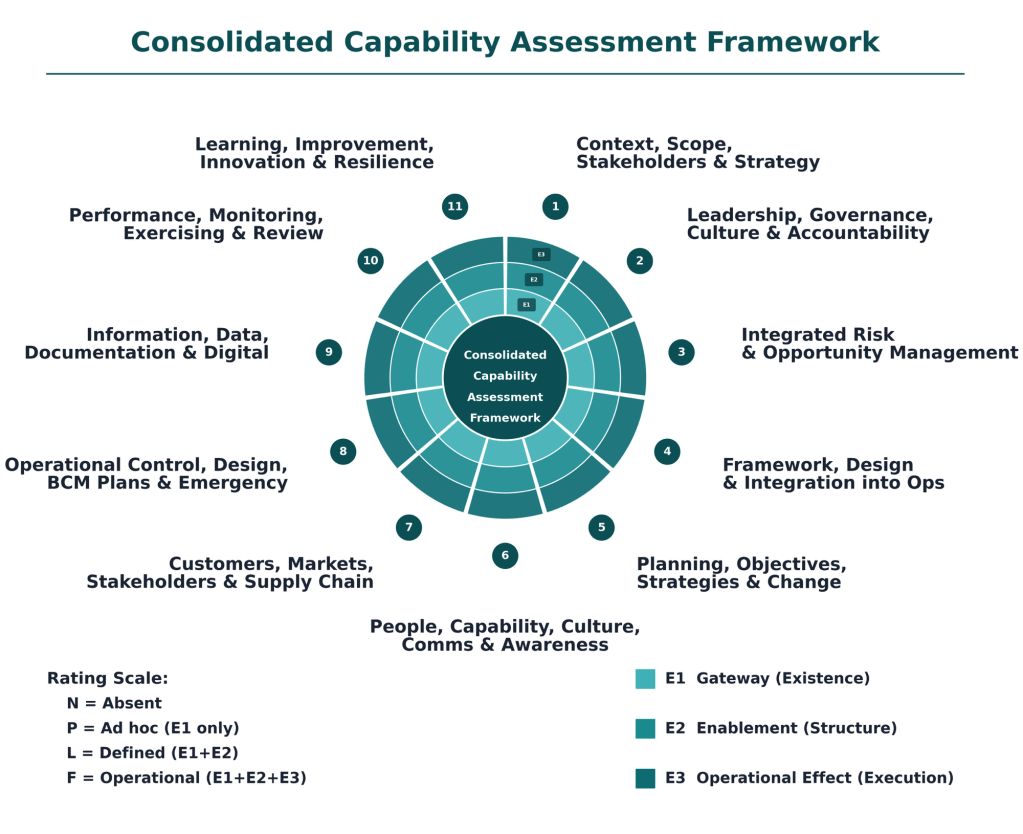
Below is a concise, practical set of examples.
1. Context, Scope, Stakeholders & Strategy
- E1 – Gateway (Existence)
- Approved procedure for context and stakeholder analysis covering QMS/EMS/Risk/BCM.
- Last completed context analysis (PESTLE, SWOT, similar) and stakeholder map.
- Documented scope statements for QMS/EMS/Risk/BCM and current strategic objectives set/approved.[1]
- E2 – Enablement (Structure)
- Version‑controlled context and stakeholder analyses stored in a defined repository, with review dates and owners.
- Objective register linking each objective to context/stakeholder drivers, with owners, measures, and targets.
- Visual or tabular mapping showing traceability: context & stakeholders → scope → objectives.[1]
- E3 – Operational Effect (Execution)
- Business cases, initiative charters, or portfolio papers explicitly referencing context/stakeholder insights and disruption scenarios.
- Risk and continuity investment decisions where disruption analysis or BIA inputs changed priorities or options.
- Steering/portfolio committee minutes showing strategic objectives used to approve, defer, or stop initiatives.[1]
2. Leadership, Governance, Culture & Accountability
- E1 – Gateway
- Approved, current policies for Quality, Environment, Risk, BCM.
- Governance structure document (e.g., RACI, terms of reference) defining roles, committees, and escalation paths.
- Board/Executive‑approved risk appetite statement or equivalent criteria.[1]
- E2 – Enablement
- Forward calendar and minutes of regular Q/E/R/BCM governance forums showing leader attendance.
- Resource plans or budgets explicitly allocating people/funding to these frameworks.
- Leadership communications (town halls, videos, emails) and recognition mechanisms promoting an open, learning culture.[1]
- E3 – Operational Effect
- Decision records where risk, quality, environmental or BCM information materially changed direction or conditions.
- Issue and action logs showing tracking, ownership, due dates, and closure of audits, incidents, and nonconformities.
- Observed leadership behaviours (e.g., walk‑throughs, safety/environment dialogues) consistent with stated policies and values.[1]
3. Integrated Risk & Opportunity Management
- E1 – Gateway
- Enterprise risk management procedure including risk criteria, treatment, and explicit BIA/continuity risk assessment method.
- Standard templates for risk registers and BIA (critical activities, RTOs, RPOs).
- Planning guidance that requires documenting opportunities as well as risks.[1]
- E2 – Enablement
- Consolidated risk registers covering strategic, operational, financial, environmental, and continuity risks, with owners and ratings.
- Completed BIA documentation for in‑scope services with current RTO/RPO, dependencies, and last review date.
- Evidence of periodic reviews updating risk and opportunity entries when services, technology, or context change.[1]
- E3 – Operational Effect
- Prioritised risk treatment plans and continuity strategies that clearly reference underlying risk ratings and BIA outputs.
- Investment, project or resource‑allocation decisions that explicitly follow risk and opportunity evaluations.
- Records of accepted, avoided, transferred, and treated risks with rationale tied to risk appetite.[1]
4. Framework, Design & Integration into Operations
- E1 – Gateway
- Integrated management framework document describing QMS/EMS/Risk/BCM processes and interfaces.
- Map showing integration points between framework processes and core operational and project processes.
- Defined project/initiative governance and delivery framework (stage gates, roles, decision rights).[1]
- E2 – Enablement
- Process documentation and templates embedding Q/E/R/BCM requirements (e.g., risk sections, environmental checks).
- Training records showing operational and project teams briefed on the integrated framework.
- Configured tools/workflows (e.g., PPM, ERP, ticketing) enforcing required checkpoints and approvals.[1]
- E3 – Operational Effect
- Samples of projects delivered following defined stage‑gates, with required framework artefacts present.
- Operational records (change requests, incident handling, service design) showing consistent use of the integrated processes.
- Findings from reviews or audits where deviations were detected, corrected, and led to updates in processes or training.[1]
5. Planning, Objectives, Strategies & Change
- E1 – Gateway
- Documented process for setting Q/E/R/BCM objectives and action plans, including risk/opportunity assessment.
- Methodology for developing continuity and recovery strategies (e.g., alternate site, manual workaround, supplier arrangements).
- Change management procedure requiring assessment of risk, continuity, and environmental impacts.[1]
- E2 – Enablement
- Objective and action plan register with targets, timelines, responsibilities, and required resources.
- Documented continuity and recovery strategies tested for feasibility (e.g., technical tests, supplier confirmations).
- Change templates/forms with mandatory sections for risk, continuity, and environmental assessment.[1]
- E3 – Operational Effect
- Budget and portfolio decisions demonstrably aligned to agreed objectives and risk‑based priorities.
- Examples where changes were modified, delayed, or rejected due to risk/continuity/environmental assessment outcomes.
- Procurement, facilities, IT, and workforce plans explicitly guided by continuity strategies (e.g., dual suppliers, resilient networks).[1]
6. People, Capability, Culture, Communication & Awareness
- E1 – Gateway
- Role profiles or competency matrices specifying requirements for BCM, Risk, QMS, EMS roles.
- Training and awareness framework for Q/E/R/BCM (curriculum, frequency, target audiences).
- Defined communication plan and channels (e.g., intranet, alerts, briefings) with owners.[1]
- E2 – Enablement
- Training records (completion data, refresher schedule) for staff in key and general roles.
- Knowledge repositories (wikis, guides, playbooks) capturing organisational knowledge for these disciplines.
- Evidence that messages (e.g., campaigns, tooltips, dashboards) reach intended audiences in a timely, understandable way.[1]
- E3 – Operational Effect
- Observed competence in exercises, incidents, audits, and daily operations (e.g., correct use of risk and BCM tools).
- Survey or interview results showing risk and BCM awareness outside specialist teams.
- Behavioural evidence (e.g., proactive risk raising, near‑miss reporting, environmental good practices) aligned with desired culture.[1]
7. Customers, Markets, Stakeholders & Supply Chain
- E1 – Gateway
- Defined processes for capturing customer/stakeholder requirements and feedback (VOC, complaints, surveys).
- Supplier/partner onboarding and management procedures including Q/E/R/BCM expectations.
- Documented continuity and environmental obligations with key suppliers in contracts or SLAs.[1]
- E2 – Enablement
- Regular customer and supplier performance reports including quality, environmental, risk, and continuity indicators.
- Controls for critical suppliers (SLAs with penalties, audit programs, contingency clauses).
- Evidence of market, stakeholder, and supply‑chain insights being fed into planning and risk assessments.[1]
- E3 – Operational Effect
- Records where customer/stakeholder feedback triggered specific improvements or control changes.
- Documented mitigation actions for critical supplier risks (diversification, alternate suppliers, stockpiles).
- Joint initiatives or co‑designed improvements with key customers/suppliers that measurably improved performance or resilience.[1]
8. Operational Control, Design, BCM Plans & Emergency Response
- E1 – Gateway
- Documented process maps and work instructions for key products/services and critical activities.
- BCM plans and emergency response procedures for relevant scenarios and locations.
- Defined design and development process (where applicable) with control points and verification steps.[1]
- E2 – Enablement
- Role‑based, accessible versions of procedures and BCM/emergency plans (e.g., mobile, control‑room copies).
- Contracts or operational procedures referencing relevant BCM and emergency requirements and triggers.
- Clear assignment of incident/BCM roles, with criteria for activating and escalating plans.[1]
- E3 – Operational Effect
- Incident and exercise records showing plans and procedures were followed and effective.
- Evidence of operational and emergency controls preventing or mitigating key risks (KPIs, loss data, safety/environmental metrics).
- Post‑incident/exercise reviews resulting in updates to operational controls, BCM plans, and training.[1]
9. Information, Data, Documentation & Digital
- E1 – Gateway
- Documented information management procedure (creation, approval, retention, access) specific to Q/E/R/BCM.
- Defined data quality standards and ownership for critical data sets.
- Inventory of digital tools and systems supporting Q/E/R/BCM, with roles and responsibilities.[1]
- E2 – Enablement
- Evidence documents and records are reviewed, approved, version‑controlled, and easily retrievable.
- Configured systems enforcing standard fields, workflows, and reports for Q/E/R/BCM data capture.
- Information security and integrity controls (access profiles, backups, audit logs) for critical information.[1]
- E3 – Operational Effect
- Examples where Q/E/R/BCM data and reports are used in operational and strategic decisions.
- Trend analyses and dashboards used to identify issues, hotspots, and improvement needs.
- Logs of data/document issues and corrections, including root cause fixes to prevent recurrence.[1]
10. Performance Measurement, Monitoring, Exercising & Review
- E1 – Gateway
- Defined KPI set and targets for quality, environmental, risk, and BCM performance.
- Documented internal audit and management review program.
- BCM exercising and testing program document specifying objectives, scope, and frequency.[1]
- E2 – Enablement
- Evidence that monitoring, audits, reviews, and exercises occur per plan, with documented outputs and actions.
- Analysis reports that go beyond compliance to examine trends, causes, and exposure.
- Action registers assigning owners and due dates to findings and exercise outcomes.[1]
- E3 – Operational Effect
- Traceable examples where monitoring/audit results led to changes in controls, priorities, or strategies.
- Exercise reports demonstrating realistic scenarios, identified gaps, and resulting updates to BIA, strategies, and plans.
- Management review minutes showing use of results to steer direction, investment, and risk posture.[1]
11. Learning, Improvement, Innovation & Resilience Evolution
- E1 – Gateway
- Procedure for capturing incidents, nonconformities, near misses, and lessons, across Q/E/R/BCM.
- Mechanisms for collecting improvement and innovation ideas (campaigns, suggestion schemes, retrospectives).
- Defined root cause analysis and improvement planning method and templates.[1]
- E2 – Enablement
- Register/portfolio of improvement and innovation initiatives with prioritisation criteria.
- Investigation records showing consistent use of root cause methods where thresholds are met.
- Action tracking system with ownership, deadlines, and status for improvement items.[1]
- E3 – Operational Effect
- Trend data showing reduction in repeat incidents, nonconformities, or near misses in targeted areas.
- Case examples where specific improvements measurably enhanced risk, quality, environmental, or continuity outcomes.
- Evidence that lessons and insights feed back into strategy, frameworks, and capability building (e.g., revised standards, new training).[1]
Sources
[1] Consolidated-Capability-Assessment-Framework-Discussion.pdf


