
A parable about resilience, evidence and capabilities that hold together.
(Like our earlier parables, this is fiction. It is a metaphor – not operational advice on maritime safety.)
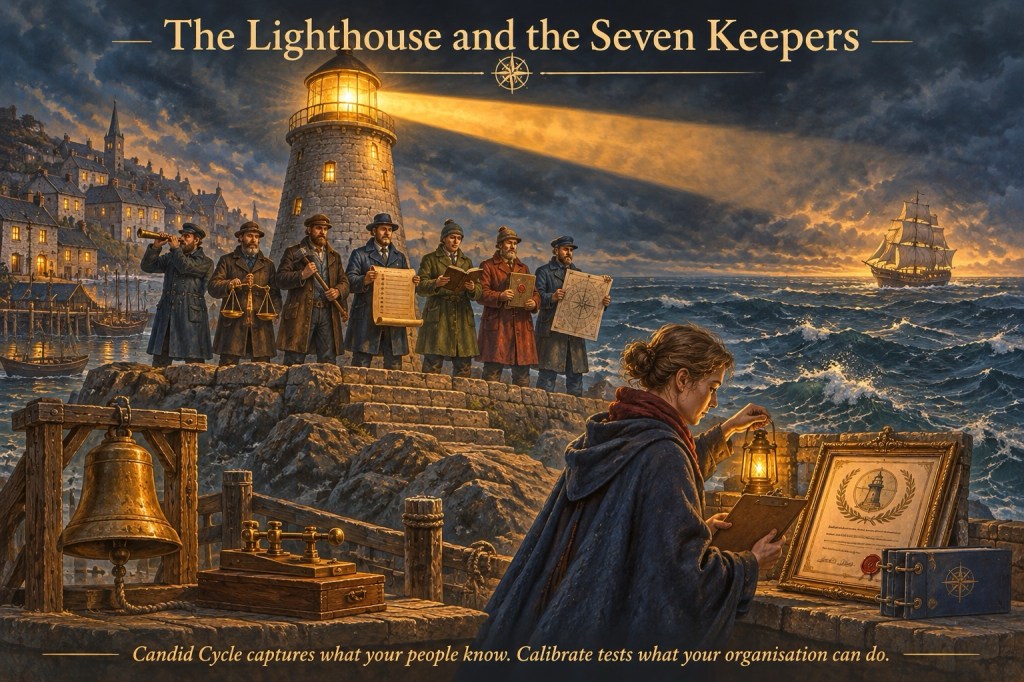
A harbour town kept a famous lighthouse on its northern rock. The council was proud of it. The lamp was polished, the logbook was full, and a framed certificate from the Inspector of Lights hung in the hall.
When a storm season approached, the council asked a visiting assessor to confirm the town was resilient.
A keeper volunteered a reply. “The lamp is the town’s resilience. Test the lamp.” The assessor tested the lamp first. It burned bright. But she did not stop there. “A lamp is one capability,” she said.
“Resilience is what happens when many capabilities hold together under strain. I will test whether the light reaches the ships.”
She followed the light down the coast and found seven keepers, each with a task.
• The Watcher knew what the town existed to protect, and who owned each duty.
• The Judge made calls that held under pressure. Orders were seldom reversed or reworked.
• The Mender repaired and rehearsed. Planned works were actually finished.
• The Rostermaster kept the critical posts staffed. When a keeper left, a trained successor stood ready.
• The Scribe held debriefs after every false alarm and near miss. Repeat incidents were falling.
• The Warden held everyone to account. Overdue repairs closed on time, and delay had consequences.
• The Harbourmaster held the centre. He had named the dangers that could sink the town and set a target for each. He could show whether every remedy had actually brought the danger down to that target.
“No keeper is resilient alone,” the assessor said. “The Harbourmaster’s measure is the test. The other six supply what lets it hold.”
Then she asked each keeper for proof at three levels.
Exists. Is there a plan, a policy or a register? The binder was thick, and every keeper could show one.
Enabled. Are there people, tools, budget and training behind it? Most keepers could show this.
Executed. Did it work when tried? Did the danger fall, and did recovery get faster? At the third level the town wavered. The fog-signal rota was written and funded. It had never been run with the telegraph down. The reserve keeper was named and paid, but had never climbed the tower at night. One keeper’s claim could not be checked at all, so the assessor wrote: assessed on attestation, not independently verified.
“The certificate on your wall proves a system is documented,” she said. “It does not prove the danger has fallen. A town can hold the certificate and still be weak.”
The council grew uneasy.
Then the Scribe spoke. “Before you judge us, ask the people who tend the light.”
So the Scribe held a candid debrief, with no names recorded. The night keepers said what the logbook never held.
• The signal rota failed whenever the telegraph failed.
• The reserve keeper was afraid of the tower stairs.
• Nobody was watching the new shipping channel, and nobody shared the town’s purpose with the fishermen.
The council set owners and dates. They ran the fog drill without the telegraph. The reserve keeper climbed at night. The Watcher began scanning the channel and the horizon. Then they measured again. One handover still failed, so they mended it and tested it again.
When the storm came, the town was not untouched. But the light reached the ships, the reserve keeper held the tower, and the harbour was open by morning.
“Are you resilient now?” asked the council.
“You are more resilient than you were,” said the assessor. “Resilience is never finished. It is proven each time you test it, and then tested again.”
The moral
Resilience is not one strong keeper – or one certified lamp.
It is many capabilities working together, and the proof is the danger falling in practice.
Candid Cycle · The voice
The night keepers’ account
Structured, anonymous debriefs surface the near misses, workarounds and quiet warnings that documents never record. Debriefs also check later whether the change was real, and whether repeat incidents fall.
Calibrate Capability · The evidence
The three levels of proof
Calibrate assesses each capability at Exists, Enabled and Executed. Domain 3 (Risk & Resilience) is the direct test: the share of critical risks whose treatments reduce risk to target. The other six domains supply the conditions that let it hold. Where evidence can’t be supplied, the report says so plainly.
Candid Cycle captures what your people know.
Calibrate Capability tests what your organisation can do.
The research
• Resilience is emergent. ISO 22316 treats it as an emergent property of the organisation, not a function. It lists nine attributes: shared vision and purpose, understanding context, effective leadership, a supportive culture, shared information, available resources, coordination of management disciplines, support for continual improvement, and the ability to anticipate and manage change. It also stresses that resilience shows in behaviour, not documents, and that no attribute develops in isolation. The seven keepers are the parable’s version of this.[continuity-resilience]
• Anticipation, coping and adaptation. Duchek’s capability-based paper defines resilience as the ability to anticipate threats, cope with adverse events and adapt to changing conditions, and treats it as a meta-capability made of underlying routines. The Harbourmaster’s targets and the Scribe’s debriefs map onto these stages.
• Plans alone are not preparation. The same paper notes that training and simulation help ensure plans achieve their aims. It also cites the finding that the main benefit of planning is the effective relationships and mutual understanding it builds among the people involved. This is why the telegraph-down drill matters more than the binder.
• Anticipation is only potential. Duchek describes anticipation as “resilience potential”, meaning resilience not yet realised, and notes it gives only limited control once an event starts. That is the Exists/Enabled/Executed logic: only Executed shows realised resilience.


