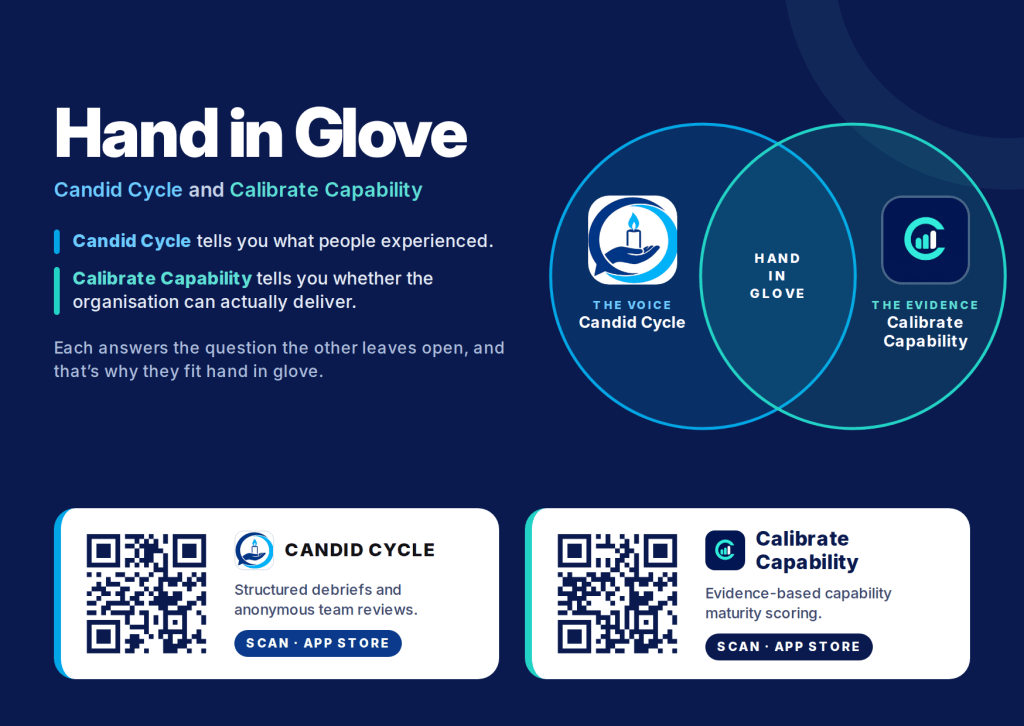
‘Candid Cycle’ tells you what people experienced. ‘Calibrate Capability’ tells you whether the organisation can actually deliver. Each answers the question the other leaves open, and that’s why they fit hand in glove.
What each one does
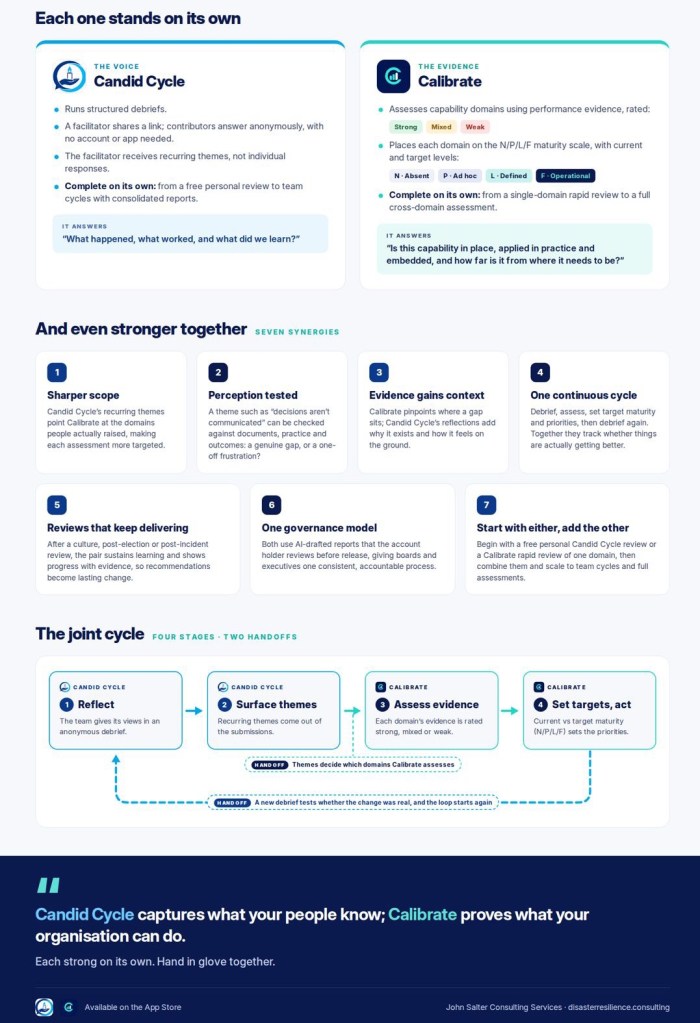
- Candid Cycle (the voice): It runs structured debriefs. A facilitator shares a link, contributors answer anonymously without needing an account or the app, and the facilitator gets recurring themes rather than individual responses. It answers “What happened, what worked, and what did we learn?”
- Calibrate Capability (the evidence): It assesses capability domains using performance evidence. It rates that evidence as strong, mixed or weak and places each domain on the N/P/L/F maturity scale (Absent, Ad hoc, Defined, Operational), with current and target levels. It answers “Is this capability in place, applied in practice and embedded, and how far is it from where it needs to be?”
Why they work together
- Themes set the scope. Candid Cycle’s recurring themes show which capability domains Calibrate should assess. The assessment then rests on what people actually raised rather than on leadership assumptions.
- Perception gets tested. A theme such as “decisions aren’t communicated” is a perception. Calibrate checks it against documents, practice and outcomes, so the organisation can tell a genuine capability gap from a one-off frustration.
- Evidence gets context. A weak rating in Calibrate shows where a gap is. Candid Cycle’s reflections explain why it exists and how it feels on the ground.
- Together they make a cycle. Debrief, then assess, then set target maturity and priorities, then debrief again after the next event or project. Candid Cycle’s iteration loop and Calibrate’s target maturity together show whether things are actually getting better.
- They follow through on reviews. After an independent review (a culture review, a post-election review, a post-incident review), the hard part is sustaining change. The pair keeps learning going and shows progress with evidence, rather than leaving the review on a shelf.
- The governance model is the same. Both use AI-drafted reports that the account holder reviews before release. That gives boards and executives one consistent, accountable process across both tools.
- They scale from light to deep. Run a free personal Candid Cycle review or a Calibrate rapid review of one domain, or scale up to multiple team cycles and a full assessment across domains.
“Candid Cycle captures what your people know; Calibrate proves what your organisation can do.”
The diagram below shows the joint cycle as a loop of four stages. Candid Cycle runs the first two (blue) and Calibrate runs the last two (teal).
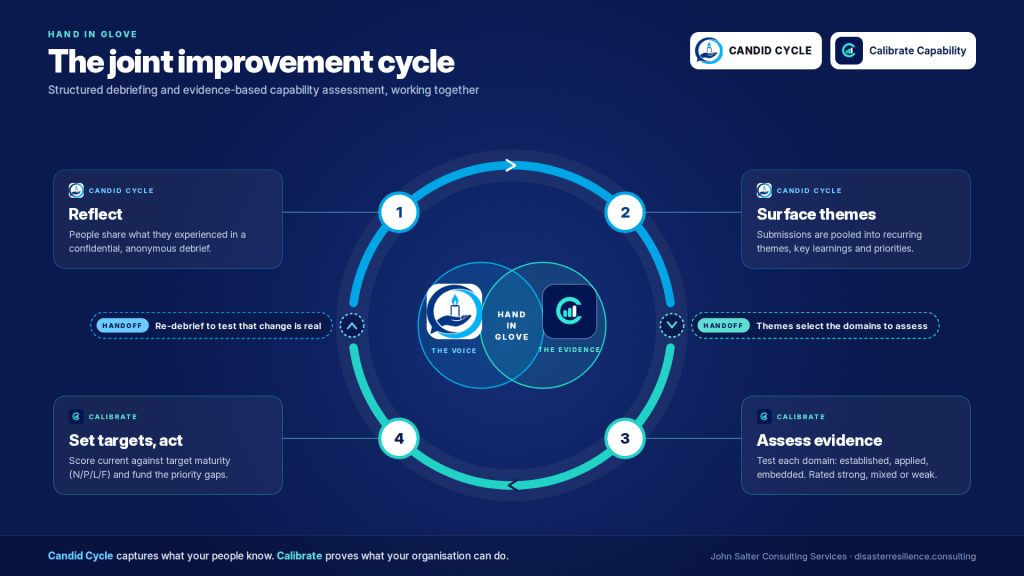
- 1. Reflect (Candid Cycle): the team gives its views in an anonymous debrief.
- 2. Surface themes (Candid Cycle): recurring themes come out of those submissions.
- Handoff: the themes decide which capability domains Calibrate assesses.
- 3. Assess evidence (Calibrate): each domain’s evidence is rated strong, mixed or weak.
- 4. Set targets and act (Calibrate): current maturity is compared with target maturity on the N/P/L/F scale, and improvement priorities are set.
- Handoff: after action, a new Candid Cycle debrief tests whether the change was real, and the loop starts again.
In a Nutshell