
A parable about speaking up, looking closely and acting on what is found.
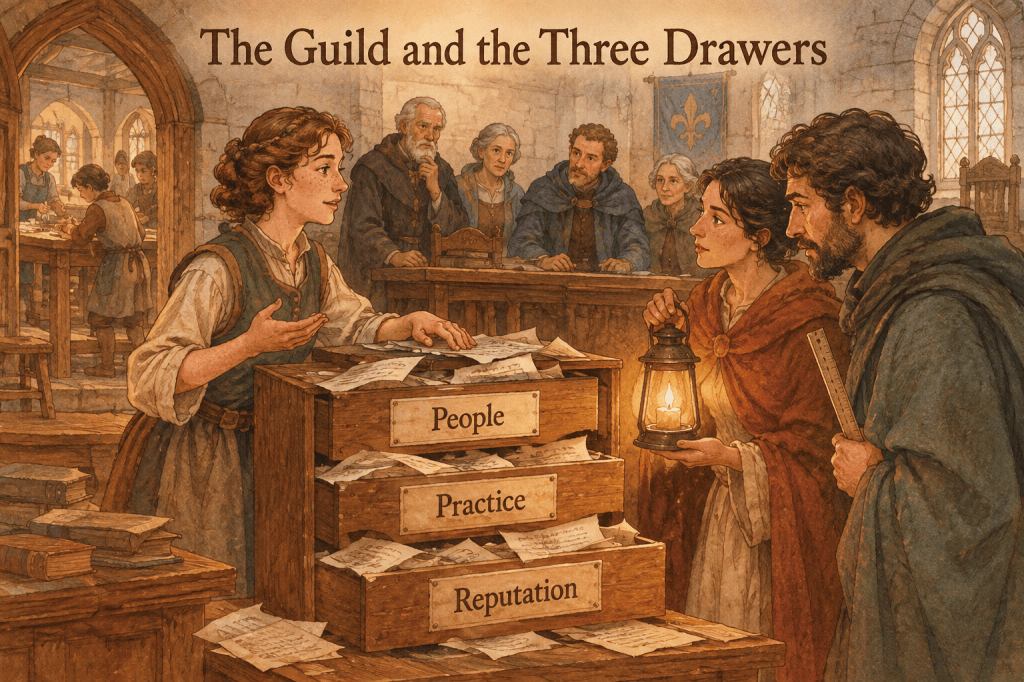
The most respected guild in the city earned its living examining other people’s accounts.
Merchants trusted its seal. Councillors sought its advice. Apprentices competed to enter its doors.
Above the entrance, carved in stone, were the words:
Nothing important escapes our attention.
Inside stood three drawers.
The first was labelled People. The second, Practice. The third, Reputation.
One morning, an apprentice reported that a master had humiliated her before the workshop and repeatedly made unwelcome advances.
The keeper recorded her account and placed it in the first drawer.
Another apprentice reported that the same master had ordered him to approve work he had not checked.
“Was he unkind when he asked?” said the keeper.
“Yes.”
The keeper placed that account in the first drawer too.
A third apprentice said the master had threatened to end her training if she questioned his instructions.
“That could damage confidence in the guild,” said the keeper, placing her account in the third drawer.
At the council meeting, the masters opened the second drawer.
Almost empty.
“Our professional standards remain strong,” they announced.
Yet apprentices continued to leave.
Eventually, the council summoned two visitors. One carried a lamp; the other, a measuring rule.
The first listened to apprentices and former workers beyond the masters’ hearing.
Some described humiliation and unwanted attention. Others spoke of hurried approvals, missing checks and warnings that had gone nowhere.
“Why did you not tell us?” asked a councillor.
“We did,” said an apprentice.
The room fell quiet.
“These accounts need careful examination,” said the visitor with the lamp. “They are not verdicts. But neither are they inconveniences to file away.”
The second visitor followed the path of a complaint.
There were rules against retaliation, but nobody checked whether a person lost work after speaking.
There were investigation procedures, but an influential master could help choose who investigated.
There were files marked closed, but little evidence that anyone had examined the disputed work.
Finally, the visitor asked to see all three drawers together.
The council hesitated.
“Those concern different matters,” said the keeper.
“Sometimes,” replied the visitor. “But a threat can silence a person and conceal a faulty account. The drawers divide the records. They do not divide the consequences.”
“Then we need a fourth drawer,” suggested a councillor.
“No. You need to stop mistaking filing for responding.”
The council’s first proposal was to replace the keeper.
“Perhaps the keeper has questions to answer,” said the visitor with the lamp. “But who named the drawers? Who accepted the reports? Who praised their emptiness?”
This time, the silence belonged to the masters.
The council arranged independent examination of the serious allegations, support for those affected and a fair opportunity for those accused to respond.
It put decisions beyond the control of anyone whose conduct was under examination.
It assigned people to check the disputed work, watch for reprisals and report directly to the council. Every corrective action received an owner, a date and a way to demonstrate that it worked.
Then the visitor with the measuring rule examined safeguards elsewhere in the guild.
“Why look where nobody has complained?” asked a master.
“Because silence cannot tell us whether a safeguard works.”
Months later, more concerns were being reported.
“The changes have made us look worse,” complained one councillor.
“More reports might mean more trouble,” said the visitor with the lamp. “They might also mean greater trust. The number alone cannot tell you which.”
So the visitors returned to the workshops.
They asked whether people could raise concerns without losing opportunities. They checked whether allegations were examined fairly and promptly. They inspected the work that had been questioned and the decisions made about it.
Some repairs held.
Others did not.
One apprentice who had spoken was quietly excluded from a valuable assignment. The council intervened, restored the opportunity and examined who had made the decision.
A new approval process looked impressive but failed during a busy week. The guild changed the workload and authority behind it, then tested it again.
Progress was slower than the council had hoped.
It was also harder to pretend.
A year later, a young apprentice found an error in an important account.
The master responsible brought the guild much of its income.
The apprentice stood outside the keeper’s room for a long time before entering.
The keeper listened.
“Which drawer does this belong in?” the apprentice asked.
“First,” said the keeper, “tell me what happened. Then we will make sure the right people examine it – and that you are kept informed.”
The account was checked. The error was corrected before the guild placed its seal upon it.
At the next council meeting, someone suggested announcing that the guild’s problems were finally behind it.
Instead, the council asked the apprentice what had happened after he spoke.
He described the examination, the correction and the work he was still being trusted to do.
Then he added, “Another apprentice has something to tell you.”
The council made room.
Below the old words above the entrance, it later added a smaller line:
What we hear must change what we do.
The moral
An empty complaints drawer is not proof of a healthy organisation.
Listen without fear or favour. Investigate fairly. Test the safeguards. Return to see whether anything changed.
Candid Cycle · The voice
Hear what the drawers divide
Bring overlooked experiences and recurring concerns into view. Use structured reflection to understand what people experience, identify questions that need examination and return after action to learn what has changed.
Learning debriefs complement – not replace – safe reporting pathways, individual support and formal investigation.
Calibrate Capability · The evidence
Test beyond the closed file
Assess whether safeguards exist, are enabled and are executed. Examine authority, independence, resources, accountability and outcomes – not simply policies or completed actions.
Test the risks people identify, and the safeguards nobody has yet questioned.
Candid Cycle captures what your people know. Calibrate Capability tests what your organisation can do.
Together, they connect honest reflection with demonstrated improvement.
An original fictional parable. The guild, characters, dialogue and events are invented.


