
Most capability reviews are based on opinion. People rate themselves, a score appears, and no one can say what it actually rests on.
Calibrate is different. Every finding is tied to evidence, so you can see what your organisation can actually deliver and what to fix first.
Who Calibrate is for
- Executives and boards who want an honest, evidenced view of organisational capability.
- Risk, resilience and governance leads who need to show maturity is improving, not just claim it.
- Team and business-unit leaders setting priorities for improvement.
- Consultants and advisers who want a repeatable, defensible assessment method for their clients.
How it works
Calibrate is built on the Universal Framework, a structured method that tests each capability at three levels:
- Exists: the capability is documented in a policy, plan or procedure.
- Enabled: the people, resources and authority are in place to make it work.
- Executed: it is actually being done, and there is proof.
That separates what is written down from what is enabled, and what is enabled from what is actually delivered. A business continuity plan may exist, but if no one has tested it, it isn’t executed. A policy on the shelf no longer looks the same as a capability your people use every day.
Where a document isn’t available, an accountable person’s attestation can be recorded instead. The report marks that finding as assessed on attestation, not independently verified, so readers know exactly how firm each conclusion is.
Seven domains, one clear picture
Assess one domain for a rapid review, or all seven for a full cross-organisation evaluation:
- Strategy & Direction
- Decision-Making Quality
- Risk & Resilience
- Execution & Control
- People Leadership
- Learning & Improvement
- Governance & Accountability
For each domain, you record current and target maturity on the N / P / L / F scale (Absent, Ad hoc, Defined, Operational). You also rate the strength of the evidence behind it as strong, mixed or weak. The result is a clear view of where you are, where you need to be, and how sure you can be of both.
What you get: maturity gaps by domain, the strength of the evidence behind each rating, and a clear list of what to fix first.
AI draft, your judgement
Calibrate drafts your assessment report with AI, then hands it to you to review before anything is released. You get the speed of an automated draft without giving up professional judgement over what goes to your board, executives or clients.
Plans that measure progress
A single assessment shows where you stand. Repeating it shows whether things are getting better. Calibrate builds reassessment into its longer plans, so you can set a baseline, act on the priorities, and measure the change against the same criteria.
- Snapshot (1 month): a clear, evidence-based read of your current position.
- Baseline + Review (3 months): set the baseline, act on it, then reassess once to confirm progress.
- Improvement Programme (12 months): four reassessments per workspace across the year, for continuous improvement you can demonstrate.
Portfolio reporting brings your workspaces together, so leaders can compare capability across teams, sites or business units in one place.
Plans and pricing
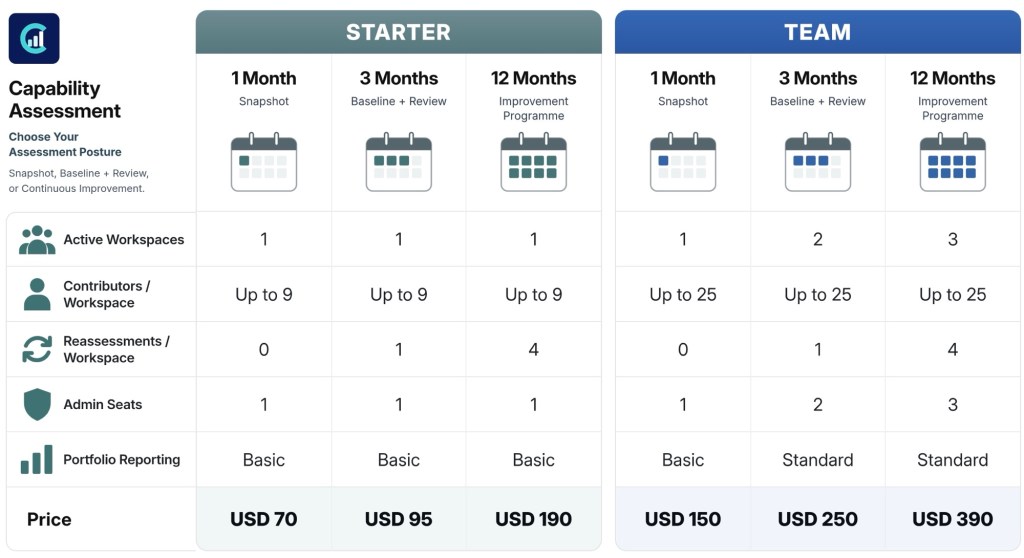
Calibrate starts from US$70 a month, and longer plans lower the monthly cost. A full year of the Team Improvement Programme works out at about US$33 a month, for up to 25 contributors across three workspaces.
Better together with Candid Cycle
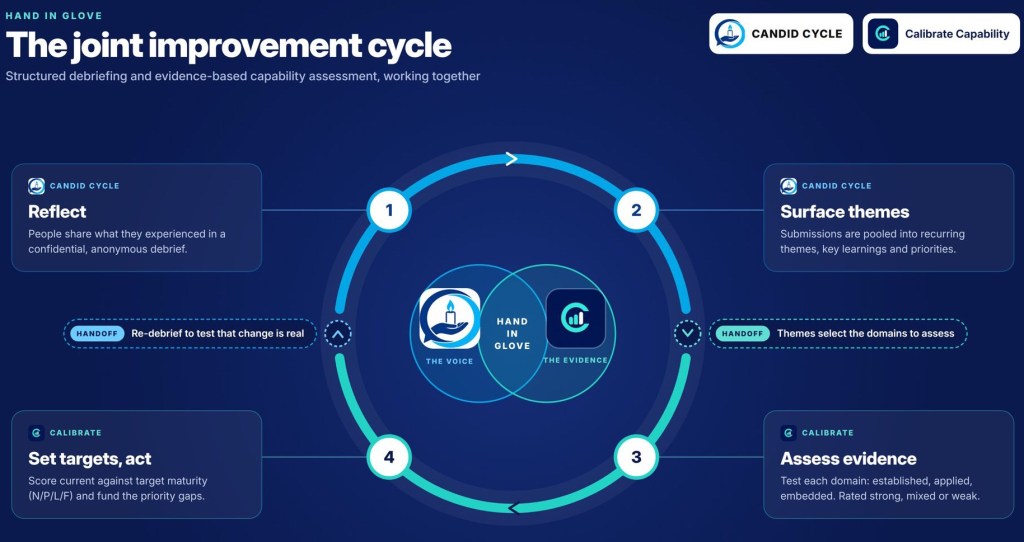
Calibrate stands strongly on its own. Paired with Candid Cycle, our structured debriefing tool, it goes further. The themes your people raise in Candid Cycle debriefs can show which capability domains to assess, so your assessment starts from real experience rather than assumptions.
See where you really stand
Download Calibrate: Capability Assessment from the App Store and find out what your organisation can really do.
Evidence, not opinion.


