
A Candid Cycle parable about borrowed loyalty, silent stakeholders and the plan nobody asked to join.
In a land of old fairs, the finest performers had always travelled with the Guild Circuit. Its pay was modest, its rules were strict and its tents were patched, but its audiences were loyal.
Then a caravan appeared on the horizon, painted gold.
Its patron, a distant merchant prince, had filled its wagons with coin. The caravan’s ringmaster rode from town to town making offers no performer had ever heard.
“Join us,” he said, “and you will never count coins again.”
The acrobats came first, then the jugglers, then the famous fire-walker. Each was paid a fortune simply for signing. Each was given a banner of their own and told they would one day own a share of the caravan.
The Guild banned them from its fairs. Families of performers split. Old friends stopped speaking.
For a while the golden caravan dazzled. Its tents were larger, its music louder, its shows shorter and brighter. In some distant cities, crowds roared.
But in many towns the benches stayed half empty. The performers noticed. So did the wagon-drivers, the cooks and the ticket-sellers.
“Should we tell the ringmaster?” asked a young ticket-seller.
“Why?” said the cook. “The prince sends another chest of coin every season. Nobody needs to listen while the chests keep coming.”
One spring, after the caravan’s most celebrated show, a messenger arrived from the prince’s palace.
The world beyond the mountains had changed. War had come to the prince’s lands. His treasurers had redrawn their plans.
“The prince will pay for this final season,” the messenger said. “After that, no more chests.”
The ringmaster stared at him. “Who decided this?”
“The palace.”
“Did anyone ask us?”
“No.”
That week, wages arrived late. Performers whispered in the wings. Strangers in dark coats, experts in closing failed enterprises, appeared at the ringmaster’s table.
The ringmaster refused to give up.
He rode to a lender in the city and returned with a plan he called the Second Caravan. It would be smaller. The season would be shorter. The prizes would be lower. In return, each performer would own a real share of the company.
“It is a sound plan,” the lender said. “I will fund it, provided your stars agree to perform.”
The ringmaster unrolled the plan before his performers.
The fire-walker read it in silence. Then she rolled it up and placed it on the table.
“For five seasons,” she said, “you asked us to sign. You never asked us what we needed. You never asked why the benches were empty, what we missed about the old fairs or what would make us stay when the coin was gone.”
“I am asking now,” said the ringmaster.
“Now you are asking us to stake our futures on a caravan we never helped to shape,” she replied. “We were paid to arrive. Nobody built a reason to remain.”
One by one, the stars declined. Some returned to the old fairs that would still have them. Others waited at the borders of towns that had not yet decided whether to forgive them.
Without the stars, the lender withdrew.
The golden wagons were sold at auction that winter. The cook, the wagon-drivers and the ticket-sellers learned of it by notice.
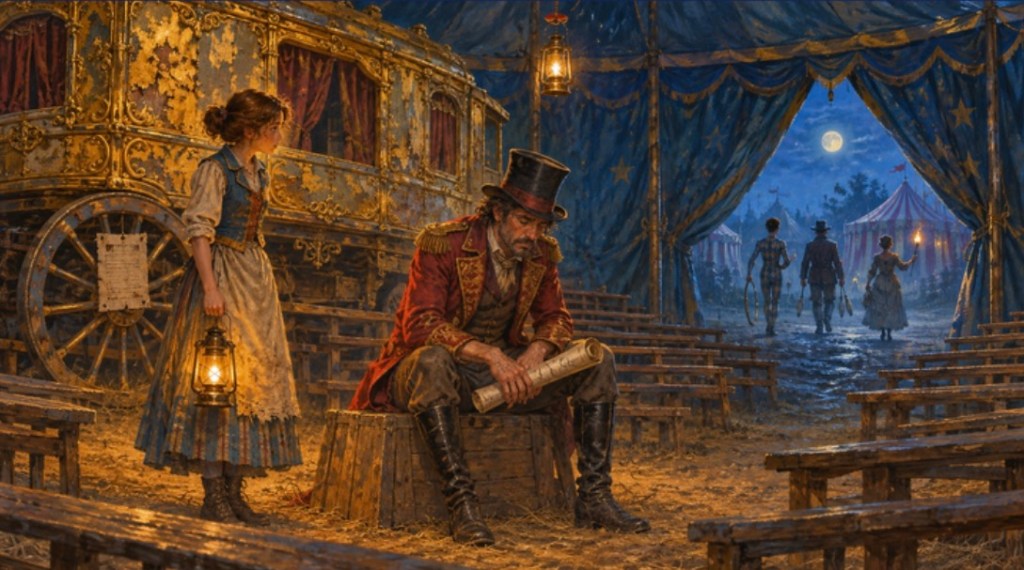
On the last night, the young ticket-seller found the ringmaster alone in the empty tent.
“Did the coin fail us?” she asked.
“The coin was the only voice we listened to,” he said. “When it went quiet, we discovered we had never heard anyone else.”
The moral
Loyalty you buy lasts only as long as the money. Commitment you earn begins with asking, and listening, before you need it.
Candid Cycle · The voice – Ask before the patron leaves.
The golden caravan knew a great deal about its money and very little about its people. Performers, crews and ticket-sellers could all see the empty benches, but nobody had a safe, structured way to say so, and nobody was asked.
Candid Cycle makes that listening routine rather than reserved for a crisis.
• Debrief regularly, not just after failure. Ask what is working, what is not and what would make people stay.
• Include everyone whose commitment the plan depends on, including people at the edges of the organisation.
• Protect candour. People share early warnings when they trust that honesty will not cost them.
• Return after action. Show people what changed because they spoke, and check whether they experience the difference.
By the time the ringmaster asked his performers what they thought, the answer was already written. Candid Cycle helps you ask while the answer can still change the outcome.

Research behind the parable
This is an original fictional parable. Its characters, dialogue and events are invented; it does not describe the private conversations, motives or views of any real person.
It was inspired by the collapse of LIV Golf, reported by The Athletic and other outlets.
• LIV launched in June 2022 with nine-figure signing bonuses to lure top players from the PGA Tour (Chicago Sun-Times).
• It was funded entirely by repeated instalments from Saudi Arabia’s Public Investment Fund, and the April 2026 decision to stop funding reportedly did not involve LIV management (GOLF.com).
• PIF invested about $5 billion in equity; LIV continually operated at a loss and was years from profitability (AP via NBC DFW).
• LIV filed for Chapter 11 on 8 September 2026 and proposed “LIV 2.0”, with a shorter schedule, reduced prize money and player equity (AFP).
• BC Partners Credit pledged $300 million, but players including Jon Rahm, Sergio Garcia, Tyrrell Hatton and Louis Oosthuizen were not interested (CBS News).
• LIV said no viable restructuring remained “due to lack of player participation and BC Partners’ termination of the Restructuring Support Agreement”, and it is moving to an orderly wind-down and liquidation (AP via NBC DFW).


