
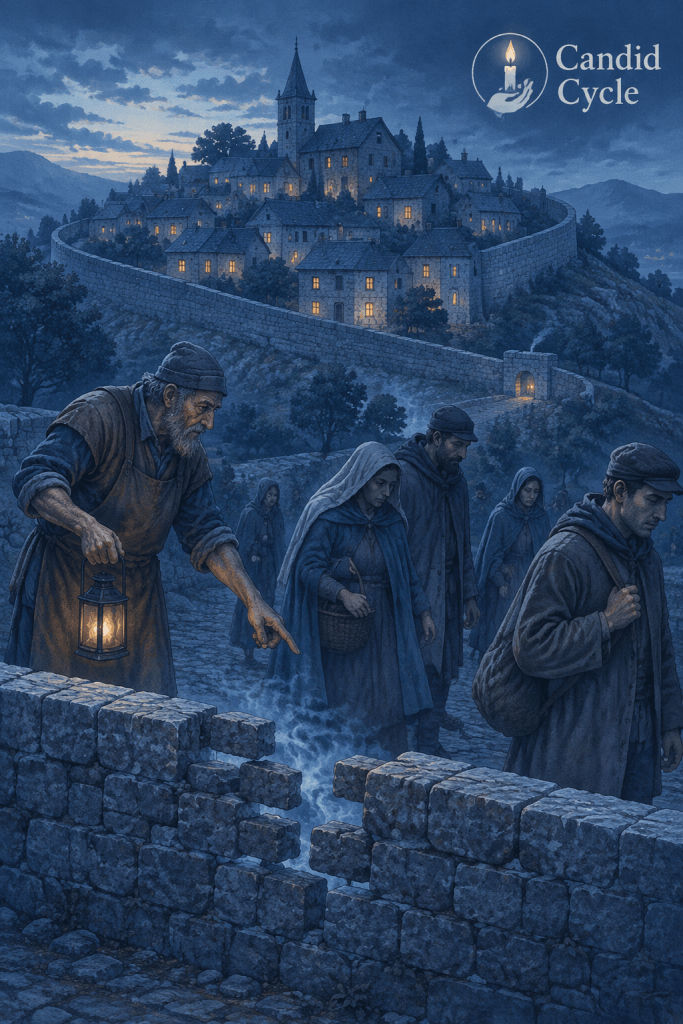
For a generation, the village of Ellenmoor was safe. Long ago a fever had swept through every winter, taking the youngest first, until the elders built a wall of a hundred stones around the village. The mist that carried the fever could not pass while ninety-five stones stood.
The wall worked so well that people forgot why it was there. Children grew up never having seen the fever. Some said the wall was old-fashioned. A few quietly took stones for their own gardens. Nobody kept count.
Martha, the stonemason, noticed first. Ninety-four stones. Then ninety-three. She mentioned it at the market, but the council was busy and the gaps seemed small. “We haven’t had the fever in twenty-six years,” they said. “Why worry now?”
That winter the mist found the gaps. It lingered in the lanes long after anyone had passed. The fever returned, and once again it took the youngest first. Afterwards, at the council meeting, people said the same thing in different words: “Someone should have told us.” Martha had. She had simply never been asked.
The moral – A safeguard you stop counting is a safeguard you have already started to lose.
How Candid Cycle closes the gaps.
Reflect: Each person records, confidentially, what they saw, what worked and what worried them. Martha’s count is captured, not lost in a market conversation.
Review: Submissions come together in one place, so small warnings from many voices are seen as a pattern rather than dismissed one by one.
Analyse: Recurring themes surface, such as eroding protections, complacency after long success and the people closest to the work being unheard, and are turned into agreed priorities.
Act and iterate: Actions have owners and dates, and the next cycle checks whether the wall was actually rebuilt.
Open dialogue. Continuous improvement.
Download Candid Cycle on the App Store.


