John Salter’s Blog
Follow my ruminations
Get new content delivered directly to your inbox.
- Is Candid Cycle good value?
Candid Cycle is good value for teams that want a structured debrief and a consolidated report, rather than simply somewhere to collect feedback. Its modest subscription prices, contributor allowances and human-reviewed reporting support that judgement. What is not yet established is how consistently it saves time or improves decisions in everyday customer use.
What customers get for the price
The Australian App Store currently lists the following prices and allowances. The per-debrief figures below are calculated at full use; they are not separate purchase prices.
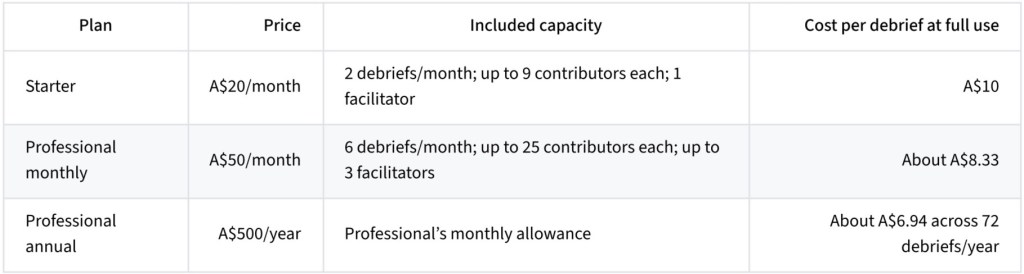
Annual Professional saves A$100 against 12 monthly payments, but its value depends on sustained use. Starter is the lower-commitment option for occasional reviews. Personal reviews are free.
Why the offer is worthwhile
The value is in the complete workflow- not just the AI-generated wording:
– Guided reflection collects context, strengths, improvement areas, learning and proposed actions, including owners and target dates.
– Contributors participate through a link without needing an account or the app.
– The facilitator receives consolidated themes rather than individual responses.
– Reports are drafted with AI, reviewed by a person and emailed as PDFs.
That combination gives customers a credible reason to pay instead of assembling a questionnaire, collecting responses and writing the report themselves. Whether it is better value than their existing process depends on how much preparation and synthesis it actually replaces.
Product Comparisons (19 Nov 2026)
- Candid Cycle’s free personal reviews
With Candid Cycle’s free personal reviews, you can work through a structured review of your own work, turn what you learn into actions, and export the completed review as a PDF – without a team subscription.
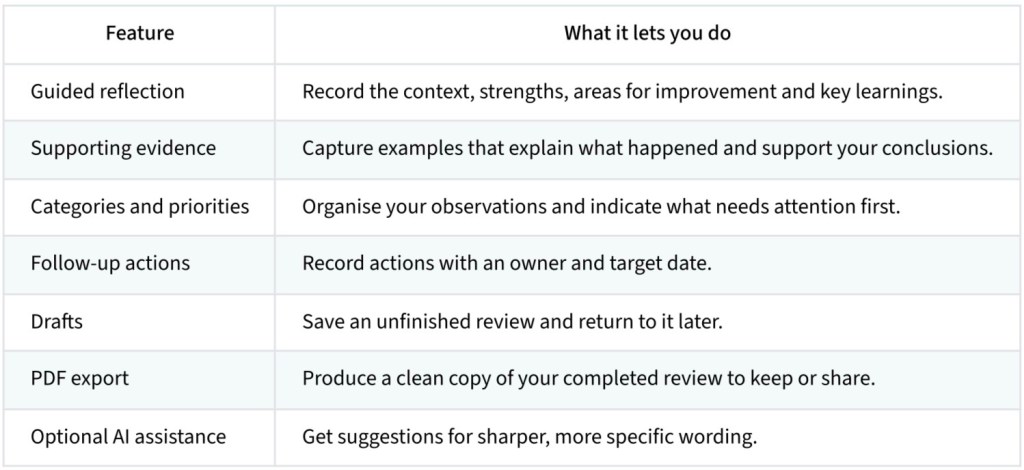
The structured workflow lends itself to:
- Reviewing a completed project or client assignment.
- Reflecting on a meeting, presentation or difficult piece of work.
- Recording lessons after an event or exercise.
- Preparing your own contribution to a performance or development conversation.
- Running a regular personal review of what to keep doing and what to change.
For example, after a client presentation, you could record that the recommendations landed well, note that the discussion ran over time, identify insufficient rehearsal as a contributing factor, and set an action to rehearse the next presentation against a timed agenda.
That illustrates the app’s context → reflection → learning → action structure.
The distinction is individual reflection versus a team feedback cycle:
- Free: you write your own review and export your completed personal-review PDF.
- Paid: you run a cycle that gathers anonymous contributions from other people and produces a consolidated report. That team report is drafted with AI, reviewed by a person and emailed as a PDF.
So the free version is useful in its own right – not merely a preview – but its personal PDF should not be confused with the paid, consolidated team report.
- Let a hundred flowers bloom
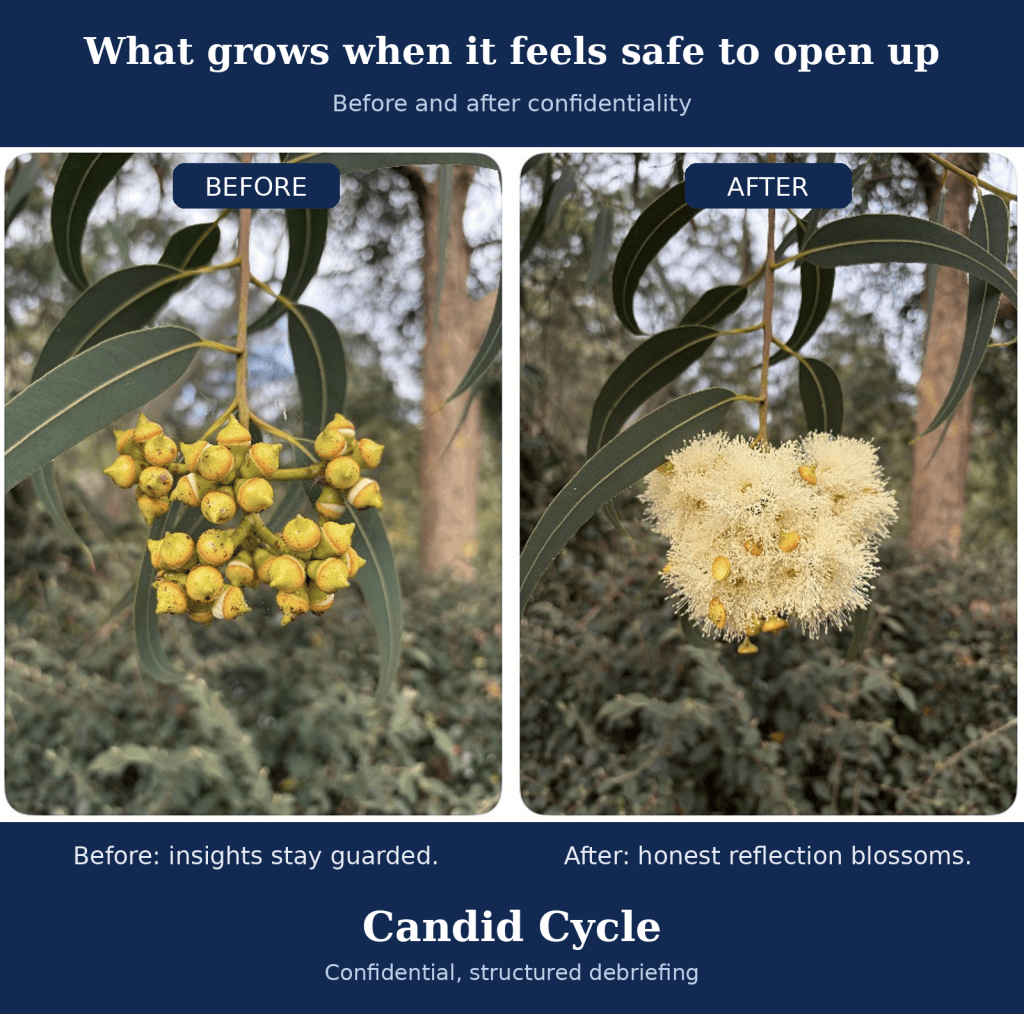
Photographs by Linda Blain Introductory background
“Let a hundred flowers bloom” is best known as a slogan promoted by Mao Zedong in 1956, encouraging diversity in the arts and intellectual debate in Communist China. Its fuller form is:
“Let a hundred flowers bloom; let a hundred schools of thought contend.”[1][2]
Its older roots
Mao did not invent the imagery from scratch. The phrase has roots in Chinese literary and intellectual traditions:
- “A hundred flowers bloom” is traced to the nineteenth-century Chinese novel Flowers in the Mirror, by Li Ruzhen, which includes an episode in which Empress Wu orders flowers to bloom simultaneously. The phrase was also used in Chinese theatrical reform in 1951, before becoming a broader political slogan.[1][3][4]
- “A hundred schools of thought contend” recalls the intellectual diversity of ancient China’s Spring and Autumn and Warring States periods, when competing philosophical schools debated how society should be governed.[1]
The two halves therefore joined an image of artistic flourishing with a tradition of intellectual competition.[1]
Why it has an uneasy historical meaning
During the Hundred Flowers Campaign, Mao’s government invited intellectuals to express their views and criticise Communist Party policies. After criticism gathered momentum in 1957, the government reversed course and launched the Anti-Rightist Campaign, persecuting many who had spoken out. Whether Mao intended the invitation as a trap from the outset remains disputed; the subsequent repression is not.[2][5][6]
Today, the expression commonly means “allow many different ideas or approaches to develop.” But its historical background gives it an ironic edge: an apparent invitation to openness followed by punishment for those who accepted it. The variant “let a thousand flowers bloom” is a common misquotation.[6]
Sources
[1] Mao Zedong’s Utopian Thought and the Post-Mao Imaginative Response (Chapter 15) – Perfect Worlds https://resolve.cambridge.org/core/books/abs/perfect-worlds/mao-zedongs-utopian-thought-and-the-postmao-imaginative-response/7D8CA83D05BE6026A794680FD283D15A
[2] Hundred Flowers Campaign | Mao Zedong, Cultural Revolution … https://www.britannica.com/event/Hundred-Flowers-Campaign
[3] A Hundred Flowers https://www.cambridge.org/core/services/aop-cambridge-core/content/view/EB6A92F083D7C3EF1AB728D00D734E82/9781009600538int_6-42.pdf/introduction_buds.pdf
[4] Hundred Flowers Campaign – Wikipedia https://en.wikipedia.org/wiki/Hundred_Flowers_Campaign
[5] Mao’s Hundred Flowers Campaign Begins | History – EBSCO https://www.ebsco.com/research-starters/history/maos-hundred-flowers-campaign-begins/
[6] Let A Thousand Flowers Bloom – Meaning & Origin Of The Phrase https://www.phrases.org.uk/meanings/226950.html
[7] 15 https://www.degruyterbrill.com/document/doi/10.1515/9789048514861-017/pdf?licenseType=open-access
[8] Let A Hundred Flowers Bloom — AP World Definition | Fiveable https://fiveable.me/ap-world/key-terms/let-a-hundred-flowers-bloom
[9] Mao Says: “Let A Thousand Flowers Bloom…” — Asian History … https://www.historycentral.com/asia/MaoSays.html
[10] The Hundred Flowers campaign – Alpha History https://alphahistory.com/chineserevolution/hundred-flowers-campaign/
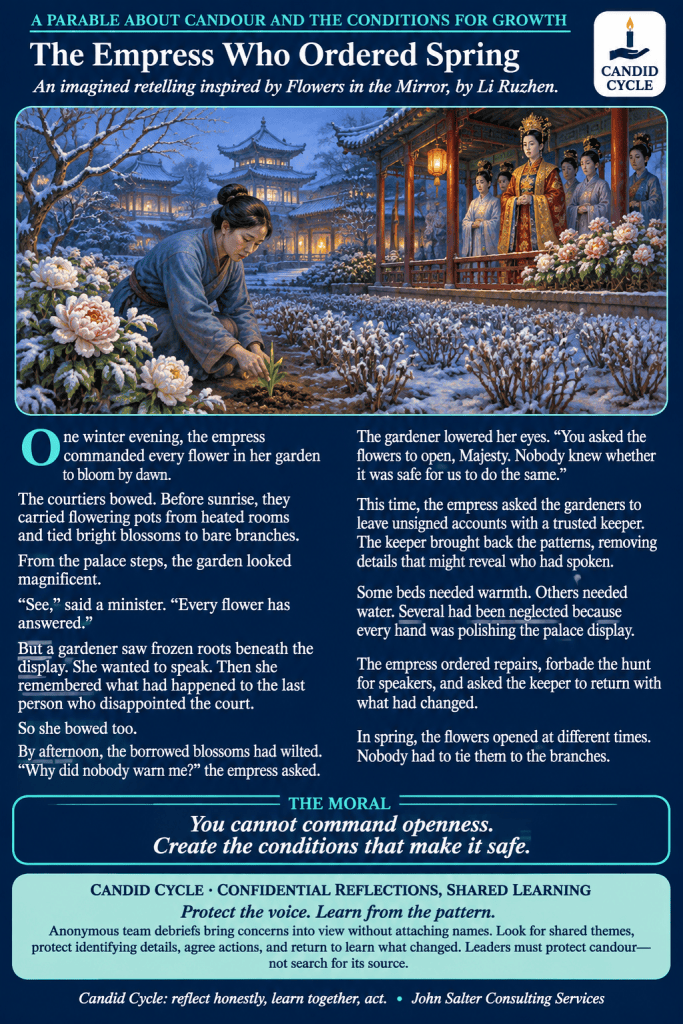
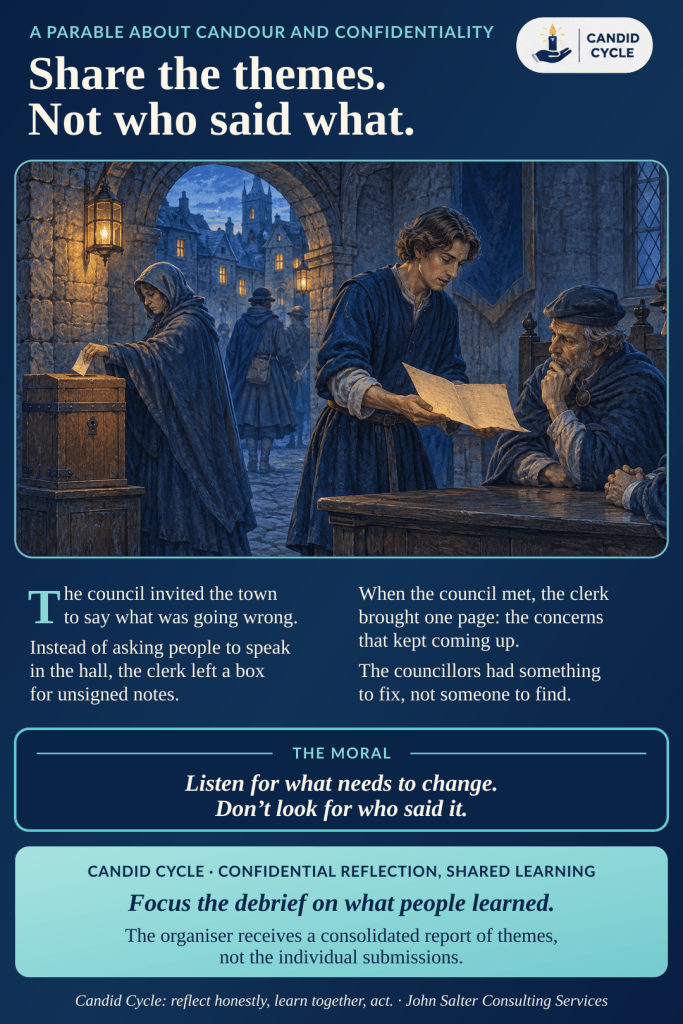
Candid Cycle protects people who offer candour by separating what they say from who said it. Its published design gives the person running a review a consolidated account of themes—not access to individual responses. That is a materially stronger safeguard than simply asking people to “speak freely”.[1]
How the protection works
- Anonymous participation. Contributors follow a shared link and do not need an account or the app. Responses are described as anonymous.[1]
- No individual responses for the organiser. The person running the cycle receives themes in a consolidated report, rather than participants’ separate submissions.[1]
- A minimum participation threshold. A report requires at least three contributions, providing a basic safeguard against a report exposing a single person’s feedback.[1]
- Identity protection in reporting. Reports exclude names and identifying roles. Quotations are labelled “Anonymised submission excerpt” rather than attributed to a contributor.[2]
- Themes rather than contributor profiles. Evidence is grouped by theme, not person, so readers can examine recurring issues without being presented with each participant’s account. A confidentiality statement appears at the front of every report.[2][3]
- Human review. The App Store description says reports are drafted with AI and reviewed by a person before delivery. It does not, however, specify the exact checks that reviewer performs.[1]
What those safeguards do—and do not—promise
The important distinction is between protecting identity in the review process and guaranteeing freedom from repercussions.
The published features support a clear claim: Candid Cycle is designed to prevent the organiser and report readers from directly attributing feedback to named participants. They do not establish that identification is impossible. A distinctive incident, recognisable wording or a very small team could still allow someone to infer the source; three contributions is a minimum threshold, not proof against deduction.
Nor does anonymity alone guarantee that leaders will respond constructively. The software’s confidentiality safeguards need to be matched by organisational conduct: no attempts to identify contributors, no retaliation, and a focus on addressing the issues rather than finding the speaker. Those are governance commitments, not technical guarantees.
The connection to “let a hundred flowers bloom” is therefore straightforward: inviting candour is not enough. Candid Cycle’s stated approach places structural limits on what the person issuing the invitation gets to see—sharing the learning while withholding individual responses and attribution.[1][2]
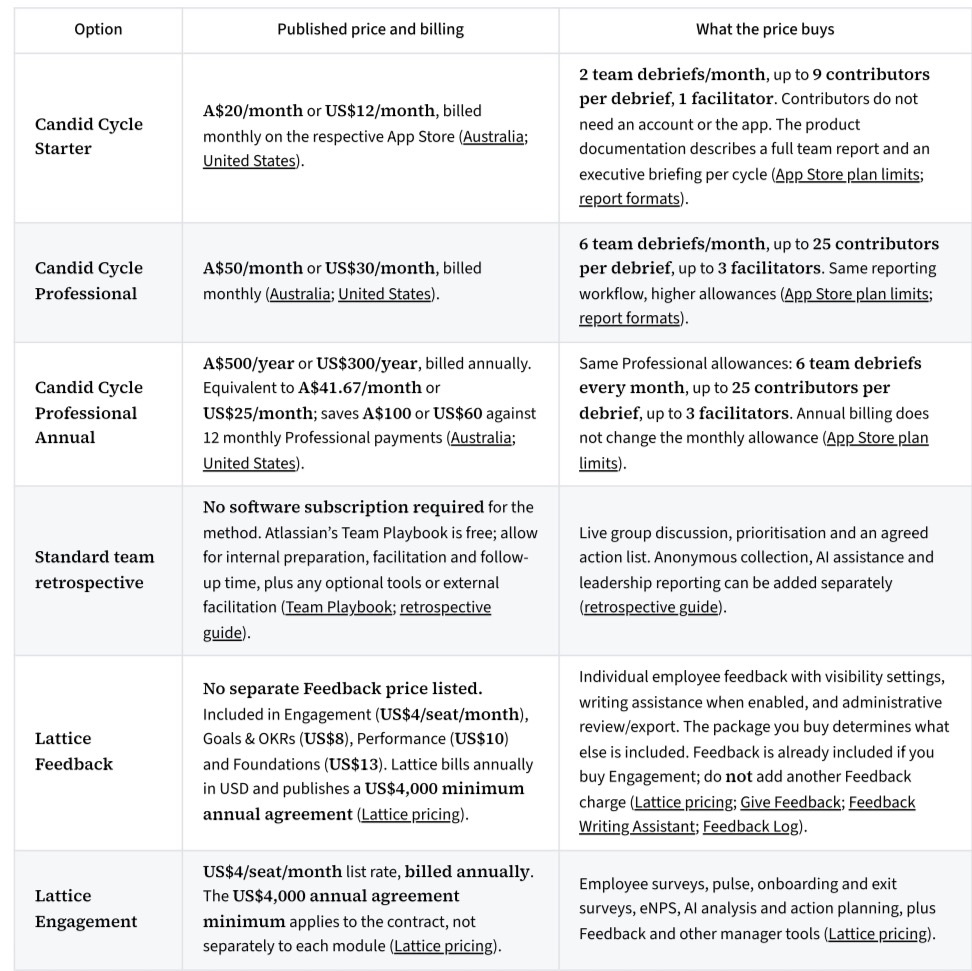
Candid Cycle comparison matrix
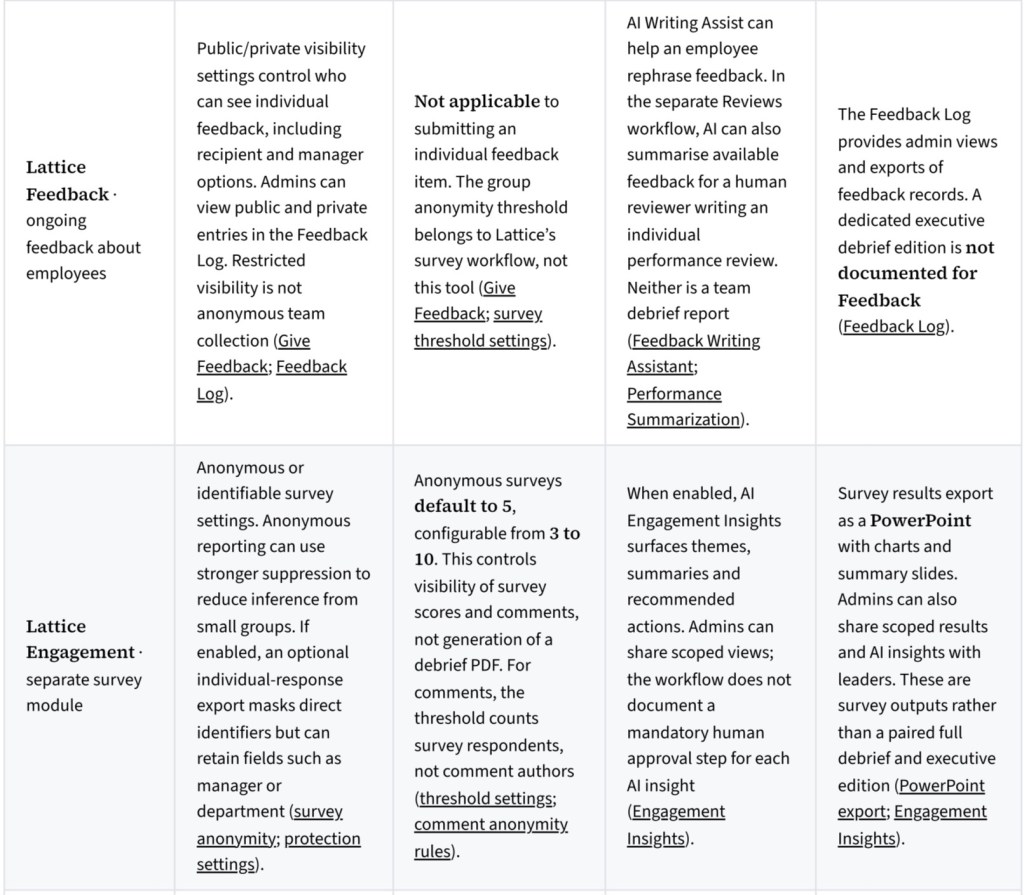
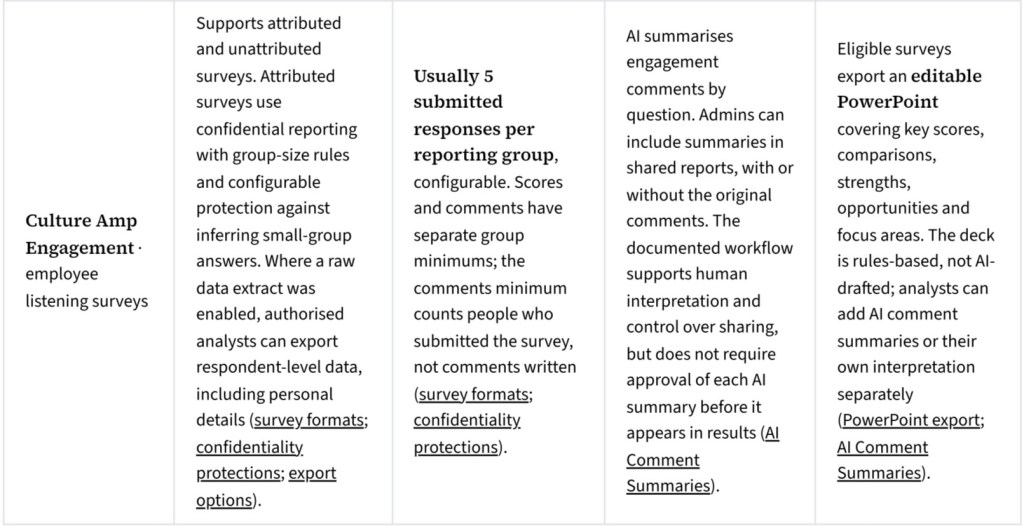
Compared on 19 November 2026. Candid Cycle is designed to turn confidential reflections about a specific piece of work into a debrief report and a shorter leadership briefing from the same analysis (Candid Cycle report formats). The alternatives solve different problems: facilitating a team conversation, giving feedback about an individual, or interpreting engagement survey results. Lattice Feedback and Lattice Engagement are shown separately so that survey features are not attributed to the Feedback tool.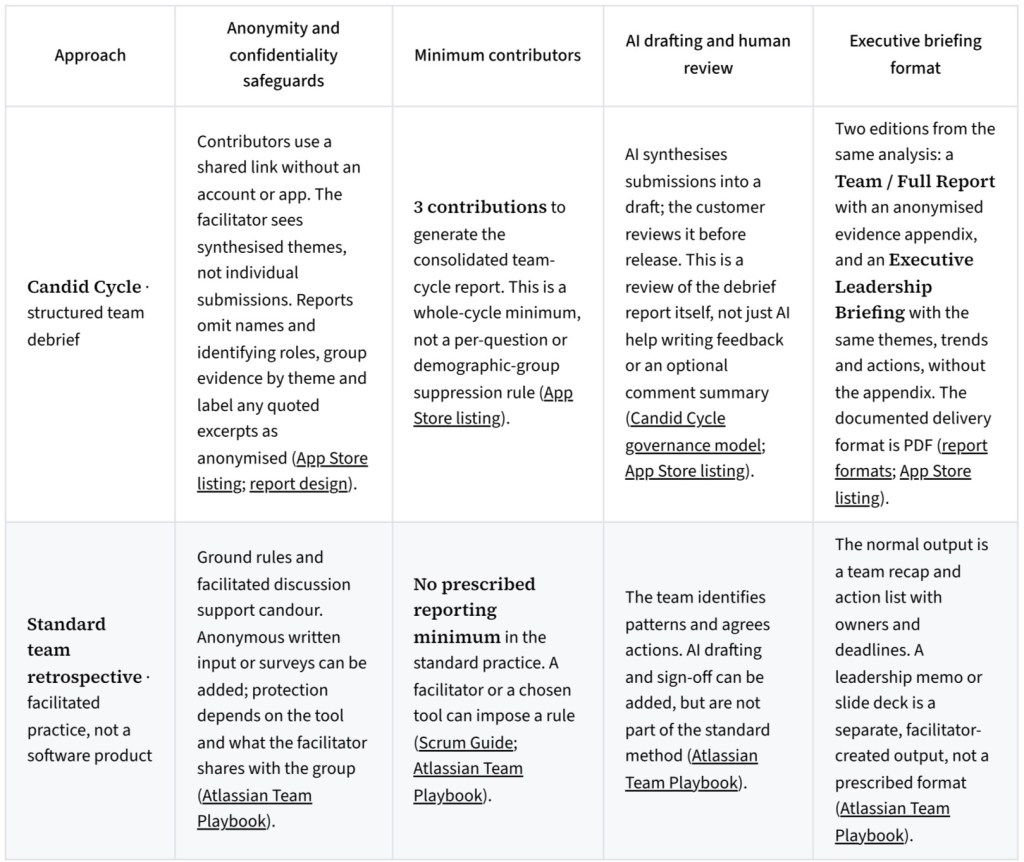
What the comparison means
• Candid Cycle’s strongest distinction: It combines confidential input about a specific event, project or period with a human-reviewed AI draft and two audience-specific outputs from the same analysis. The differentiator is this workflow, not anonymity, AI or leadership reporting in isolation (Candid Cycle report formats; Candid Cycle governance model).
• Thresholds are not like-for-like: Three contributions unlock a Candid Cycle report; survey thresholds suppress reporting where too few people responded in a group. Neither should be used alone to claim stronger privacy. For sensitive debriefs, consider inviting a wider group or omitting distinctive quotations and details if colleagues could infer who spoke (Candid Cycle App Store listing; Lattice protection settings; Culture Amp confidentiality protections).
• Choose by the job: Use a standard retrospective when the priority is live team discussion and agreement on what to change; use Lattice Feedback for ongoing feedback about individuals; use Culture Amp or Lattice Engagement when the job is tracking employee sentiment and comparing groups. Choose Candid Cycle when a specific piece of work needs a structured debrief that the team can act on and leadership can read separately (Atlassian Team Playbook; Lattice Feedback; Lattice Engagement Insights; Culture Amp survey presentation; Candid Cycle report formats).
“Not documented” means the reviewed public guidance did not specify the capability for that workflow. It does not rule out a custom process, integration or feature in another module.
Sources
[1] Candid Cycle App – App Store https://apple.co/4sGPrni
[2] Candid Cycle – John Salter Consulting Services https://disasterresilience.consulting/candid-cycle/
[3] The Candid Cycle Report – John Salter Consulting Services https://disasterresilience.consulting/2026/10/26/the-candid-cycle-report/
[4] Experts react to ‘Sandpapergate’ https://www.linkedin.com/news/story/experts-react-to-sandpapergate-9658922/
[5] Experts react to cricket’s ‘Sandpapergate’ https://www.linkedin.com/news/story/experts-react-to-crickets-sandpapergate-8921513/
[6] John Salter – Focused on Candid Reflections, Capability Assessment … https://www.linkedin.com/in/john-salter-8b60294
[7] How to Use Calibrate — Guidebook https://disasterresilience.consulting/wp-content/uploads/2026/11/calibrate-how-to-use-guidebook.pdf
[8] Candid Cycle App – App Store https://apps.apple.com/us/app/candid-cycle/id6780116127?itscg=30200&itsct=apps_box_link&mttnsubad=6780116127
[9] A landslide can hide weaknesses. https://disasterresilience.consulting/2026/11/06/a-landslide-can-hide-weaknesses/
[10] communication – John Salter Consulting Services https://disasterresilience.consulting/category/communication/
- Send Three and Fourpence
“Send reinforcements. We are going to advance.”
By the time the message reached the town hall, it read:
“Send three and fourpence. We are going to a dance.”That is the starting point for my latest Candid Cycle parable.
A river keeper sees water seeping through the northern bank and sends for help. The message passes from runner to carter to shepherd to boy. Each person repeats what they heard. Nobody checks what it means.
At the hall, the treasurer thinks it an odd time for a celebration, but he counts out the coins anyway. The clerk records the payment. The boy gets a receipt.
Everyone has done their job. And at the embankment, nobody comes.
It takes an apprentice, standing in the mud with a handful of useless coins, to ask a better question: “What do you need the town to understand?”
I see this pattern in organisations far more often than I would like. A warning is raised, then forwarded and summarised until it becomes something easier to process. Every team can show that it acted. None of them can show that it understood.
A message delivered is not necessarily a message understood. And a message understood is not yet action taken.
So, a question for leaders. When did you last check what your people actually heard, rather than just confirming that the message was sent?
Candid Cycle helps teams trace where the meaning was lost. Its anonymous debriefs capture what each person heard, assumed and did, so the team can agree what to change and then come back to see whether it worked.
Get Candid Cycle: apple.co/4sGPrni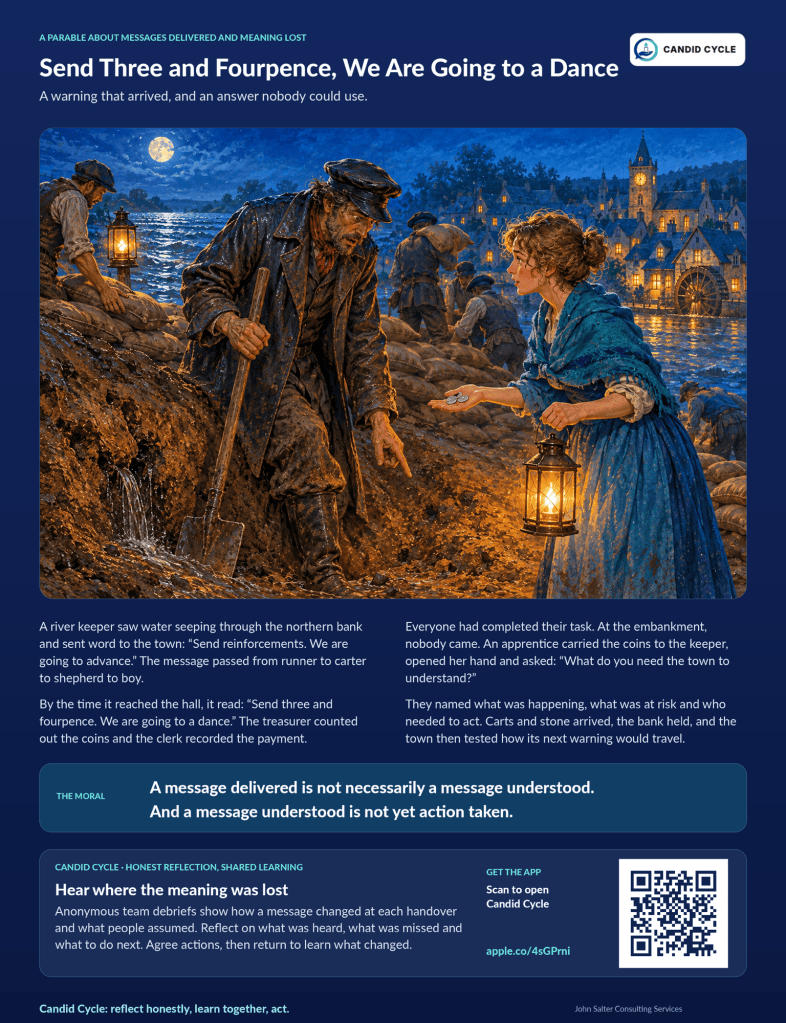
- The Town That Retired Its Watch
A parable about prevention, complacency and listening before hard-won gains are lost.
For twenty-six years, no great fire had swept through the town.
Above the council door hung a polished plaque: The Town That Defeated Fire.
At first, everyone remembered why. Chimneys were swept. Water barrels were filled. Neighbours practised raising the alarm.
But quiet years changed the conversation.
“Why keep paying for precautions?” asked a councillor. “Nothing ever happens.”
Gradually, inspections slipped and the night watch shrank.
The chimney sweep noticed blocked flues. The watchkeeper found empty barrels. Some households had begun saying that the precautions were more dangerous than the flames.
Each heard a different warning. Nobody brought the warnings together.
When smoke appeared in an outlying lane, the council called it an isolated incident.
Then another roof caught. And another.
At the public debrief, the watchkeeper placed an empty bucket beneath the plaque.
“We kept celebrating the result,” she said, “while abandoning the work that produced it.”
This time, the council asked every street what had changed, what prevented action and which warnings had gone unanswered.
They restored the rounds, helped households address the hazards and named who would do what next.
At each review, they returned to the same questions: Were the barrels filled? Had concerns been answered? What still needed attention?
The plaque stayed.
Beneath it, they hung the watch roster.
The moral
Yesterday’s success does not maintain itself.
Keep listening to the people who keep it safe.
Candid Cycle · Honest reflection, shared learning
Hear the warnings between the quiet years
Anonymous team debriefs bring scattered concerns into view. Explore what is working, what is weakening and what needs to change. Agree actions and responsibilities, then return to learn whether the safeguards—and people’s confidence in them—have improved.
Candid Cycle: reflect honestly, learn together, act.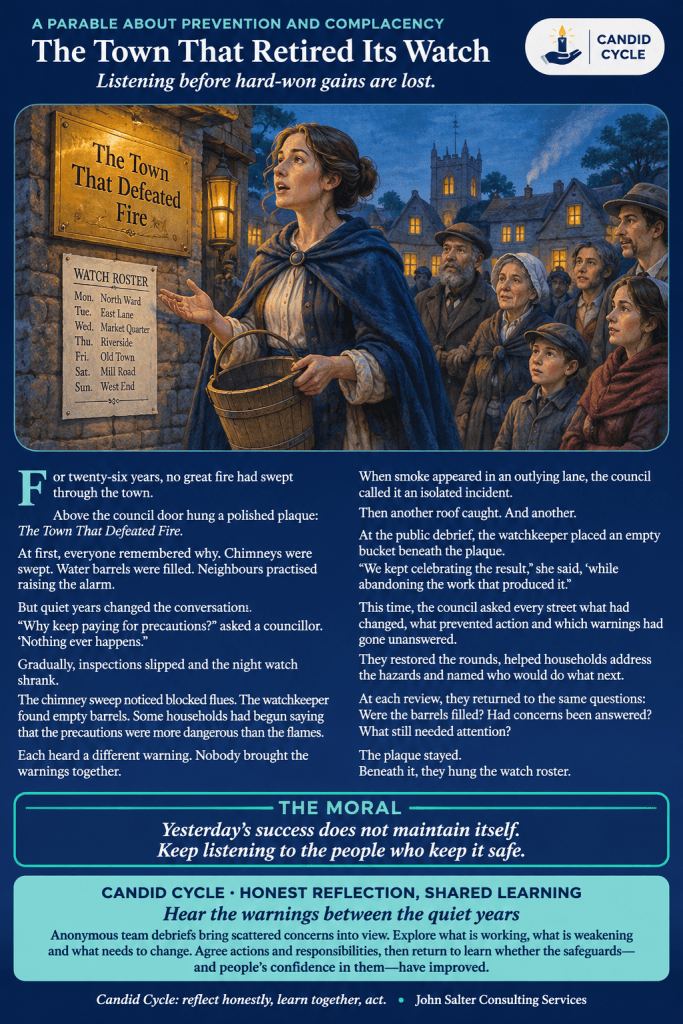
- The wall of ninety five stones
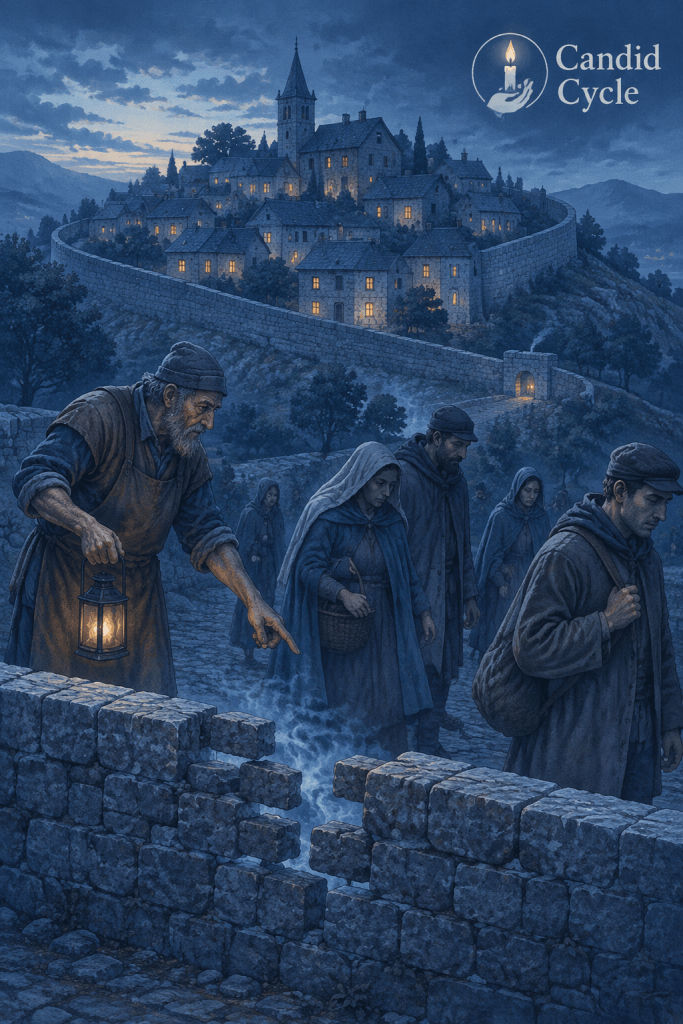
For a generation, the village of Ellenmoor was safe. Long ago a fever had swept through every winter, taking the youngest first, until the elders built a wall of a hundred stones around the village. The mist that carried the fever could not pass while ninety-five stones stood.
The wall worked so well that people forgot why it was there. Children grew up never having seen the fever. Some said the wall was old-fashioned. A few quietly took stones for their own gardens. Nobody kept count.
Martha, the stonemason, noticed first. Ninety-four stones. Then ninety-three. She mentioned it at the market, but the council was busy and the gaps seemed small. “We haven’t had the fever in twenty-six years,” they said. “Why worry now?”
That winter the mist found the gaps. It lingered in the lanes long after anyone had passed. The fever returned, and once again it took the youngest first. Afterwards, at the council meeting, people said the same thing in different words: “Someone should have told us.” Martha had. She had simply never been asked.The moral – A safeguard you stop counting is a safeguard you have already started to lose.
How Candid Cycle closes the gaps.
Reflect: Each person records, confidentially, what they saw, what worked and what worried them. Martha’s count is captured, not lost in a market conversation.
Review: Submissions come together in one place, so small warnings from many voices are seen as a pattern rather than dismissed one by one.
Analyse: Recurring themes surface, such as eroding protections, complacency after long success and the people closest to the work being unheard, and are turned into agreed priorities.
Act and iterate: Actions have owners and dates, and the next cycle checks whether the wall was actually rebuilt.
Open dialogue. Continuous improvement.
Download Candid Cycle on the App Store. - The Golden Caravan
A Candid Cycle parable about borrowed loyalty, silent stakeholders and the plan nobody asked to join.
In a land of old fairs, the finest performers had always travelled with the Guild Circuit. Its pay was modest, its rules were strict and its tents were patched, but its audiences were loyal.
Then a caravan appeared on the horizon, painted gold.
Its patron, a distant merchant prince, had filled its wagons with coin. The caravan’s ringmaster rode from town to town making offers no performer had ever heard.
“Join us,” he said, “and you will never count coins again.”
The acrobats came first, then the jugglers, then the famous fire-walker. Each was paid a fortune simply for signing. Each was given a banner of their own and told they would one day own a share of the caravan.
The Guild banned them from its fairs. Families of performers split. Old friends stopped speaking.
For a while the golden caravan dazzled. Its tents were larger, its music louder, its shows shorter and brighter. In some distant cities, crowds roared.
But in many towns the benches stayed half empty. The performers noticed. So did the wagon-drivers, the cooks and the ticket-sellers.
“Should we tell the ringmaster?” asked a young ticket-seller.“Why?” said the cook. “The prince sends another chest of coin every season. Nobody needs to listen while the chests keep coming.”
One spring, after the caravan’s most celebrated show, a messenger arrived from the prince’s palace.
The world beyond the mountains had changed. War had come to the prince’s lands. His treasurers had redrawn their plans.
“The prince will pay for this final season,” the messenger said. “After that, no more chests.”
The ringmaster stared at him. “Who decided this?”
“The palace.”
“Did anyone ask us?”
“No.”
That week, wages arrived late. Performers whispered in the wings. Strangers in dark coats, experts in closing failed enterprises, appeared at the ringmaster’s table.
The ringmaster refused to give up.
He rode to a lender in the city and returned with a plan he called the Second Caravan. It would be smaller. The season would be shorter. The prizes would be lower. In return, each performer would own a real share of the company.
“It is a sound plan,” the lender said. “I will fund it, provided your stars agree to perform.”
The ringmaster unrolled the plan before his performers.
The fire-walker read it in silence. Then she rolled it up and placed it on the table.
“For five seasons,” she said, “you asked us to sign. You never asked us what we needed. You never asked why the benches were empty, what we missed about the old fairs or what would make us stay when the coin was gone.”
“I am asking now,” said the ringmaster.
“Now you are asking us to stake our futures on a caravan we never helped to shape,” she replied. “We were paid to arrive. Nobody built a reason to remain.”
One by one, the stars declined. Some returned to the old fairs that would still have them. Others waited at the borders of towns that had not yet decided whether to forgive them.
Without the stars, the lender withdrew.The golden wagons were sold at auction that winter. The cook, the wagon-drivers and the ticket-sellers learned of it by notice.
On the last night, the young ticket-seller found the ringmaster alone in the empty tent.
“Did the coin fail us?” she asked.“The coin was the only voice we listened to,” he said. “When it went quiet, we discovered we had never heard anyone else.”
The moral
Loyalty you buy lasts only as long as the money. Commitment you earn begins with asking, and listening, before you need it.Candid Cycle · The voice – Ask before the patron leaves.
The golden caravan knew a great deal about its money and very little about its people. Performers, crews and ticket-sellers could all see the empty benches, but nobody had a safe, structured way to say so, and nobody was asked.
Candid Cycle makes that listening routine rather than reserved for a crisis.
• Debrief regularly, not just after failure. Ask what is working, what is not and what would make people stay.
• Include everyone whose commitment the plan depends on, including people at the edges of the organisation.
• Protect candour. People share early warnings when they trust that honesty will not cost them.
• Return after action. Show people what changed because they spoke, and check whether they experience the difference.By the time the ringmaster asked his performers what they thought, the answer was already written. Candid Cycle helps you ask while the answer can still change the outcome.
Research behind the parable
This is an original fictional parable. Its characters, dialogue and events are invented; it does not describe the private conversations, motives or views of any real person.
It was inspired by the collapse of LIV Golf, reported by The Athletic and other outlets.
• LIV launched in June 2022 with nine-figure signing bonuses to lure top players from the PGA Tour (Chicago Sun-Times).
• It was funded entirely by repeated instalments from Saudi Arabia’s Public Investment Fund, and the April 2026 decision to stop funding reportedly did not involve LIV management (GOLF.com).
• PIF invested about $5 billion in equity; LIV continually operated at a loss and was years from profitability (AP via NBC DFW).
• LIV filed for Chapter 11 on 8 September 2026 and proposed “LIV 2.0”, with a shorter schedule, reduced prize money and player equity (AFP).
• BC Partners Credit pledged $300 million, but players including Jon Rahm, Sergio Garcia, Tyrrell Hatton and Louis Oosthuizen were not interested (CBS News).
• LIV said no viable restructuring remained “due to lack of player participation and BC Partners’ termination of the Restructuring Support Agreement”, and it is moving to an orderly wind-down and liquidation (AP via NBC DFW).
- The King and the Silent Signal Towers
A fictional parable about inherited weaknesses, accountable leadership and the difference between restoring a system and recovering a service.

Across a prosperous kingdom, signal towers guided travellers through mountain passes. Each tower relayed messages to the next, telling gatekeepers when the road ahead was clear.
The network had grown under many kings. Some towers were new; others relied on mechanisms their keepers repaired with parts no longer made.
The present king promised to modernise them.
“Our roads will be the envy of every kingdom,” he declared.
One afternoon, while workers fitted a new mechanism in a distant tower, its bell began ringing without pause. Neighbouring towers relayed the signals until messages arrived faster than the keepers could distinguish them.
Some signals remained clear. Others could no longer be trusted.
The chief keeper ordered the departure gates closed.
Merchants protested. Carriages queued. But travellers already in the passes were guided safely to shelter.
For two days, the kingdom struggled to untangle the disruption.
At last, the king addressed the crowd.
“My predecessor left us these ancient towers,” he said. “You should ask him why your journeys were delayed.”
An old courier stepped forward.
“He should answer for what he neglected,” she replied. “But whose orders govern the towers today?”
The king summoned his council.
“Find who caused this.”
“We must establish that,” said the chief keeper. “But finding a person will not, by itself, make the network dependable.”
She placed three objects on the council table: an old gear, a new bell and a map.

“The gear may be worn. The bell may be faulty or wrongly fitted. The map may reveal how one tower’s trouble reached so many others. We must examine all three.”
They first gathered the people who had lived through the disruption: tower keepers, repairers, gatekeepers, couriers and those responsible for stranded travellers.
They asked what had happened, what had helped and what had made their work harder.
One keeper described signals that contradicted each other. A repairer explained where instructions had been unclear. A gatekeeper said she had known how to close her gate, but not who could authorise its reopening.
The chief keeper thanked the people who had stopped departures.
“Protecting travellers was not the mistake,” she said. “We must learn why that protection became necessary.”
Then an assessor examined the network.
She traced the backup routes rather than merely counting them. She checked how a faulty tower could be isolated, who could halt an upgrade and whether the previous arrangement could be restored.
She also examined the recovery plan.
“The bells are working again,” announced a minister. “Surely the trouble is over.”
The courier pointed through the window.
Horses were at the wrong staging posts. Drivers had exhausted their permitted hours. Travellers waited in towns where no onward carriage was available.
“The signal can return in a moment,” she said. “The journey cannot.”
The council assigned owners, resources and deadlines. Workers trialled changes in a limited part of the network before extending them. Keepers practised isolating a troublesome tower. Dispatchers rehearsed restoring journeys as well as reopening gates.
At the first exercise, a backup route failed.
This time, nobody called the exercise a failure. They repaired the weakness and tested again.
Months later, the king asked whether the kingdom could now promise uninterrupted travel.
“No,” said the chief keeper. “But we can show what we have tested, what remains vulnerable and who must act.”
“And what shall I tell the people about my predecessor?”
“Tell them what the evidence establishes,” she replied. “Then tell them what you are doing with the responsibility you inherited.”
The moral
You may inherit the weakness. You still own the response.
Restoring the signal is not the same as restoring the journey.
Candid Cycle · The voice
Hear beyond the royal explanation
Structured debriefs bring together what people experienced across the disruption: warnings, uncertainty, effective safeguards, workarounds and recovery difficulties. Those accounts identify questions to investigate; they do not, alone, establish the technical cause.
Return after action to learn whether people experience the intended improvement. This follows the voice-and-learning role used in your existing parables.[1][2]
Calibrate Capability · The evidence
Test the network, not just the new bell
Assess whether capability exists, is enabled and is executed across change control, fault isolation, backup arrangements, decision authority and service recovery. Examine evidence beyond the issues raised in debriefs.
Set targets, assign accountable owners and reassess demonstrated performance—not merely whether equipment was purchased or a plan was written. This preserves the distinct assessment role established in the series.[1][2]
Candid Cycle captures what your people know. Calibrate tests what your organisation can do.[1]
Research behind the parable
Three distinctions make this story more useful than a simple tale about blame.
- The protective decision is not confused with the underlying failure. The FAA says the network experienced instability, rather than a complete loss of all communications and radar. Its account states that some frequencies and radar feeds remained operational and that the ground stop protected safety while aircraft already airborne landed safely. The chief keeper therefore deserves scrutiny of readiness, but not condemnation merely for closing the gates.[3]
- A modern component is not the same as a resilient network. Officials associated the disruption with work transitioning telecommunications from copper to fibre and a surge of connection attempts; reporting also made clear that the precise initiating error remained under investigation. Reuters separately reported the FAA administrator’s warning that replacing copper alone would not prevent future outages without a modern telecommunications architecture. The old gear, new bell and map distinguish component condition, change execution and system design without pretending the investigation is settled.[4][5]
- Technical restoration and service recovery have different clocks. The supplied ABC report describes continuing cancellations and the need to reposition aircraft, crews and travellers after the ground stop. That becomes the courier’s observation that working bells do not put horses, drivers and passengers back where they belong. The report also supplies the political-blame theme, but the parable turns it into a broader question of stewardship rather than a claim that one administration alone caused the disruption.[6]
Author’s note
This is an original fictional parable inspired by the supplied ABC article and related reporting. Its characters, dialogue, assessment findings, exercises and outcomes are invented. The unclear instructions, unsuccessful backup exercise and other organisational weaknesses are questions the story explores—not findings asserted about the FAA or its contractors. The actual initiating cause and allocation of responsibility should remain matters for evidence and investigation.[4]
Sources
[3] Nationwide Ground Stop: Questions and Answers https://www.faa.gov/newsroom/nationwide-ground-stop-questions-and-answers
[4] FAA blames Friday’s ground stop on ‘equipment issue’ during telecoms network upgrade https://www.npr.org/2026/11/14/nx-s1-6040952/faa-ground-stop-airplane-travel
[5] US flight shutdown exposes deepening air traffic network crisis https://www.reuters.com/business/aerospace-defense/us-flight-shutdown-exposes-deepening-air-traffic-network-crisis-2026-11-14/
[6] Trump breaks silence after airline ground stop to blame Biden administration https://www.abc.net.au/news/2026-11-16/trump-breaks-silence-after-airline-ground-stop/107388942?utm_source=abc_news_app&utm_medium=content_shared&utm_campaign=abc_news_app&utm_content=link
[7] US government says wire replacement caused nationwide grounding of flights https://www.abc.net.au/news/2026-11-15/us-airlines-more-disruptions-ahead-of-thanksgiving/107386452
[8] Thousands of flights canceled as airlines work to recover from … https://www.inquirer.com/news/nation-world/ground-stop-nationwide-faa-flights-cancel-upgrade-blamed-sean-duffy-markwayne-mullin-20261114.html
[9] Live updates: FAA issues nationwide ground stop for all flights | CNN https://edition.cnn.com/2026/11/13/us/live-news/flights-ground-stop-faa?t=1794608105391
[10] FAA lifts nationwide ground stop after experiencing … https://www.nbcphiladelphia.com/news/transportation-and-transit/all-airports-ground-stopped-due-to-extraordinary-circumstances-faa-says/4497173/
[11] FAA says it has lifted nationwide ground stop that snarled airports https://www.detroitnews.com/story/news/nation/2026/11/13/faa-orders-nationwide-groundstop-at-us-airports-citing-safety/92765499007/
[12] FAA blames telecommunications issue for nationwide ground stop https://fedscoop.com/faa-nationwide-ground-stop-tech-telecommunications-issue/
[13] Legacy tech issue led to FAA’s nationwide ground stop https://www.nextgov.com/modernization/2026/11/legacy-tech-issue-led-faas-nationwide-ground-stop/417232/
[14] FAA issues nationwide ground stop citing ATC communication … https://www.cnbc.com/2026/11/13/faa-ground-stop.html?msockid=3879c168fa9b6c1d059ad978fb3b6dff
[15] Ground stop followed contractor upgrade to L3Harris … https://www.cnbc.com/2026/11/14/faa-ground-stop-flights-resume-delays.html
[16] FAA Issues Nationwide Ground Stop Across US Airports After … https://www.republicworld.com/world-news/faa-issues-nationwide-ground-stop-across-us-airports-after-communication-outage-thousands-of-flights-disrupted-2026-11-14-141048
[17] ‘Extremely Frustrating’: Aviation Experts Explain Why System Worked and Didn’t Work in Ground Stop https://ground.news/article/ground-stop-highlights-chronic-vulnerabilities-in-air-traffic-system
[18] Critical Network Outages: Why Isn’t Redundancy Working? Part I. https://techblog.comsoc.org/2026/11/13/critical-network-outages-why-isnt-redundancy-working-part-i/ - Who Watches, Who Questions, Who Acts?
Three parables about power and accountability
A watchtower stands above the trading house. A golden seal rests on the council table. A warning bell hangs in the courtyard.
Each looks like a safeguard. But what happens when the watcher cannot see the back gate, the council never refuses a proposal, and nobody takes responsibility when the bell rings?
These three parables explore the gap between having the appearance of oversight and making it work:
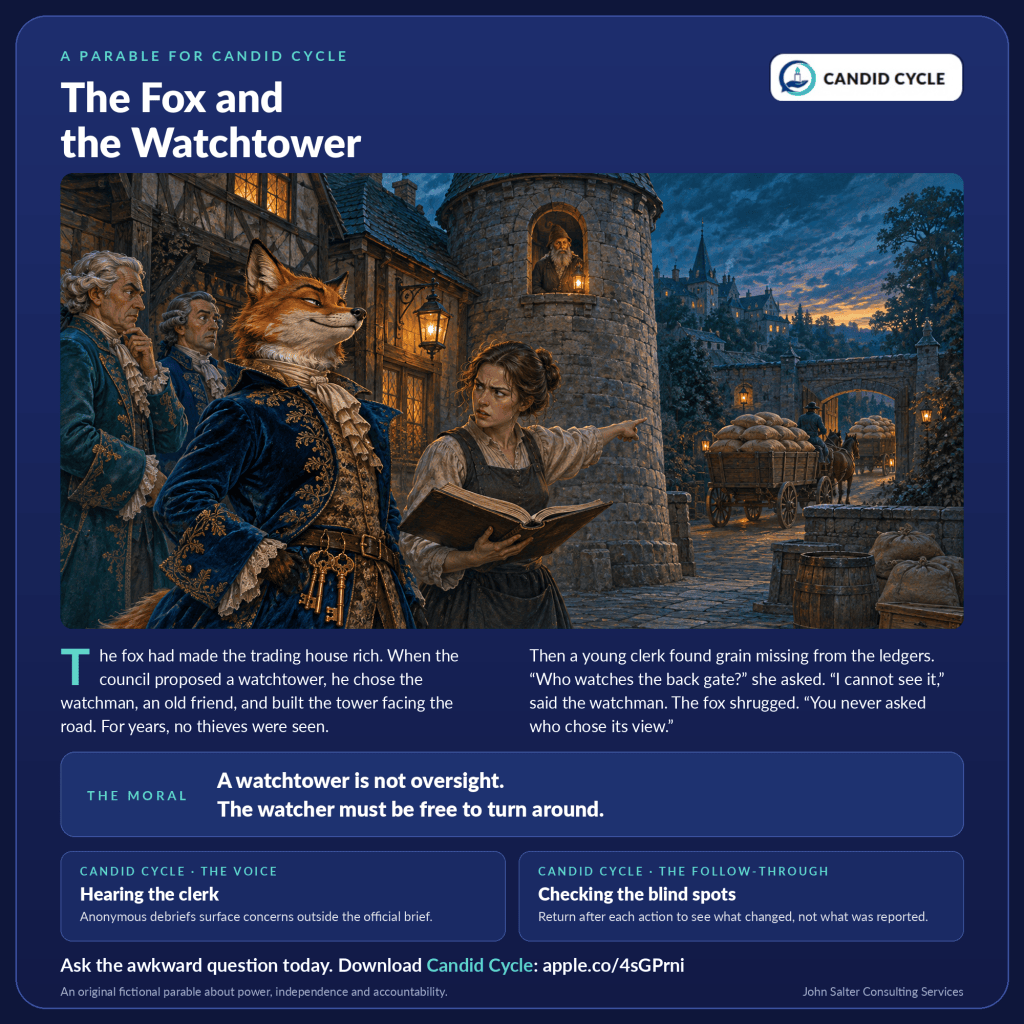
- The Fox and the Watchtower asks who decides what scrutiny is allowed to see.
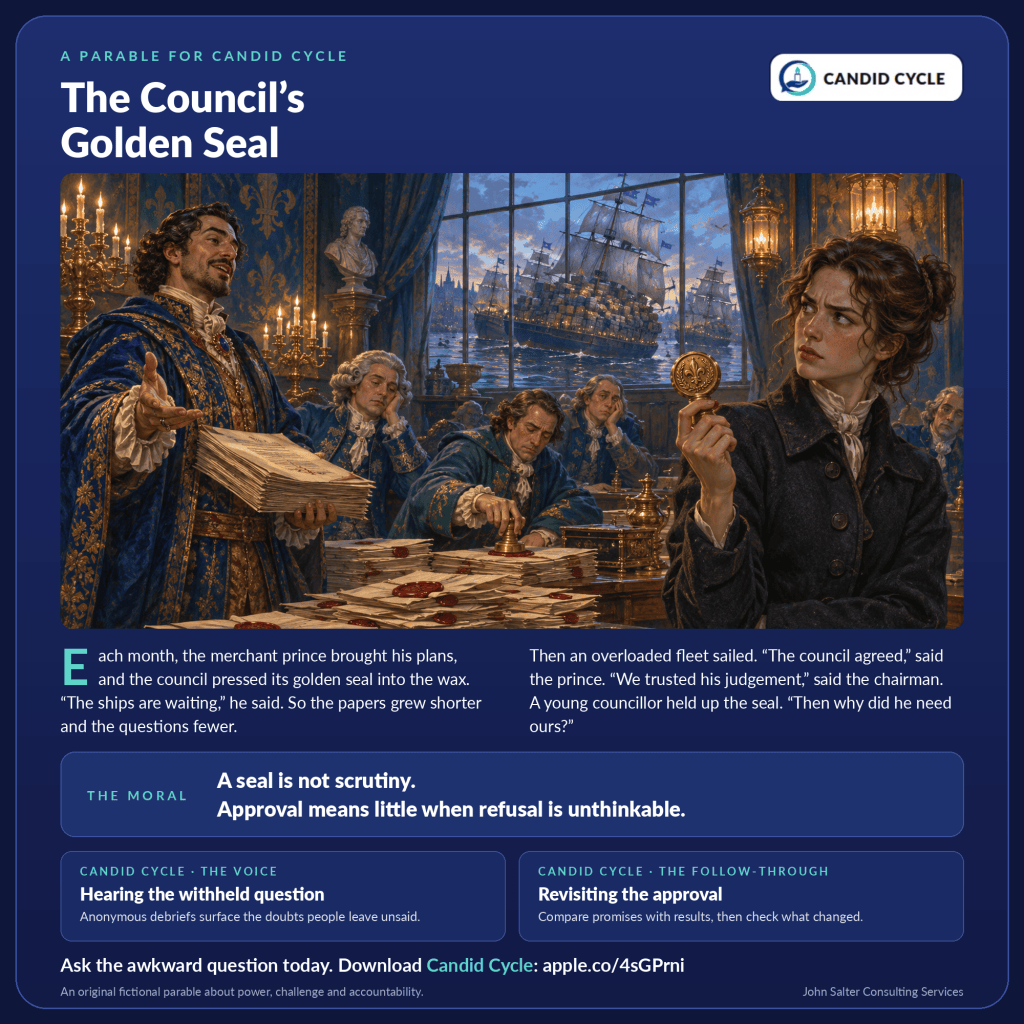
- The Council’s Golden Seal asks whether approval means anything when challenge is unwelcome.
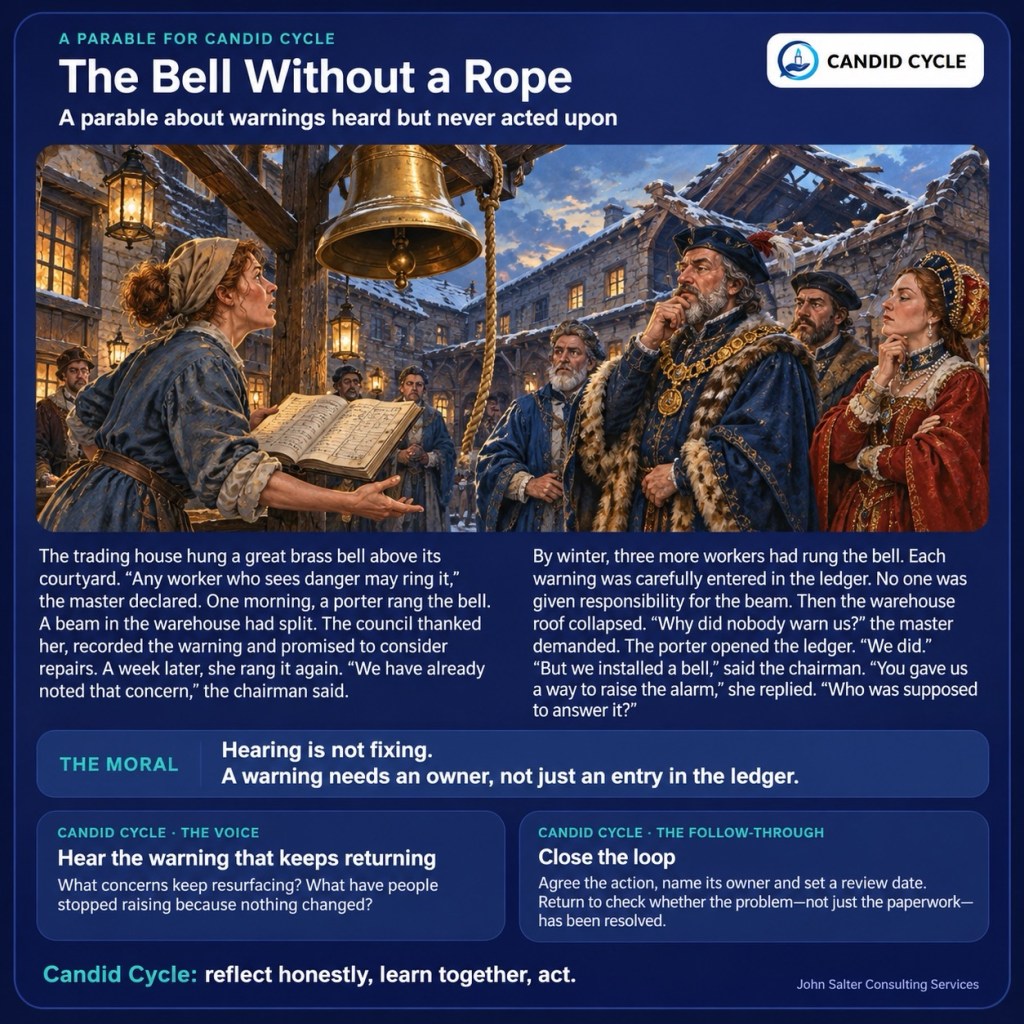
- The Bell Without a Rope asks what speaking up achieves when nobody acts.
Together, they pose three questions: Are we looking in the right places? Can we genuinely challenge a decision? And who will make sure something changes?
That is the thread connecting these stories to Candid Cycle: reflect honestly, learn together, and turn what is heard into action.
- Not a silver bullet but …
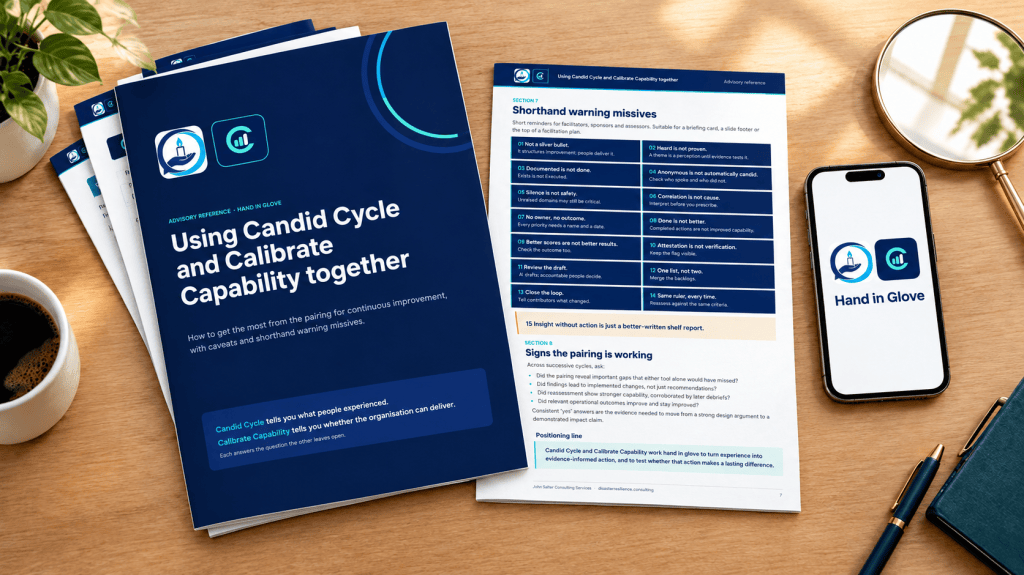
In Hand in Glove I described how Candid Cycle and Calibrate Capability fit together. Candid Cycle tells you what people experienced. Calibrate Capability tells you whether the organisation can actually deliver. Each answers the question the other leaves open.
That raises a fair question: is the pairing a silver bullet for continuous improvement? The answer is no. But it can still do something useful.
What the pairing does well
Its real strength is joining two things that usually sit apart. Organisational learning asks “What did we learn?” Capability assurance asks “What can we demonstrate?” The pairing connects them, and keeps them connected over time.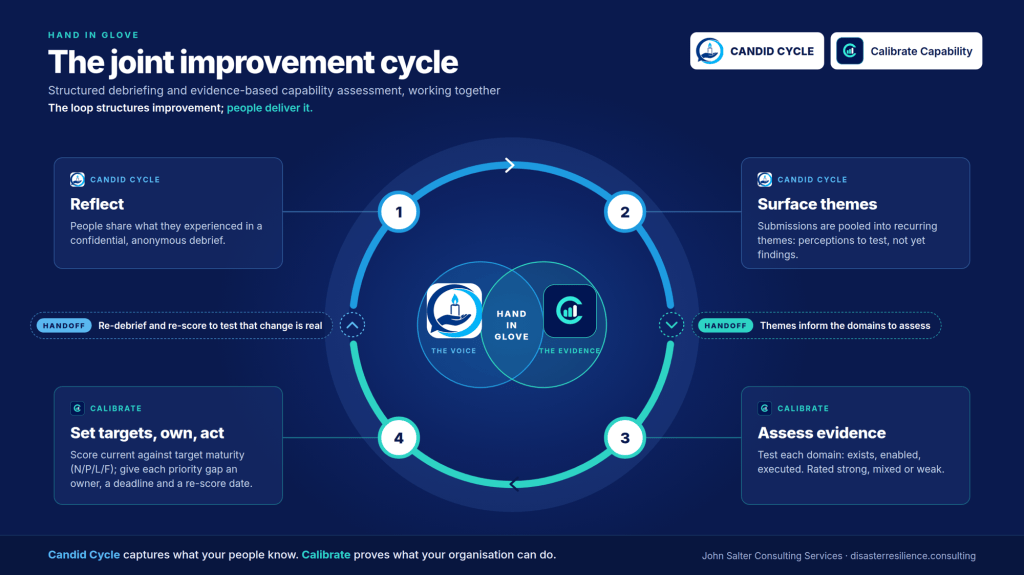
In practice:
• Themes inform the scope. The assessment starts from what people raised, not from leadership’s assumptions.
• Perceptions get tested. A debrief theme is checked against documents, practice and outcomes.
• Evidence gets context. A weak rating shows where a gap is; the reflections help explain why.
• Change gets checked twice. A re-score shows whether capability has improved; a fresh debrief shows whether people feel the difference.Why it isn’t a silver bullet
The loop is reflect, surface themes, assess evidence, set targets and act, then repeat. The word that matters most is “act”. Every other stage produces insight. Only that stage produces change, and software can support it but cannot carry it out.Fifteen shorthand warnings
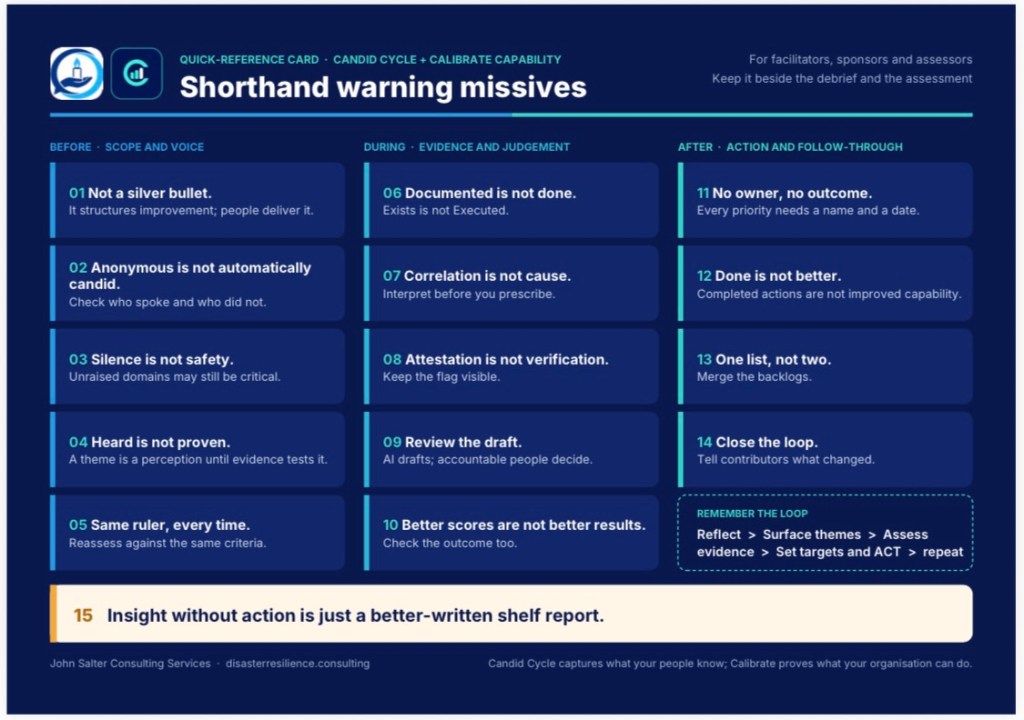
The pairing can also be weakened by:
• Shared blind spots, when the same people frame the questions, supply the evidence and judge the results.
• Missing voices. Anonymity supports candour; it does not guarantee it.
• Hasty interpretation. “Decisions took too long” has more than one possible cause.
• Narrow coverage. A critical capability may never come up in a debrief simply because it hasn’t been tested recently.
• No capacity to act. The tools don’t supply budget, authority, time or skills.
• Mistaking scores for results. A completed action is not improved capability, and improved capability is not yet a better outcome.So, not a silver bullet but …
… a disciplined way to turn experience into evidence-informed action, and to test whether that action makes a lasting difference. It works best when findings are tested rather than simply recorded, and when every priority has an owner, a deadline and a re-score date.
Free download
Using Candid Cycle and Calibrate Capability together, an eight-page advisory reference covering when to use each tool, ten practice principles, caveats and signs the pairing is working.
Thinking of running the pairing in your organisation?

Book a conversation
or email johnsalter@me.com