Two people share one line of communication. Three people share three. Five people share ten. By the time a team reaches ten, there are 45 separate lines, and at fourteen there are 91. Headcount grows steadily; the number of conversations grows far faster.
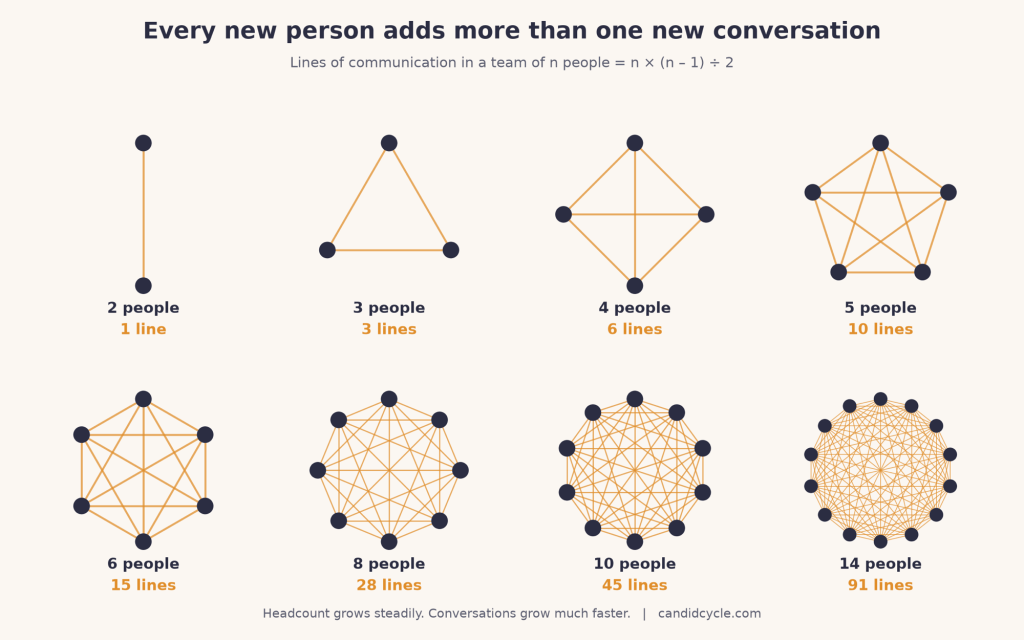
This is why small teams so often feel quick, close and candid, and why larger groups can feel slow, noisy and guarded, even when everyone is acting in good faith.
Why more people means more friction.
In digital networks, more connections are a good thing. Metcalfe’s law suggests a network’s value rises roughly with the square of the number of connected users. Every new phone on the network makes every other phone more useful.
People are not phones. Each line in a human network carries more than information. It carries trust, history, tone, assumptions and unspoken expectations. Research associated with Robin Dunbar suggests we can hold only a handful of very close relationships (around five) and a slightly wider circle of perhaps fifteen. Beyond that, our capacity to keep every relationship clear and current begins to strain.
Organisations have long tried to manage this with structure. Hierarchies, and the middle manager in particular, were partly designed to reduce the “transaction costs” of communicating, coordinating and agreeing. Many practitioners find the sweet spot for a working team is around five or six people.
But structure has a cost of its own. Every layer that filters information can also soften it, delay it, or quietly remove the uncomfortable parts.
The real problem is not volume. It is candour. When communication strains, the first casualty is rarely the routine update. It is the honest observation:
• “That handover didn’t work, and I think we all knew it.”
• “I didn’t raise the risk because I wasn’t sure it was my place.”
• “We keep saying we’ll fix this, and we never do.”
In a team of five, these things are often said over coffee. In a team of fifty, spread across several layers, they are often never said at all, or they surface only after something has gone wrong.
More lines of communication do not automatically produce more insight. Frequently they produce more noise and less candour.
Where Candid Cycle fits
Candid Cycle is structured debriefing software designed to capture what people genuinely experienced, then turn individual reflections into shared understanding.
Rather than adding yet another channel to an already crowded network, it gives the team one clear, safe line to the truth.
- One structured line instead of dozens of informal ones
You cannot hold 45 or 91 honest one-to-one conversations after every project, event or incident. Candid Cycle lets everyone respond to the same structured questions at the same time. Every voice enters through a single, consistent channel, so nothing depends on who happened to talk to whom. - Anonymity that lowers the cost of honesty
The hardest observations are often the most valuable. Anonymous debriefs remove much of the social risk of speaking up, particularly for newer or quieter team members, and for anyone reporting up through a hierarchy. People can comment on the process without feeling they are accusing a colleague. - Themes rather than anecdotes
When many people contribute, individual comments can easily be lost or dismissed. Candid Cycle helps bring recurring themes to the surface. A concern raised by one person may be an outlier; the same concern raised by eight people is a signal. Leaders see patterns, not just the loudest opinions.