
Every organisation sees itself through a lens. The question is whether it can recognise what that lens leaves out – and across which domains.
A rhinoceros stood every evening on the edge of the savanna with an easel, a palette and a great sense of purpose.
He loved to paint the landscape: the gold of the grass, the distant hills, the flat-topped acacias, the red sun sinking into the horizon. When he had finished, he invited the other animals to admire his work.
“Magnificent,” said the zebra.
“Very true to life,” said the wildebeest.
“Such a clear picture of the savanna,” said the warthog.
The rhinoceros beamed.
Yet every painting contained the same curious feature: a large, pale triangle stood in the middle of the scene. It rose from the foreground, cutting through trees, grasslands, rivers and sunsets alike.
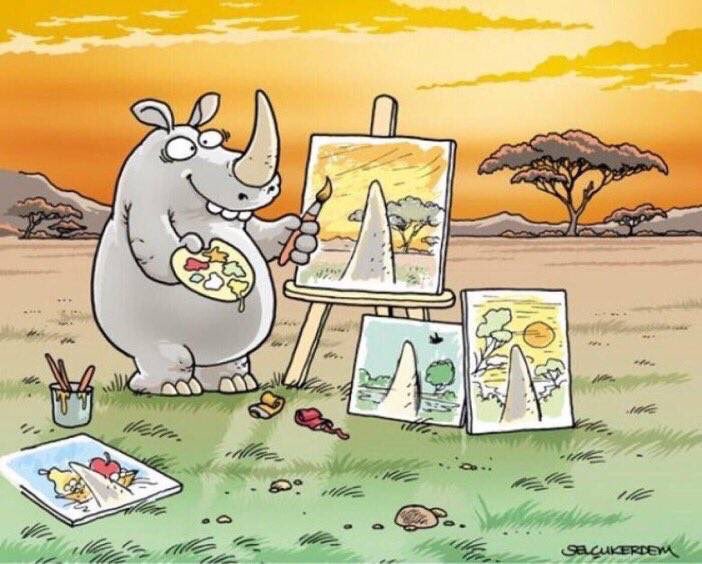
One day, an elephant studied the latest canvas for a long time.
“Rhino,” she said gently, “that is not a hill.”
“Of course it is,” replied the rhino. “I see it every time I paint.”
“It is your horn,” said the elephant.
The rhinoceros laughed. From where he stood, his horn was always there: large, familiar and impossible to ignore. Because it had always been in his line of sight, he had stopped seeing it as an obstruction. He had begun to mistake it for part of the landscape.
One Painting, Seven Missing Views
The heron, who had been circling above, landed beside the easel.
“You keep painting the same triangle,” she said, “because you only ever look from one place, in one direction. What if you painted seven views of the savanna instead of one?”
The rhino was doubtful, but he listened as the animals described what each of them could see that he could not.
The elephant described the strategy of the herd – where the migration was heading, and why. The zebra described the quality of decisions made at the water’s edge, when predators were near and there was no time to deliberate. The heron, from above, described risk and resilience – the flood plains that looked safe from the ground but flooded every wet season. The warthog described execution and control – the burrows and root systems that either held firm or gave way underfoot. The lion described leadership of the pride – who actually got followed when danger came, regardless of who held the title. The tortoise, who had outlived them all, described learning and improvement – the patterns that repeated because no one had written them down. And the old baobab, rooted at the centre of the plain for a hundred years, represented governance and accountability – the one who could say, with evidence, whether all the other six views actually held together.
Seven views. One triangle had never shown any of them.
Painting With Evidence, Not Just Confidence
The rhino wanted to argue that his single painting had already captured the savanna. But the animals asked him a harder question, one domain at a time:
- Does this actually exist – is there a real path, a real plan, a real arrangement? (E1)
- Is it enabled – does it have what it needs to function: resources, authority, information, people who know their role? (E2)
- Is it executed – has it actually worked, been tested, been used under real pressure, not just described on paper? (E3)
The rhino realised his triangle had never been tested against any of these three questions. It was simply what he saw, repeated with confidence.
So the animals gathered evidence, domain by domain, and rated what they found: None, Partial, Limited, or Full. Some domains – like the warthog’s execution and control – turned out to be strong: well tested, reliably repeated. Others – like the baobab’s governance – existed on paper but had barely been exercised. The picture that emerged was not one triangle but seven honest panels, each showing where the herd genuinely stood.
The Moral
We all see the world through subjective lenses: our roles, incentives, habits and past successes. These lenses are not inherently bad – the rhino’s horn protected him and helped him survive. But a single, familiar vantage point can never show all seven domains that determine whether a herd, or an organisation, is truly capable.
“Not seeing something is not the same as it not being there.”
Confidence is easy to paint. Capability – demonstrated with evidence, across every domain that matters – is harder, and far more valuable.
See Your Own Seven Domains Clearly
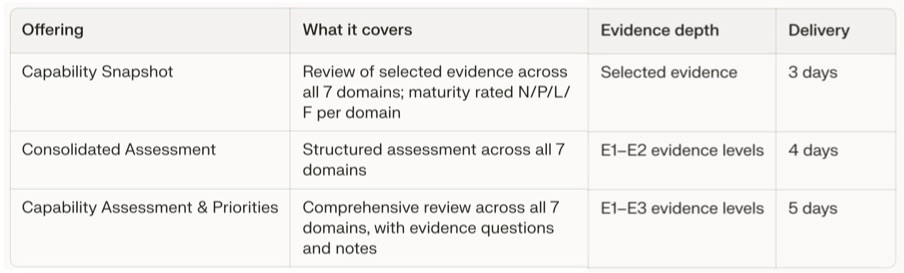
If your organisation’s picture of itself has been painted from one vantage point for too long, the Universal Framework offers a structured way to look again – across the same seven domains the animals uncovered together: Strategy \& Direction, Decision-Making Quality, Risk \& Resilience, Execution \& Control, People Leadership, Learning \& Improvement, and Governance \& Accountability. Every engagement, regardless of scope, is assessed against the same E1 (Exists) / E2 (Enabled) / E3 (Executed) evidence logic – so the result reflects what can be demonstrated, not just what is believed.
Three ways to start:
The rhino didn’t become wiser because he stopped having a horn. He became wiser because he finally saw all seven views – and could show what was true, not just what he assumed.
How capable are you, really – across all seven domains?


