How suitable is the Operational Resilience Capability Assessment Framework? Very. Read More
Category: decision making
Business Continuity Review Document Checklist for Clients
Selecting the right paperwork to achieve an appropriate capability assessment review. Read More
Management Capability Assessment Report
A Capability Assessment of some value – but limited by publicly available information. Read More

Is Resilience Core?
“Can we demonstrate, with evidence, that our most important services will remain within acceptable limits during severe but plausible disruption?” Read More
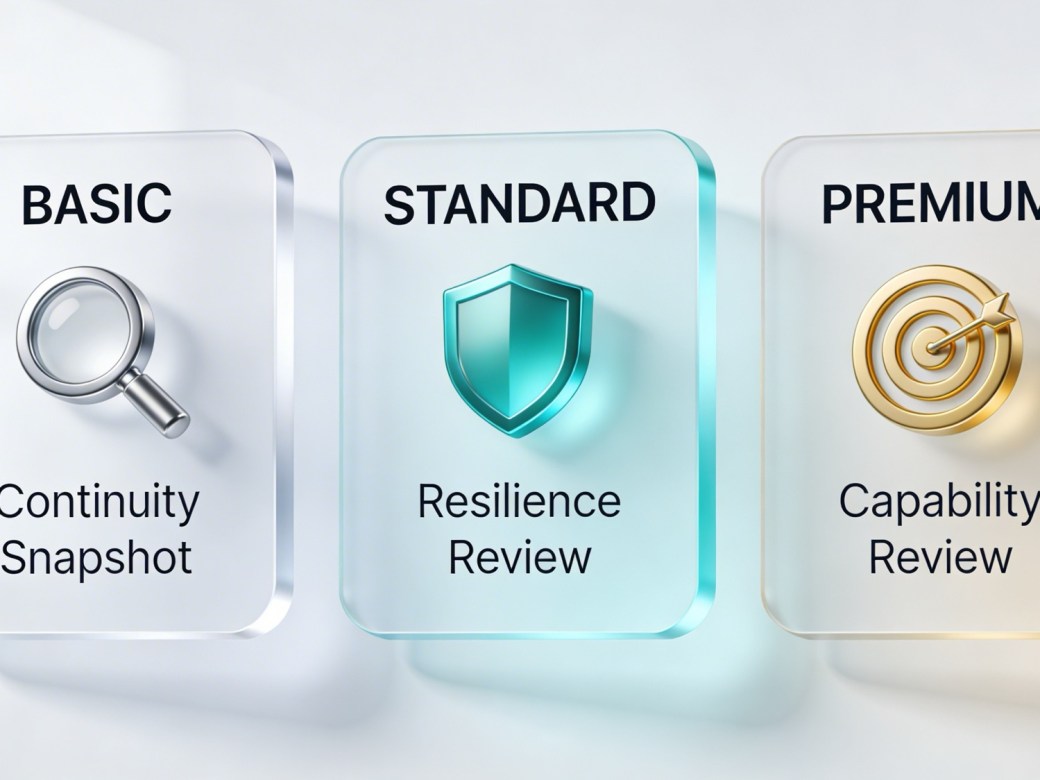
Standard Continuity & Resilience Review
An example Executive Summary of a Business Continuity Resilience Review by John Salter Read More
A necessary and sufficient BCM/resilience “evidence set”
When commissioned to review a client’s continuity and resilience capabilities I am nearly always asked – “What documentation do you need to review?” You can reflect on my response below: “Minimum Viable” set to request client to consider BCM minimum evidence set: policy & framework, risk register with BCM risks and latest assessment, approved BIAs,… Read More
Necessary and Sufficient Evidence (Consolidated Framework)
For each domain, “necessary and sufficient” evidence means: the minimum concrete artefacts and observations that prove the criterion is in place (E1), enabled (E2), and working in practice (E3). Below is a concise, practical set of examples. 1. Context, Scope, Stakeholders & Strategy 2. Leadership, Governance, Culture & Accountability 3. Integrated Risk & Opportunity Management… Read More
“Necessary and Sufficient” Resilience Evidence
You can treat “necessary and sufficient” at each level as (a) existence of defined artefacts (E1), (b) evidence of use and quality (E2), and (c) evidence that use is routine, linked to other systems, and self‑reinforcing (E3) across all seven domains.[1] Below are concise criteria you can use as an assessment rubric. 1. BCM Program… Read More
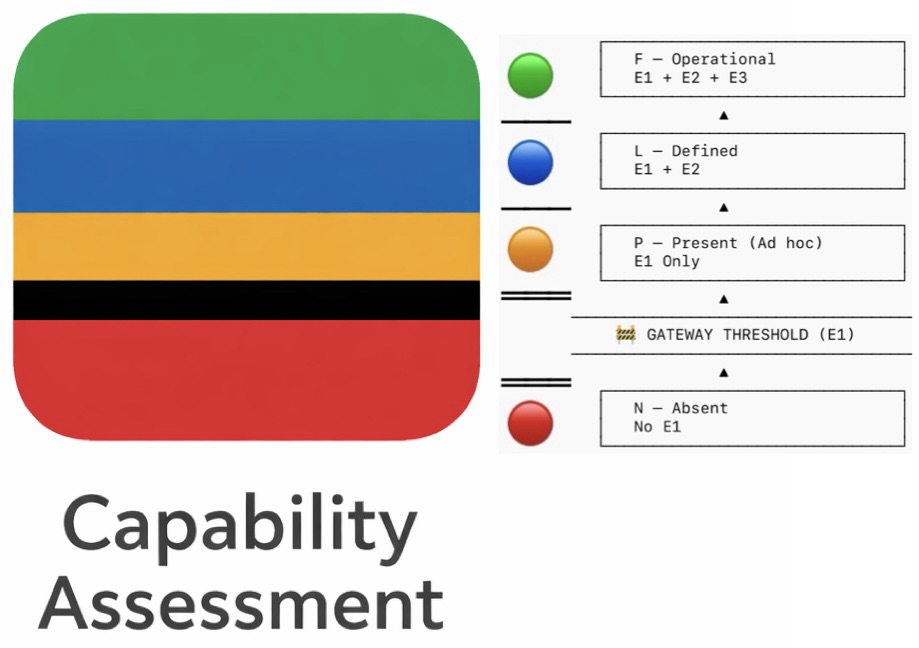
Executive Brief – “How ya going?”
An example Capability Assessment across three sites and 11 management domains Read More
What does “Exercise Convergence” mean for you?
Exercise Convergence was a recent national preparedness exercise designed to test Australia’s ability to manage extreme to catastrophic, overlapping crises through coordinated action across governments, emergency services, industry, charities, and critical infrastructure partners. The exercise examined how concurrent disruptions such as severe weather, fire, flooding, fuel shortages, health impacts, power outages, supply chain failures, and… Read More
Yes, of course … but what is the right question?
Asking the right questions: what great thinkers teach leaders about inquiry Voltaire once wrote, “Judge a man by his questions rather than by his answers.” That single line turns a lot of conventional leadership wisdom on its head. We are used to celebrating the leader with the confident answer, the bold solution, the decisive verdict.… Read More
Maps that matter
Some maps show a difference – some maps make a difference. Read More

Capability Assessment and Organisational Debriefing
Our niche consulting services strengthen capability before disruption and turn organisational debriefing into practical improvements. Read More
Shoring up the ship
Most organisations respond to a drop in performance the same way: tighten targets, add new dashboards, reshuffle roles, and ask people to try harder. For a quarter or two, the numbers might improve. Then the leaks return, often in exactly the same places. Some leaders stand on the bridge of the ship, staring at the… Read More
War, Interconnection, and the Hidden Weaknesses in Your Operating Model
War has a way of exposing vulnerabilities that arise from interconnection. Inside organisations, conflict acts like an extreme stress test: it doesn’t create fragility from nowhere, it reveals weaknesses already baked into operating models, supply chains, and decision‑making rhythms. The question for leaders is not whether those vulnerabilities exist, but how consciously they have been… Read More
What’s for breakfast?
A significant, prolonged oil shortage would not usually mean these foods disappear, but it would very likely mean patchy availability, higher prices, and less choice, especially for imported or processed items.[1][2][3][4][5] What an oil shortage affects Oil underpins food via three main links: farm production (diesel for tractors, fertiliser), processing and refrigeration (electricity, packaging inputs),… Read More
Operational Resilience and Continuity – without the drama
Our consulting offer for vulnerable times. The gap most mid-sized firms face Most firms have bits and pieces of business continuity, risk, and IT/DR work, but too often: Plans are outdated or don’t match how operations actually run today. • Operations, IT, risk, and suppliers each see their own slice – no one owns the… Read More
Will ISO 9001 have “a place at the table” in 2026?
Given ISO 9001:2026 will incorporate extra depth for leadership, culture, risk–opportunity, digital and climate themes, how popular is the domain model (below) likely to be with the current USA leadership? Below is a domain model one could turn into a capability assessment framework (maturity grid, heat map, etc.).[1][2][3][4] 1. Context, Stakeholders and Strategic Alignment Assess… Read More

No cherry on top …
Don’t be preoccupied by the “cherry on top” marketing – check the fundamentals for soundness. Read More
Universal Management System – Capability Assessment Evidence
When supporting clients assess capabilities we use the approach in the PDF below
 John Salter Consulting Services