For each domain, “necessary and sufficient” evidence means: the minimum concrete artefacts and observations that prove the criterion is in place (E1), enabled (E2), and working in practice (E3). Below is a concise, practical set of examples. 1. Context, Scope, Stakeholders & Strategy 2. Leadership, Governance, Culture & Accountability 3. Integrated Risk & Opportunity Management… Read More
Category: Consulting
“Necessary and Sufficient” Resilience Evidence
You can treat “necessary and sufficient” at each level as (a) existence of defined artefacts (E1), (b) evidence of use and quality (E2), and (c) evidence that use is routine, linked to other systems, and self‑reinforcing (E3) across all seven domains.[1] Below are concise criteria you can use as an assessment rubric. 1. BCM Program… Read More
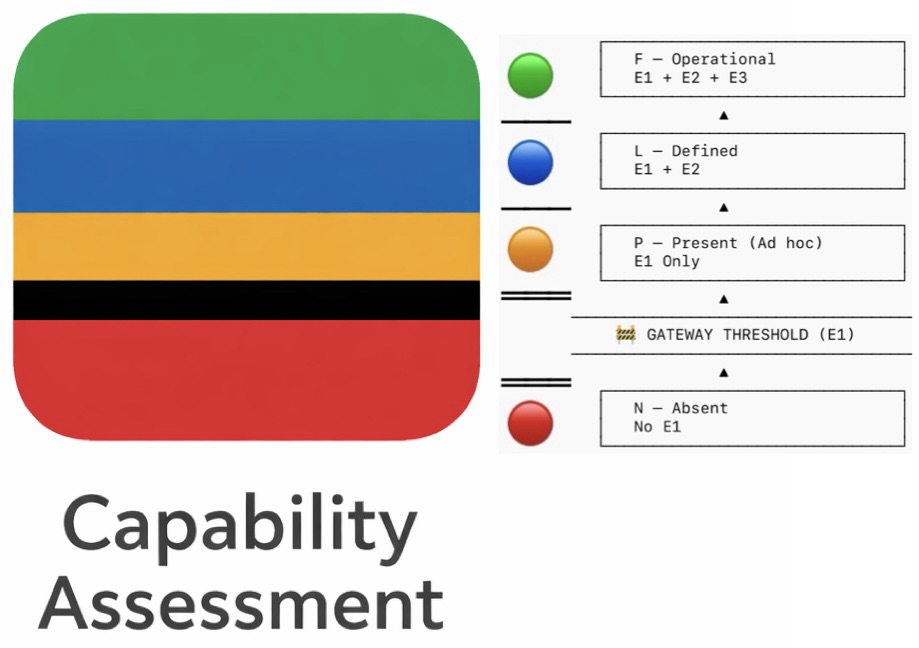
Executive Brief – “How ya going?”
An example Capability Assessment across three sites and 11 management domains Read More
Supporting “good” decisions
Good decision-making is a topic of discussion which ranks as a perennial favorite – across board and dinner tables. Managers, CEOs and Boards frequently reflect “did we get that right”? This begs the question of what does “right” mean? What do “good” decisions look like? The key to good decisions is good decision-making processes. Supporting… Read More
For want of a nail.
“For want of a nail” is a proverb, having numerous variations over several centuries, reminding that seemingly unimportant acts or omissions can have grave and unforeseen consequences. For want of a nail the shoe was lost.For want of a shoe the horse was lost.For want of a horse the rider was lost.For want of a… Read More
◦ Sharing some of Munger’s famous quotes
◦ If Warren Buffett is the king of the investment wisecrack, then his long-time business partner Charlie Munger, who died on Tuesday (Wednesday AEDT) aged 99, was the perfect straight man. ◦ The two held court at Berkshire Hathaway’s annual meeting for decades as chairman and vice chairman. Munger could be taciturn – he could… Read More
Check your emergency plan
Terrific basis for conversations!
Mind the Gap
Mind the Gap, is not just for London railway platforms 😀 We help clients identify gaps between current and desired performance. By determining, the difference between business requirements and current capabilities, gap analysis builds on benchmarking and other assessments. This comparison (between where you are and where you need to be) becomes the gap –… Read More
Old wine – New bottles
So on a reflective Friday morning over coffee, I have browsed through some of my early writing – partly for fun, and partly to see how well it still “stands up”. It may depend on how you measure it 😂 From my point of view – and context at the time – they were written… Read More
A reminder – vulnerability is variable
A wet day at Hazel’s cafe this morning reminded me of one of my free apps – vulnerability is variable!
Reputation Risk
This week gave us a classic story of “ambush by a reputation risk”. … for want of a horseshoe nail.
How prepared are you? How prepared ought you be?
A short story … Once upon a time, in the bustling city of New York, there was a small family-owned business named “Lighthouse Marketing”. The business was doing exceptionally well and was generating substantial profits for the family. However, the owner, Mr. James, was always concerned about the future of his business. He knew that… Read More
How prepared are you? How prepared ought you be?
A short story … Once upon a time, in the bustling city of New York, there was a small family-owned business named “Lighthouse Marketing”. The business was doing exceptionally well and was generating substantial profits for the family. However, the owner, Mr. James, was always concerned about the future of his business. He knew that… Read More
Heart, Head, and Gut
How do you make tricky decisions? “Duke it out” immediately focuses on the importance of tensions between different things – in this context, between different decision criteria. For each of us, a key question is “which rules” – or, in this decision making context, what weighting is given to each criterion?
“Good” Decision
How might you make a “good” decision? Elements of General Approach A decision matrix is just one of many tools currently considered “best practice” for good decision-making. It uses a systematic approach to narrow down options, comparing choices by using a combination of weighted voting and ranking. A criteria matrix is especially helpful when: 1.… Read More
Storms and Sandwich Boards
The clean up uses parking areas as a sound strategy to store debris before removal. Sound, but with some unintended consequences. Losing your “Premises”
Risk @ Interfaces
On the edge. On the boundary. At the interface.
When should you invest in disaster management?
Purists … say you ought to have already set it up “yesterday”. Pragmatists … say you ought to do it “whenever you’re ready”. Whenever you decide, there are some things to consider. 3. Consider using a criteria-based decision making approach when determining the most appropriate planning solution for you.
Couldn’t make this up!
My favourite “risk management errors” story today comes out of the Perth Mint. Greed, arrogance and incompetence characterise a range of activities over years. https://apple.news/AmOJXFdVNQeW4MxBpK6mHTQ

Scenario Analysis
Introducing our Scenario Analysis app, available as a Tier 1 product (costing less than US$1) from Apple and Google stores. Screen 1 Scenarios Field 1 “Assets” Prompt “Compile a list of assets. Consider significant operational processes, activities, and the resources upon which they rely including people, facilities, machinery, equipment, infrastructure (including premises), technology (including plant… Read More
 John Salter Consulting Services