How suitable is the Operational Resilience Capability Assessment Framework? Very. Read More
Tag: resilience
Business Continuity Review Document Checklist for Clients
Selecting the right paperwork to achieve an appropriate capability assessment review. Read More
Management Capability Assessment Report
A Capability Assessment of some value – but limited by publicly available information. Read More

Is Resilience Core?
“Can we demonstrate, with evidence, that our most important services will remain within acceptable limits during severe but plausible disruption?” Read More
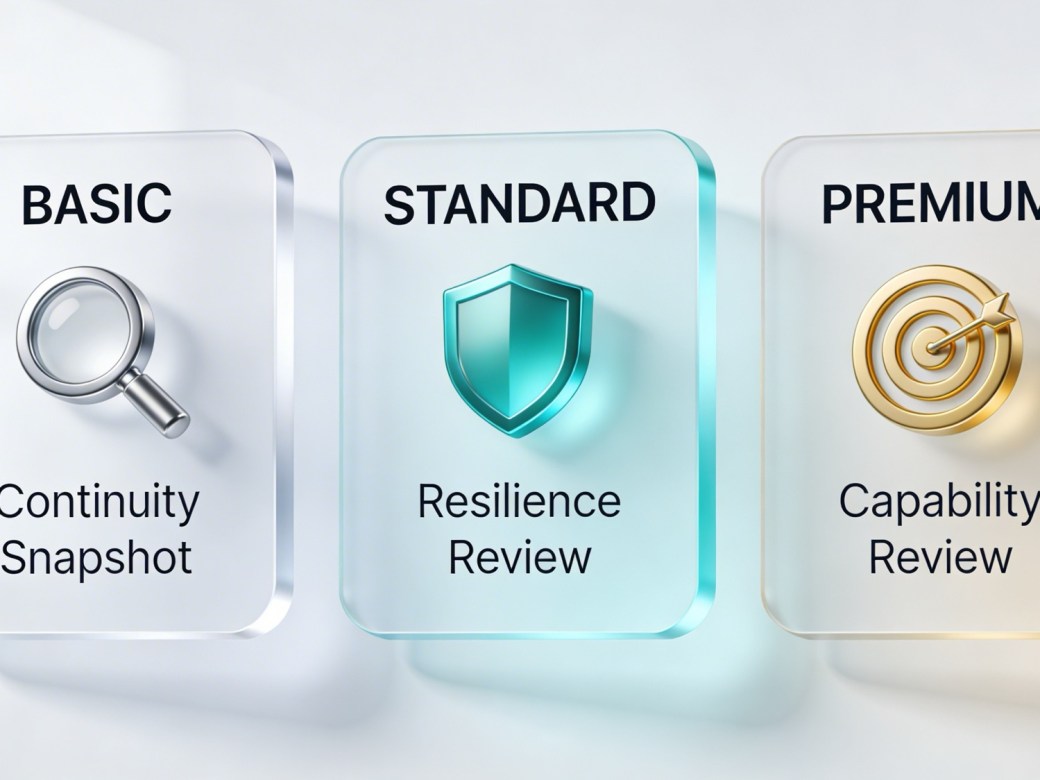
Standard Continuity & Resilience Review
An example Executive Summary of a Business Continuity Resilience Review by John Salter Read More
A necessary and sufficient BCM/resilience “evidence set”
When commissioned to review a client’s continuity and resilience capabilities I am nearly always asked – “What documentation do you need to review?” You can reflect on my response below: “Minimum Viable” set to request client to consider BCM minimum evidence set: policy & framework, risk register with BCM risks and latest assessment, approved BIAs,… Read More
Necessary and Sufficient Evidence (Consolidated Framework)
For each domain, “necessary and sufficient” evidence means: the minimum concrete artefacts and observations that prove the criterion is in place (E1), enabled (E2), and working in practice (E3). Below is a concise, practical set of examples. 1. Context, Scope, Stakeholders & Strategy 2. Leadership, Governance, Culture & Accountability 3. Integrated Risk & Opportunity Management… Read More
“Necessary and Sufficient” Resilience Evidence
You can treat “necessary and sufficient” at each level as (a) existence of defined artefacts (E1), (b) evidence of use and quality (E2), and (c) evidence that use is routine, linked to other systems, and self‑reinforcing (E3) across all seven domains.[1] Below are concise criteria you can use as an assessment rubric. 1. BCM Program… Read More
What does “Exercise Convergence” mean for you?
Exercise Convergence was a recent national preparedness exercise designed to test Australia’s ability to manage extreme to catastrophic, overlapping crises through coordinated action across governments, emergency services, industry, charities, and critical infrastructure partners. The exercise examined how concurrent disruptions such as severe weather, fire, flooding, fuel shortages, health impacts, power outages, supply chain failures, and… Read More
Yes, of course … but what is the right question?
Asking the right questions: what great thinkers teach leaders about inquiry Voltaire once wrote, “Judge a man by his questions rather than by his answers.” That single line turns a lot of conventional leadership wisdom on its head. We are used to celebrating the leader with the confident answer, the bold solution, the decisive verdict.… Read More

Capability Assessment and Organisational Debriefing
Our niche consulting services strengthen capability before disruption and turn organisational debriefing into practical improvements. Read More
Operational Resilience and Continuity – without the drama
Our consulting offer for vulnerable times. The gap most mid-sized firms face Most firms have bits and pieces of business continuity, risk, and IT/DR work, but too often: Plans are outdated or don’t match how operations actually run today. • Operations, IT, risk, and suppliers each see their own slice – no one owns the… Read More
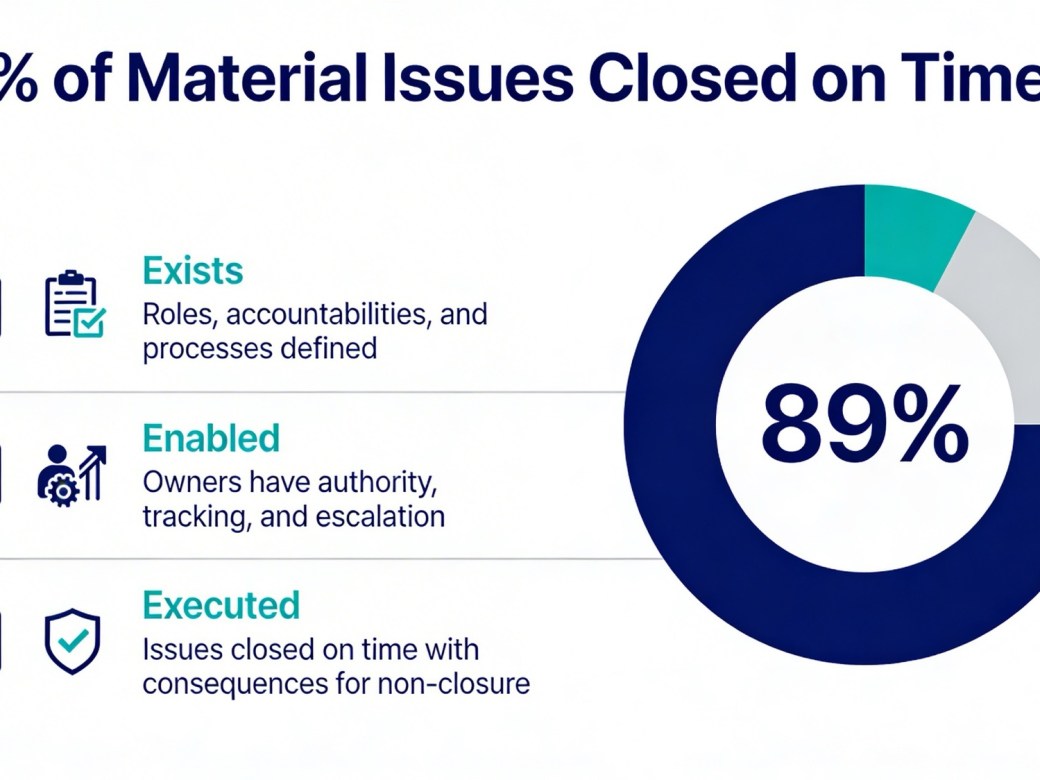
UNIVERSAL FRAMEWORK – Domain 7. Governance & Accountability – evidence notes
Metric: % of material issues closed on time (audit, reviews, incidents) E1 – Exists (Gateway Evidence) Do defined governance roles, accountabilities, and issue management processes exist? E2 – Enabled Are issue owners supported with authority, tracking, and escalation mechanisms? E3 – Executed Are material issues reliably closed on time, with consequences for non-closure? Evidence and… Read More
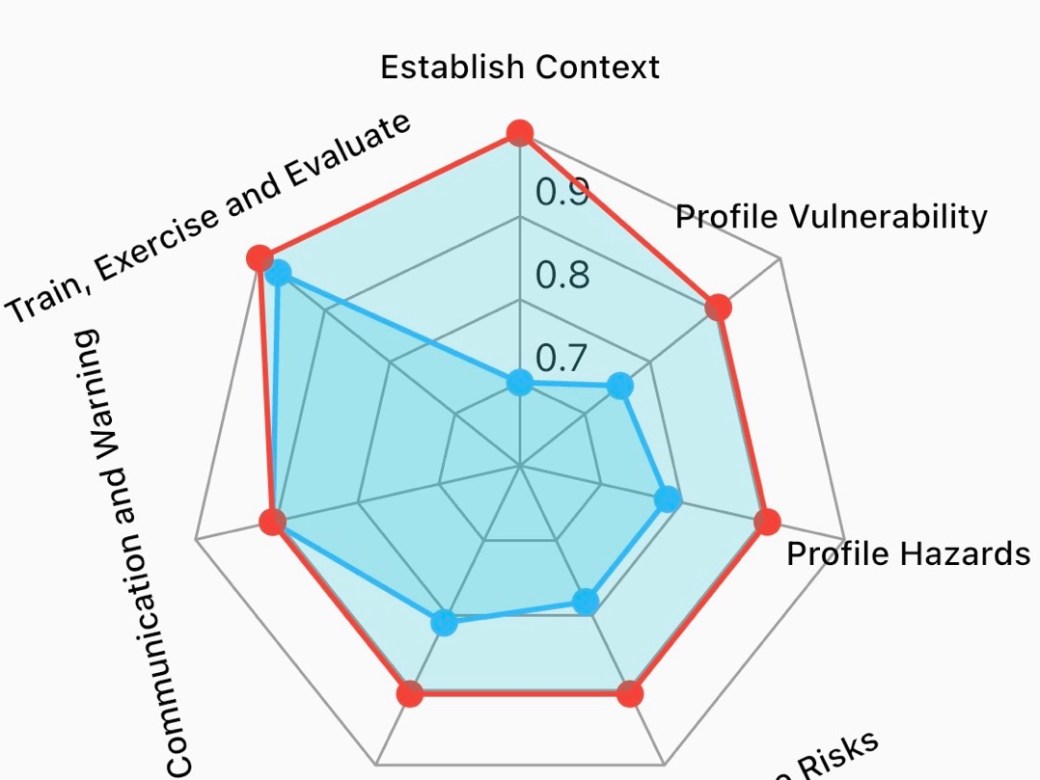
Analyse gaps to improve capability
Inform your decisions with gap assessment Read More
Short term plus long term risks
Free Disaster Risk Assessor App
Use our free app to map and explore how you are at risk. We also use it as a “pre-read” lead into our business continuity workshops. Hazards are not equally significant. Google Store https://play.google.com/store/apps/details?id=com.disaster.risk&hl=en_AU&gl=US Apple Store https://apps.apple.com/au/app/disaster-risk-assessor/id6443818654
Move over “resilience”
Move over “resilience” – make room in the disaster management lexicon for “uninsurable enclaves”. It has been recognised for nearly five decades that disaster risk is a function of hazard and vulnerability. Our efforts have focused on supporting those at risk to be more resilient – more prepared. This focus – I suggest – has… Read More
 John Salter Consulting Services