
On reading the piece below (uncertain wisdom) I remembered a friend reflecting (late one evening, decades ago) on his first experiences in a “command, control and coordination centre” during a disaster. He quoted “while all about are losing theirs” with the wry observation that they were probably the sanest in the room – and that uncertainty should be given the highest respect possible when making crucial decisions.
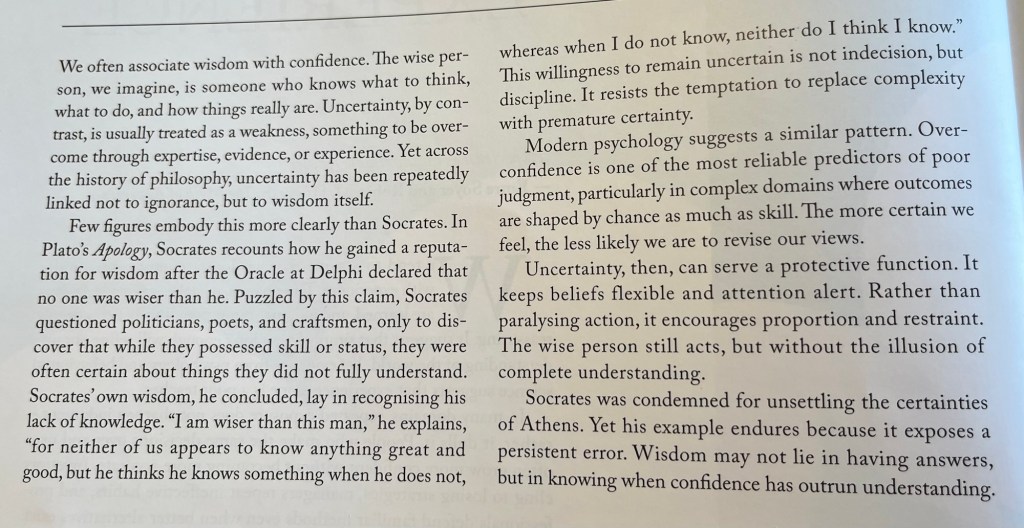
Here’s Perplexity’s response to the “Risk and Uncertainty” context in the above piece.
Real wisdom in risk isn’t about feeling sure, but about staying consciously uncertain so your judgments don’t outrun what you can actually know.[2]
Uncertainty and the definition of risk
Modern risk standards literally build uncertainty into the definition of risk: risk is the “effect of uncertainty on objectives” or, more simply, the possibility that reality deviates from what you expect. That means the danger in risky situations does not come only from bad outcomes, but also from limits in your knowledge, your models, and your ability to foresee what can happen. When we acknowledge uncertainty, we accept that our estimates (probabilities, scenarios, impact ranges) are imperfect and that there are things we don’t know we don’t know.[4][1]
What the quote is saying
The quote is making three moves:
- In everyday thinking, we equate wisdom with strong confidence (“knowing what to do”), and treat uncertainty as a flaw to be removed by more expertise or data.[7]
- Socrates shows the opposite: he is “wiser” because he knows where his knowledge stops, while others are confidently wrong about things they don’t truly understand.[7]
- Modern psychology echoes this: overconfidence is a robust predictor of bad judgment, especially in complex, chance-driven domains, because once people feel certain they stop updating their views.[7]
So the quote’s key claim is that a disciplined willingness to live with uncertainty—resisting “premature certainty”—is a hallmark of wisdom, not a sign of weakness.[7]
How this connects to risk as uncertainty
When you define risk as grounded in uncertainty, a “wise” risk attitude looks like Socratic humility:
- You assume your risk estimates are incomplete, so you keep looking for blind spots instead of locking in a story that feels neat.[2]
- You treat confidence as something that must match the quality and limits of your information, rather than as a virtue in itself.[7]
- You stay ready to revise your assessment as new evidence appears, because you never believed you had “complete understanding” in the first place.[2]
In other words, the quote is saying: when risk is fundamentally about uncertainty, the wise stance is not to crush uncertainty with bold predictions, but to act while still holding your beliefs lightly—deciding, but without the illusion that you’ve fully tamed the unknown.[1]
Does this match the way “risk” is being discussed in the context you’re reading (e.g., finance, safety, personal decisions), or should we connect this more concretely to a particular domain?
Sources
[1] What Is “Uncertainty” And How It Differs From “Risk”? – ISRM https://www.theisrm.org/what-is-uncertainty-and-how-it-differs-from-risk/
[2] Treating Epistemic Uncertainty in Bayesian Networks for Risk … https://academic.oup.com/ieam/article/17/1/221/7727181
[3] [pdf] Chapter 9 – Risk and Uncertainty https://web.pdx.edu/~rueterj/CCC/v7-Rueter-chap9.pdf
[4] Risk – Wikipedia https://en.wikipedia.org/wiki/Risk
[5] Making Decisions Under… https://moneyfortherestofus.com/risk-vs-uncertainty/
[6] Favoring Consensus Over… https://www.rmmagazine.com/articles/article/2025/11/06/how-to-overcome-cognitive-biases-in-risk-management
[7] Confidence Without Wisdom: The Dunning–Kruger Problem … – PMC https://pmc.ncbi.nlm.nih.gov/articles/PMC12925674/
[8] Defining Risk and Uncertainty – LinkedIn https://www.linkedin.com/pulse/defining-risk-uncertainty-paul-sweeting
[9] ERM: Risk Versus Uncertainty – GARP https://www.garp.org/risk-intelligence/culture-governance/erm-risk-versus-uncertainty-250523
[10] Difference between Risk and Uncertainty – GeeksforGeeks https://www.geeksforgeeks.org/business-studies/difference-between-risk-and-uncertainty/
[11] The risks of uncertainty | ACCA Qualification | Students https://www.accaglobal.com/an/en/student/exam-support-resources/fundamentals-exams-study-resources/f5/technical-articles/the-risks-of-uncertainty.html
[12] Difference Between Risk and Uncertainty (with Comparison Chart) https://keydifferences.com/difference-between-risk-and-uncertainty.html
[13] 11. Step 11: Assess risk and uncertainty https://www.atap.gov.au/tools-techniques/cost-benefit-analysis/12-step-11-assess-risk-and-uncertainty
[14] Risk vs. Uncertainty in Strategy – Decision-making – Aevitium LTDwww.aevitium.com › post › risk-vs-uncertainty https://www.aevitium.com/post/risk-vs-uncertainty
[15] Uncertainty and Variability | US EPA https://www.epa.gov/expobox/uncertainty-and-variability


