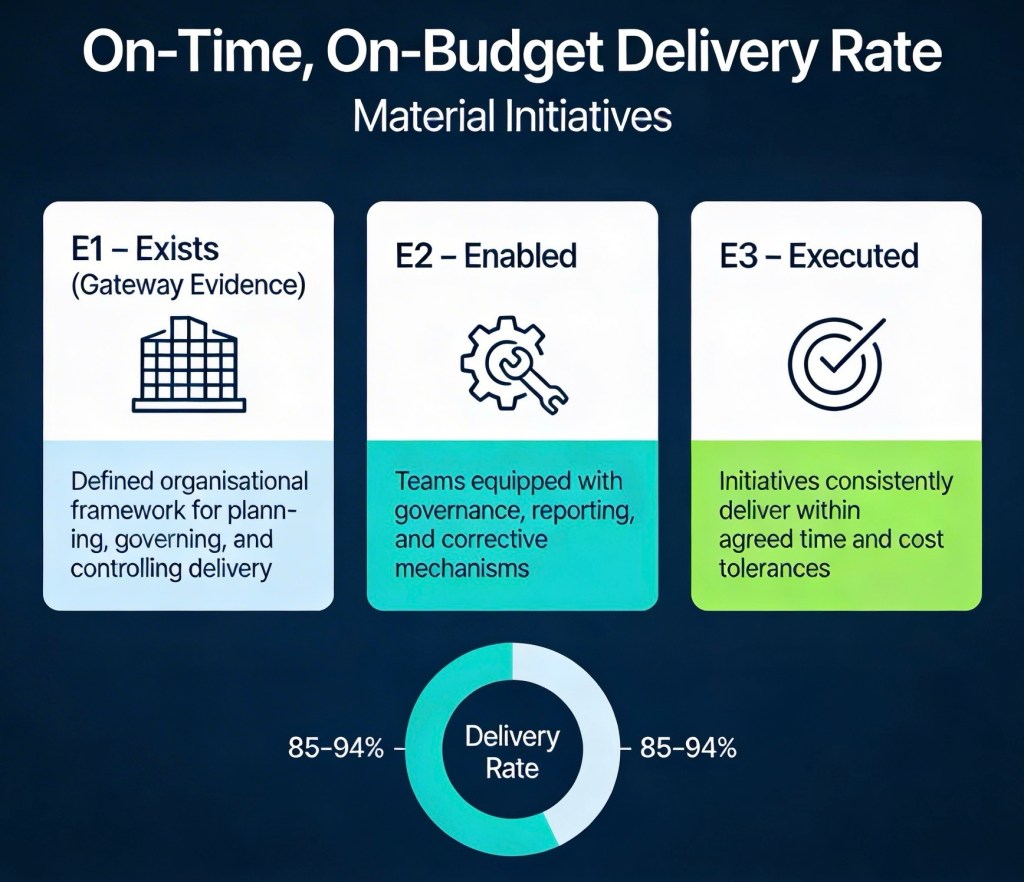
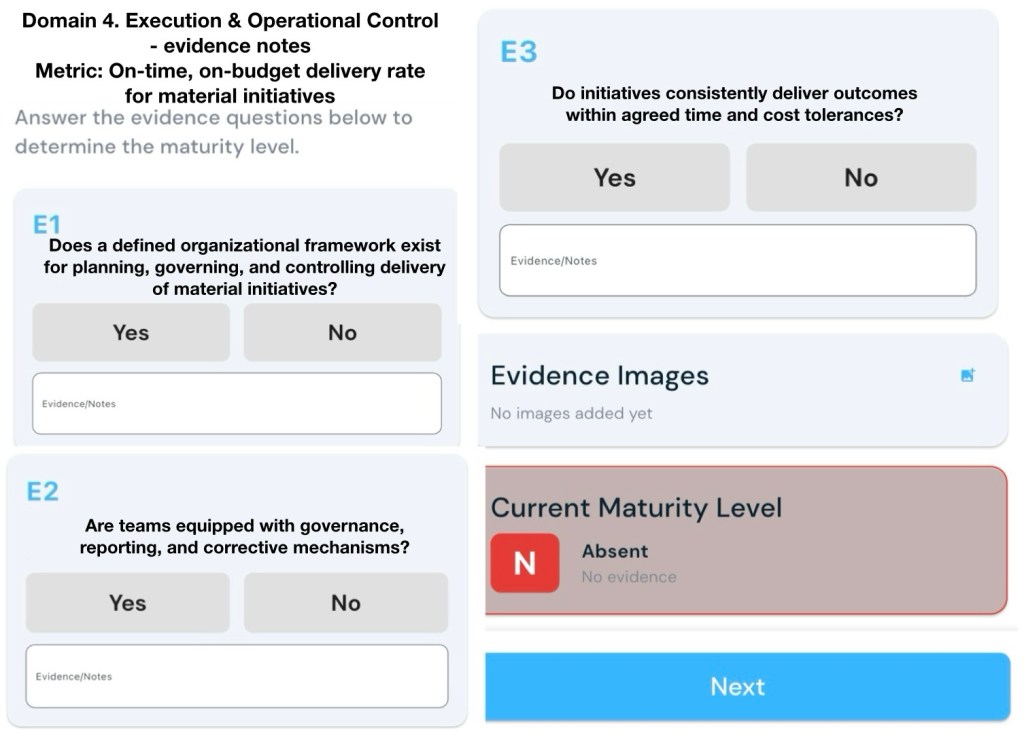
Metric: On-time, on-budget delivery rate for material initiatives
Evidence
E1 – Exists (Gateway Evidence)
Does a defined organisational framework exist for planning, governing, and controlling delivery of material initiatives?
E2 – Enabled
Are teams equipped with governance, reporting, and corrective mechanisms?
E3 – Executed
Do initiatives consistently deliver outcomes within agreed time and cost tolerances?
An assessment of that metric at E1, E2, and E3 would be supported by progressively stronger evidence that: (1) a coherent delivery governance framework exists, (2) it is actually equipped and used by teams, and (3) it is demonstrably driving on‑time, on‑budget outcomes for “material initiatives”. Below is a structured view of the kinds of evidence and notes you would look for.
E1 – “Exists” (Gateway evidence)
You are assessing whether a defined organisational framework for planning, governing, and controlling material initiatives actually exists on paper and is coherent.
Typical evidence:
- Documented delivery framework
- Enterprise project/program/portfolio delivery framework, methodology, or “end‑to‑end project delivery framework” approved by senior leadership (or equivalent), covering stages such as initiation, business case, planning, execution, control, and closure.[1][2]
- Standard templates (business case, project charter/PID, schedule, risk register, change request, status report, benefits plan) referenced in the framework.[1]
- Governance structures and roles
- Formal governance model for material initiatives: e.g. steering committee, project control board, portfolio board, and their terms of reference (decision rights, quorum, escalation paths).[3][4]
- Defined roles and responsibilities (sponsors, SROs, project managers, PMO, finance, risk) documented in RACI or equivalent.[5]
- Control and assurance mechanisms defined
- Defined stage‑gate/“gateway” or investment lifecycle with criteria for progressing (e.g. business case quality, risk assessment, affordability, delivery readiness).[3][1]
- Policy or standard for minimum controls on material initiatives: risk management, issues management, schedule and cost baselines, change control, reporting cadence.[2][6]
- Metric definition
- Defined metric for “on‑time, on‑budget delivery rate” in the framework or PMO standards: clear rules for what counts as “on time”, “on budget”, and which initiatives are in scope.[7][2]
Notes you might record at E1:
- Framework exists, is approved and version‑controlled, and applies explicitly to “material initiatives” (e.g. above a value/complexity threshold).
- Governance forums and roles are defined, with TORs and RACIs, but you may not yet have strong evidence of consistent use.
- On‑time/on‑budget metric is defined and included in standard PMO or performance reporting, even if data quality or usage is still maturing.
E2 – “Enabled”
You are assessing whether teams are equipped with governance, reporting, and corrective mechanisms and can actually use the framework in practice.
Typical evidence:
- Operating governance in place
- Active steering committees/PSC/boards with forward‑planned meeting schedules, agendas, packs, and minutes for current material initiatives.[6][3]
- Evidence that these forums review schedule/budget status, risks, and issues, and make decisions or approvals (e.g. gate approvals, scope decisions, risk responses).[4][3]
- Practical tools and standards
- Standardised toolset in use (PPM system, scheduling tools, risk registers, financial tracking), with configuration reflecting the organisational framework.[8][2]
- Standard templates actually used in current initiatives (charters, business cases, stage‑gate documentation, status reports, change requests).[9][1]
- Reporting and escalation mechanisms
- Regular, standardised status reporting for material initiatives showing schedule variance, cost variance, forecast at completion, risks, issues, and change log.[6][8]
- Defined and used escalation paths for red/amber status, including thresholds and timeframes for escalation to higher governance levels.[4][5]
- Corrective action and risk management
- Evidence of corrective actions being raised, tracked, and closed (e.g. schedule recovery plans, rebaselining with approval, scope trade‑offs to protect critical dates).[10][8]
- Active risk and issue management with mitigation plans, owners, and due dates, and discussion of these in governance forums.[6]
- Capability and training
- Training materials, onboarding guides, or communities of practice that teach the framework and use of tools for schedule/budget control.[2]
- Role descriptions or competency frameworks requiring project governance and control skills for PMs/SROs.[4]
Notes you might record at E2:
- Teams have access to and demonstrably use standard tools, templates, and governance forums for material initiatives.
- There is consistent periodic reporting to governance bodies and a visible path from red/amber status to agreed corrective actions and decisions.
- The on‑time/on‑budget metric is calculated and reported, even if performance is not yet strong.
E3 – “Executed”
You are assessing whether the framework and controls are used consistently and are effective: material initiatives actually deliver within agreed time and cost tolerances, with a stable, reliable metric.
Typical evidence:
- Quantitative performance data
- Portfolio‑level KPI showing percentage of material initiatives delivered on time and on budget over at least 12–24 months, with defined tolerances (e.g. ±10% schedule, ±5% cost).[7][2]
- Trend analysis showing stable or improving on‑time/on‑budget rates and explanations for variances by segment (e.g. type of initiative, business unit).[7]
- Demonstrated linkage between governance and outcomes
- Case studies or post‑implementation reviews for major initiatives showing that governance interventions (gate decisions, scope changes, risk responses) helped avoid or recover delays and overruns.[11][6]
- Evidence that initiatives with stronger adherence to governance exhibit fewer delays and cost overruns (internal analysis, or referencing industry evidence that robust governance correlates with fewer delays and cost overruns).[6]
- Consistency across the material portfolio
- Sample of recent material initiatives shows that each had: an approved baseline, regular reporting, use of risk and change control, and closure reports including time and cost performance.[1][2]
- Low rate of “surprises” (e.g. late discovery of major overruns) because issues are surfaced early through governance.[10][6]
- Embedded continuous improvement
- Routine post‑implementation reviews feeding lessons learned into updates of the framework, templates, and training.[2]
- Governance bodies periodically review portfolio performance (including on‑time/on‑budget rates) and adjust criteria, thresholds, or capability focus areas.[4]
Notes you might record at E3:
- Metric for on‑time, on‑budget delivery rate is actively used as a management KPI for material initiatives, with sustained data and clear tolerances.
- Majority of material initiatives meet agreed time and cost tolerances, and where they do not, there is traceable governance oversight, documented causes, and learning incorporated back into the framework.
- Governance is not just present but demonstrably influencing decisions and driving better schedule and cost outcomes, consistent with research linking good project governance to lower delay and cost overrun rates.[6]
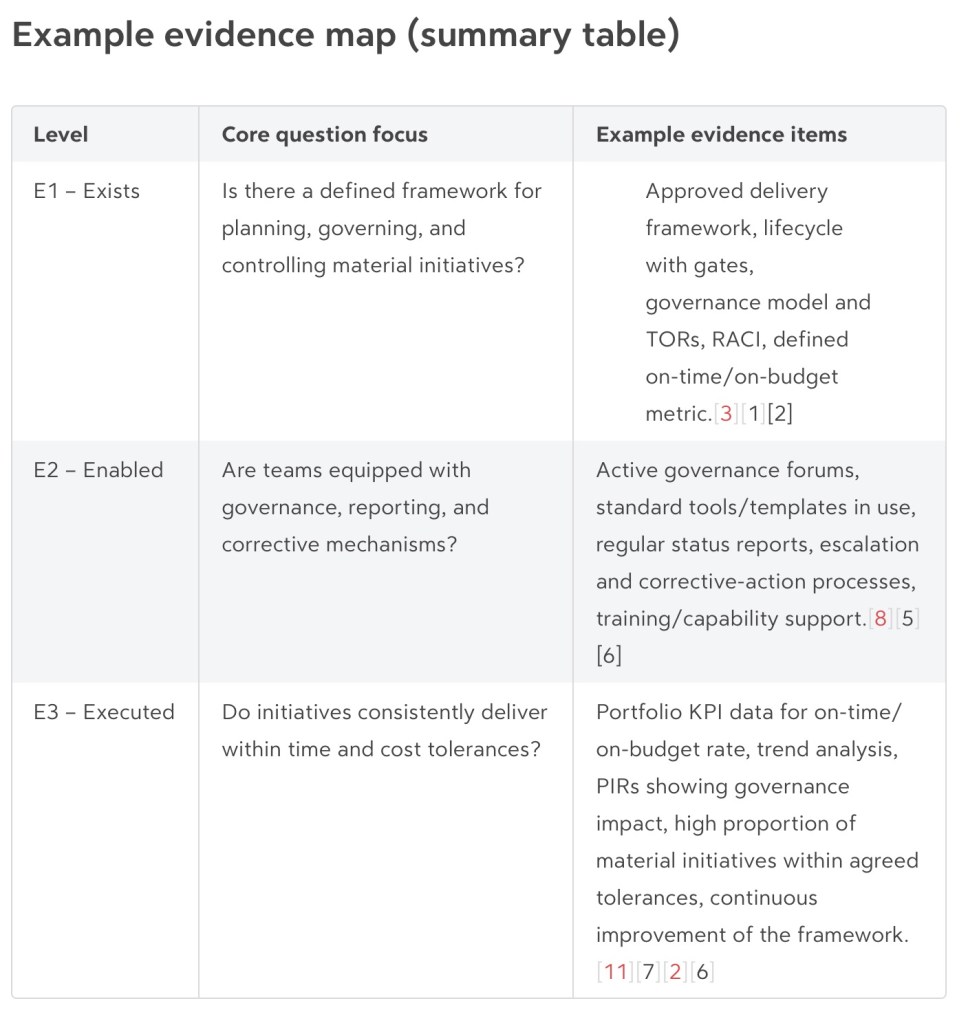
You can adapt these examples into your assessment checklist and evidence log, mapping what you actually observe in your organisation to each level and noting any gaps (e.g. “E2 enabled but not yet E3: data shows inconsistent on‑time performance despite strong documented framework”).
Sources
[1] PM-GUIDE-03-End-to-End-Project-Delivery-Framework.docx https://www.vic.gov.au/sites/default/files/2019-08/PM-GUIDE-03-End-to-End-Project-Delivery-Framework.docx
[2] [PDF] PM SOLUTIONS’ – Project Portfolio Management Maturity Model https://www.pmsolutions.com/white_papers/PPM_Maturity_Model_Paperback.pdf
[3] Project governance – Investment Lifecycle Framework https://ideasadvisory.com.au/wp-content/uploads/2023/01/Governance-Guideline.pdf
[4] Introduction To a Project Portfolio Management Maturity Model https://www.pmi.org/learning/library/project-portfolio-management-maturity-model-6126
[5] IT Governance and Its Role in Project Management Success https://moldstud.com/articles/p-understanding-the-crucial-role-of-it-governance-in-effective-project-management
[6] [PDF] Project Governance and Its Role in Reducing Contractors’ Time … https://www.jetir.org/papers/JETIR2511303.pdf
[7] Performance-Based Budgeting: Concepts and Examples https://apps.legislature.ky.gov/lrc/publications/ResearchReports/RR302.pdf
[8] Delivering Software on Time and on Budget – Codurance https://www.codurance.com/delivering-software-on-time-and-on-budget
[9] Project Management – Deliver in Time, Within Budget and Desired … https://www.linkedin.com/pulse/project-management-deliver-time-within-budget-desired-zamawah
[10] Cost Optimisation: The Hidden Drivers of Project Delivery Blowouts https://www.quayconsulting.com.au/news/cost-optimisation-the-hidden-drivers-of-project-delivery-blowouts/
[11] High Value High Risk 2016–17: Delivering HVHR Projects https://www.audit.vic.gov.au/report/high-value-high-risk-2016-17-delivering-hvhr-projects/?section=
[12] Snowy 2.0 Governance of Early Implementation https://www.anao.gov.au/work/performance-audit/snowy-20-governance-early-implementation
[13] P3M3 – Wikipedia https://en.wikipedia.org/wiki/P3M3
[14] A Review of Project Governance Effectiveness In Australia https://www.infrastructureaustralia.gov.au/sites/default/files/2019-06/caravel_group_project_governance_effectiveness_march_2013.pdf
[15] Interactive https://assets.publishing.service.gov.uk/government/uploads/system/uploads/attachment_data/file/1080238/Governance_-_FINAL.pdf