
The Universal Framework draws selectively from the management and support services portion of the American Productivity & Quality Center’s Process Classification Framework® (PCF) and reframes it as a maturity assessment rather than a process taxonomy.

What the PCF looks like
The PCF divides all enterprise work into two layers:
- Operating Processes: Develop Vision and Strategy (1.0), Develop/Manage Products and Services (2.0), Market and Sell (3.0), Deliver Products and Services (4.0), Manage Customer Service (5.0)
- Management and Support Services: Develop and Manage Human Capital (6.0), Manage IT (7.0), Manage Financial Resources (8.0), Acquire/Construct/Manage Assets (9.0), Manage Enterprise Risk, Compliance, Remediation and Resiliency (10.0), Manage External Relationships (11.0), Develop and Manage Business Capabilities (12.0)
The PCF organises operating and management processes into 12–13 enterprise-level categories covering everything from product development to customer service, while the Universal Framework deliberately narrows to seven domains that test management capability quality rather than process existence or classification.
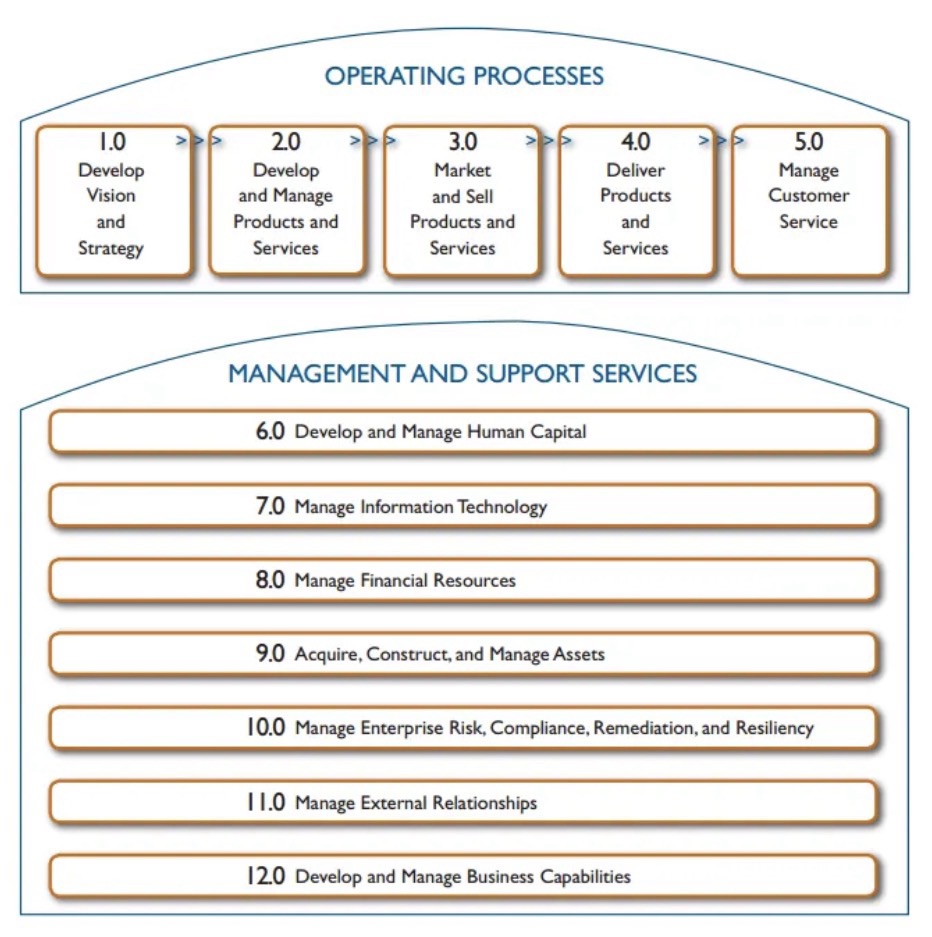
The PCF is a hierarchical process taxonomy – a classification tool intended for benchmarking what processes exist and how they are structured across organisations.
The Universal Framework is a maturity and evidence model – it tests whether processes are defined, applied, and producing results through E1, E2, and E3 questions. This means the two are complementary in intent but different in design logic.
Evidence standard – E1, E2, and E3 evidence standard should follow a simple pattern:
E1 requires proof that a defined process or framework exists, E2 requires proof that people are equipped and the process is actually being applied, and E3 requires proof that the process produces reliable results in practice. A practical test is:
- E1: design evidence, the process exists and is defined.
- E2: deployment evidence, people use it consistently and have the means to do so.
- E3: effectiveness evidence, results show the process is working.
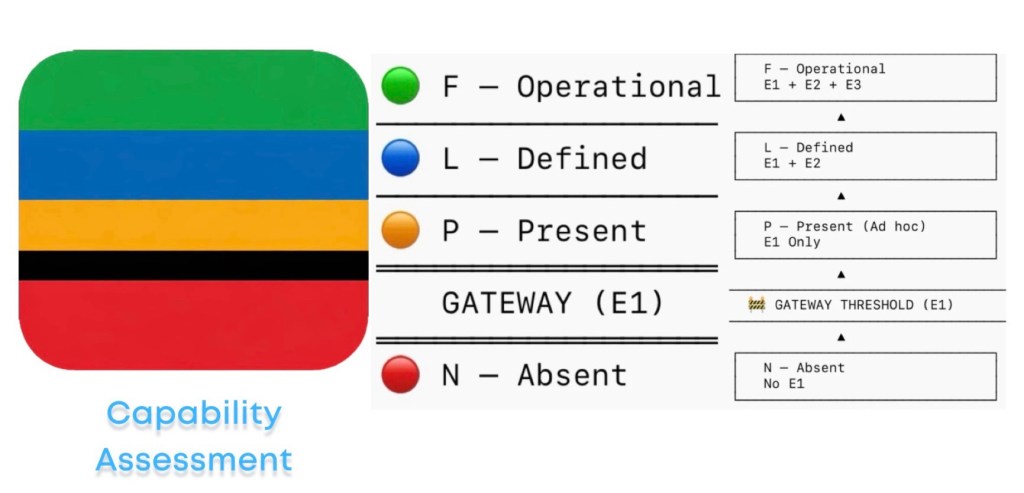
The Universal Framework is PCF-aligned at enterprise-management level, especially across strategy, human capital, risk/resilience, governance, and business capability management, but it is not a full substitute for the PCF’s operating-process taxonomy.
The Universal Framework asks, “Does the organisation have the capability and does it work?”, while APQC asks, “Which enterprise processes and process groups exist, and how are they classified for management and benchmarking?”
Alignment
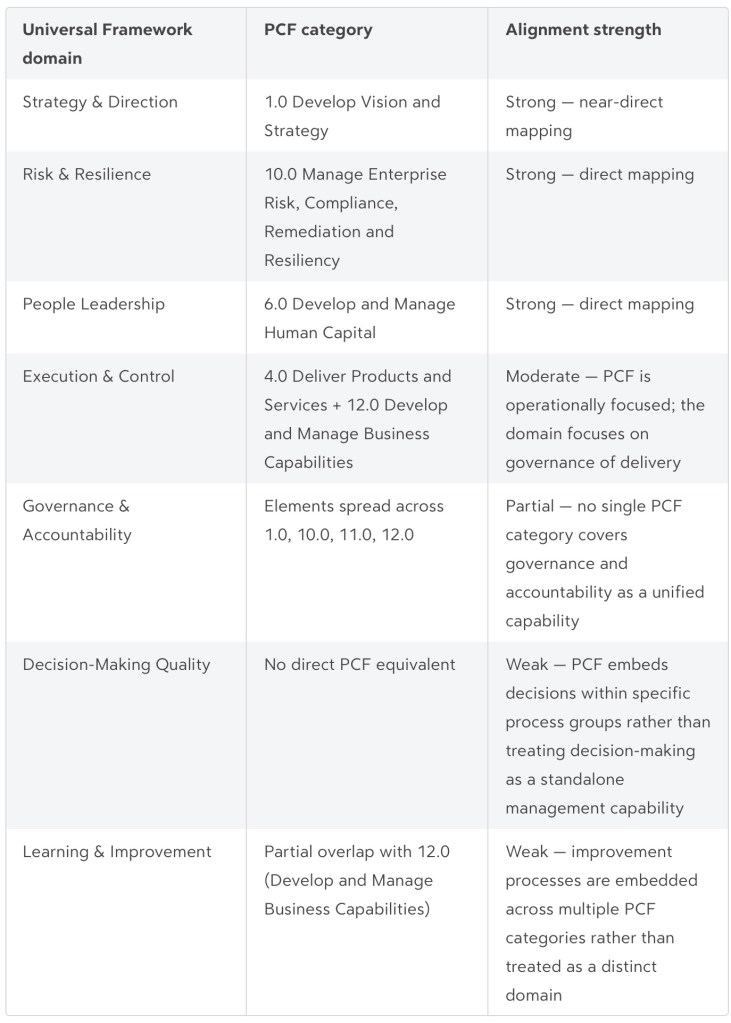
Key structural differences
Three practical gaps stand out:
- The Universal Framework omits entire PCF operating categories — products, services, customers, IT, finance, and external relationships are not domains in the capability model, because these are operational functions rather than management capability dimensions.
- Decision-Making Quality has no PCF equivalent at the category level; APQC treats decision authority and escalation as embedded activities within specific process groups rather than as a cross-cutting management capability.
- Learning & Improvement is similarly distributed across multiple PCF categories (quality management, corrective action, knowledge management), whereas the Universal Framework treats it as a standalone domain with its own maturity ladder.
Overall verdict
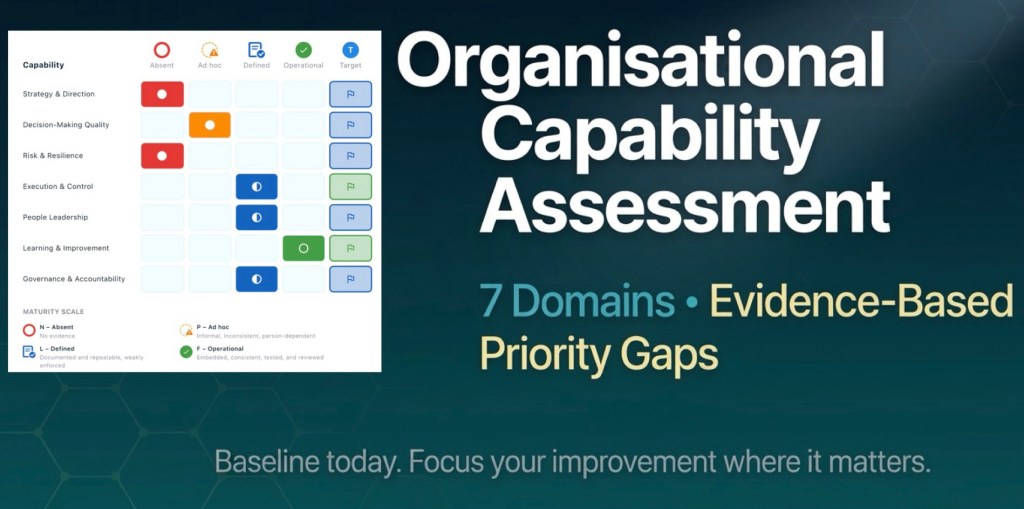
The alignment is solid for four of the seven domains (Strategy, Risk, People, and partially Execution) and loose for the remaining three. The Universal Framework has been derived primarily from the management and support services half of the PCF, filtered down to the capabilities that most directly determine whether an organisation is well-led and controlled, (rather than whether it has documented every process in a taxonomy). This is a purposeful narrowing, but it means the two frameworks serve different purposes and should not be treated as equivalent.
Appendix
A best-fit crosswalk from the seven-domain Universal Framework to APQC PCF Level 1 categories and the most relevant Level 2 process-group anchors. It is best read as an alignment map rather than a strict one-to-one translation, because the Universal Framework assesses management capability through E1/E2/E3 evidence, while the PCF is a hierarchical taxonomy for processes and process groups.
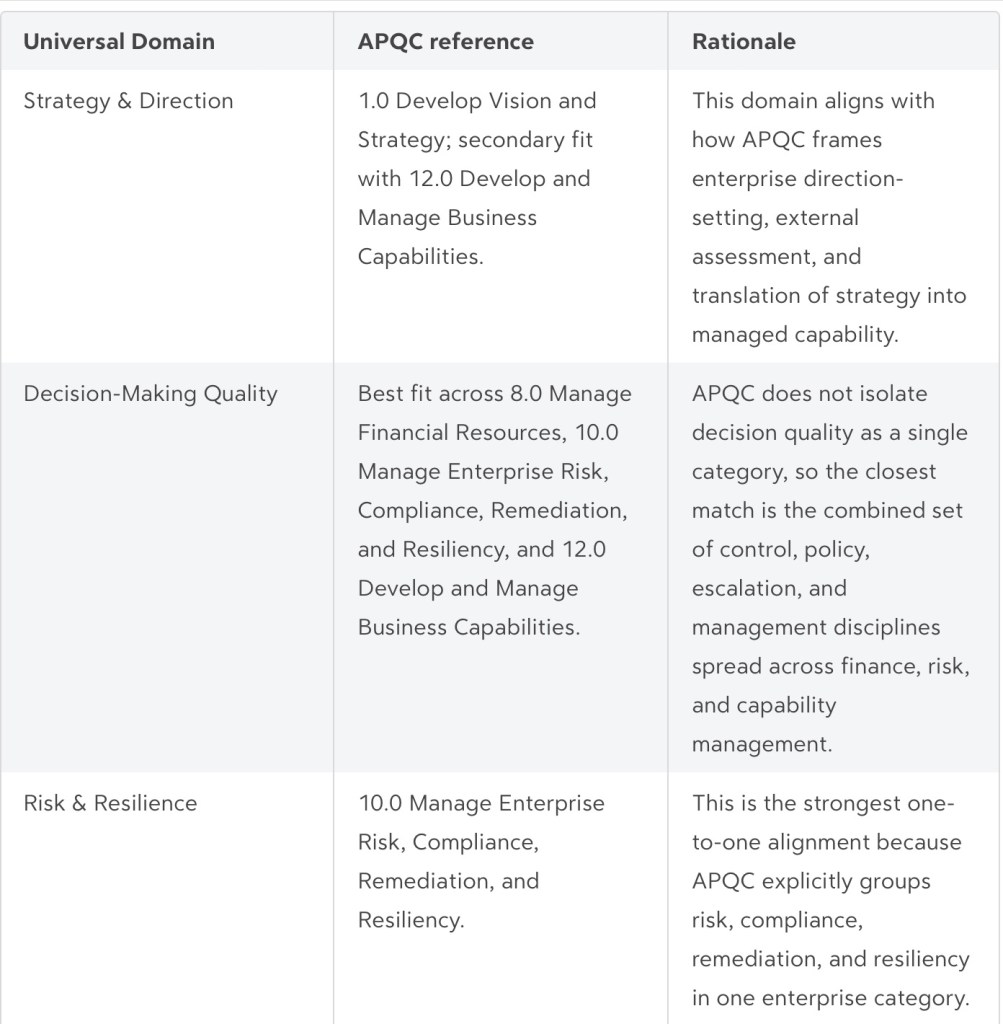
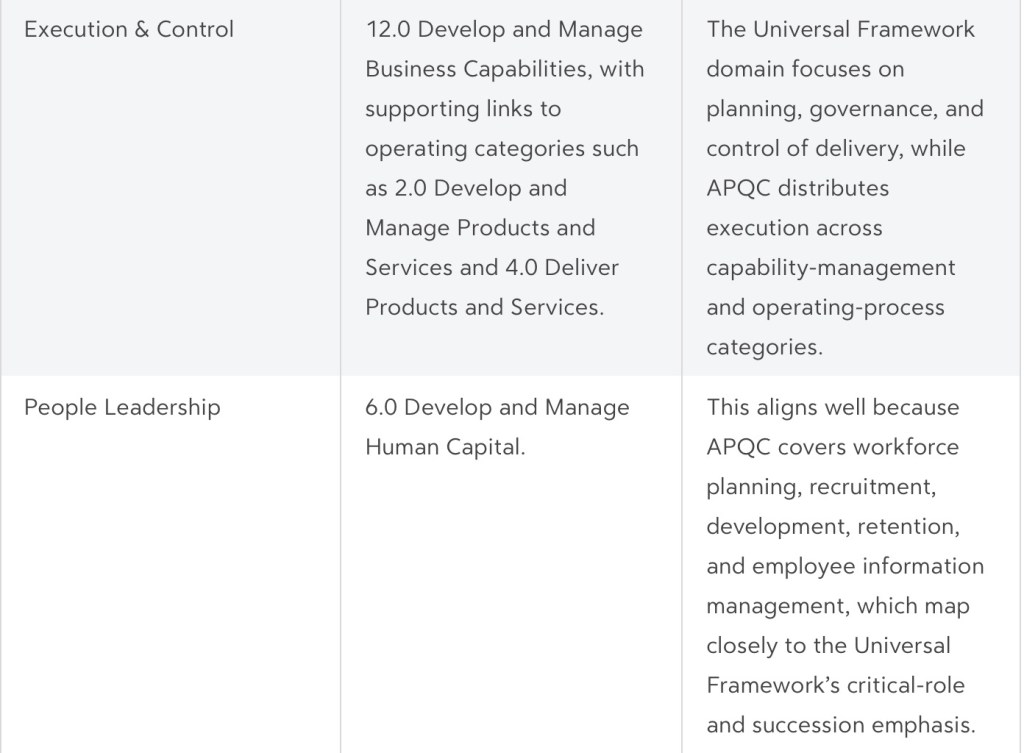
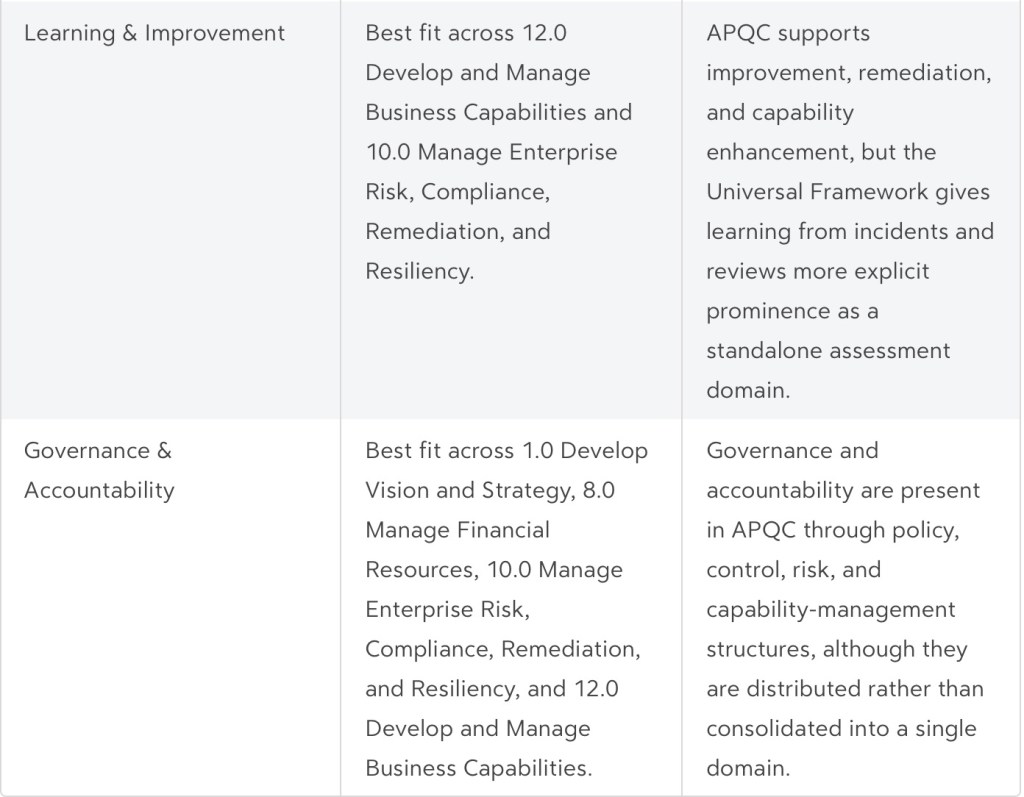
Appendix note: The Universal Framework is aligned to APQC at the enterprise-management level, particularly in strategy, human capital, risk and resilience, governance, and capability management, but it is not intended to replicate the full APQC operating-process taxonomy.
Understand whether your organisation is capable, not just compliant

 John Salter Consulting Services