Entity: Bayside Council (NSW)
Assessment basis: Publicly available documents only
Assessment status: Complete
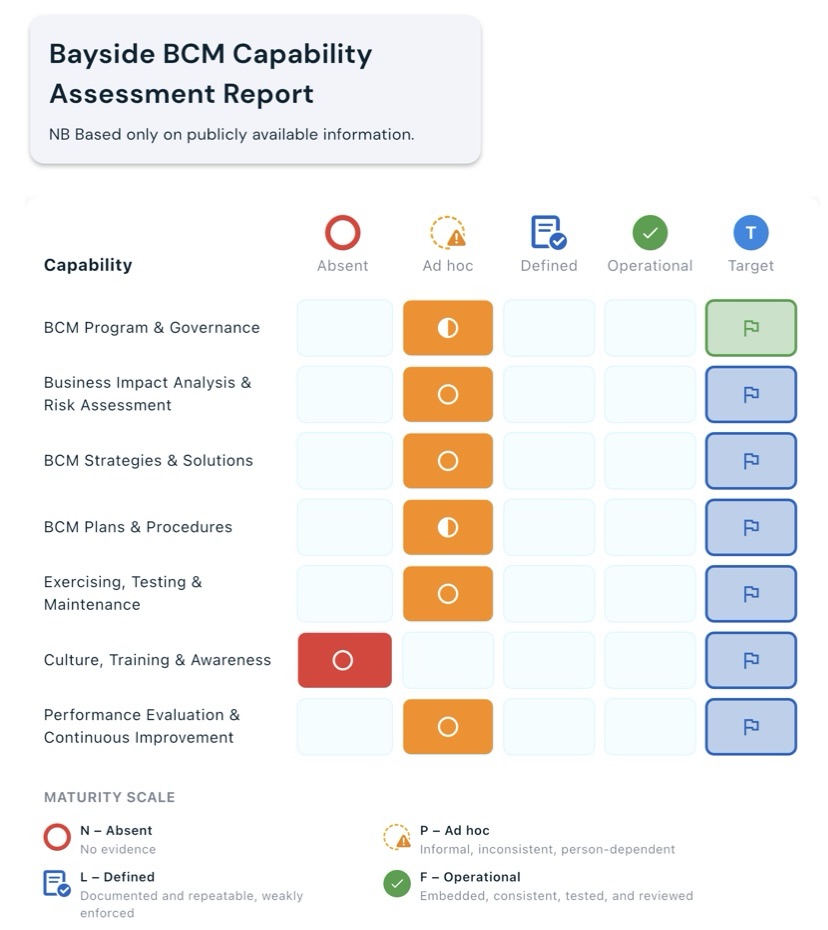
Overall maturity: P (Ad hoc)
Maturity distribution: N = 1, P = 6, L = 0, F = 0
Capability maturity summary
Assessment summary
The entity shows a visible BCM foundation through an approved BCM policy, broader risk management arrangements, a local emergency management plan, and audit and risk governance structures. The main limitation is that public evidence does not extend far beyond framework-level documentation.
This means the organisation appears to have continuity architecture in place, but there is not enough publicly available evidence to demonstrate that the programme is routinely exercised, maintained, measured, and improved in line with the E2 and E3 evidence standard.
Domain overview
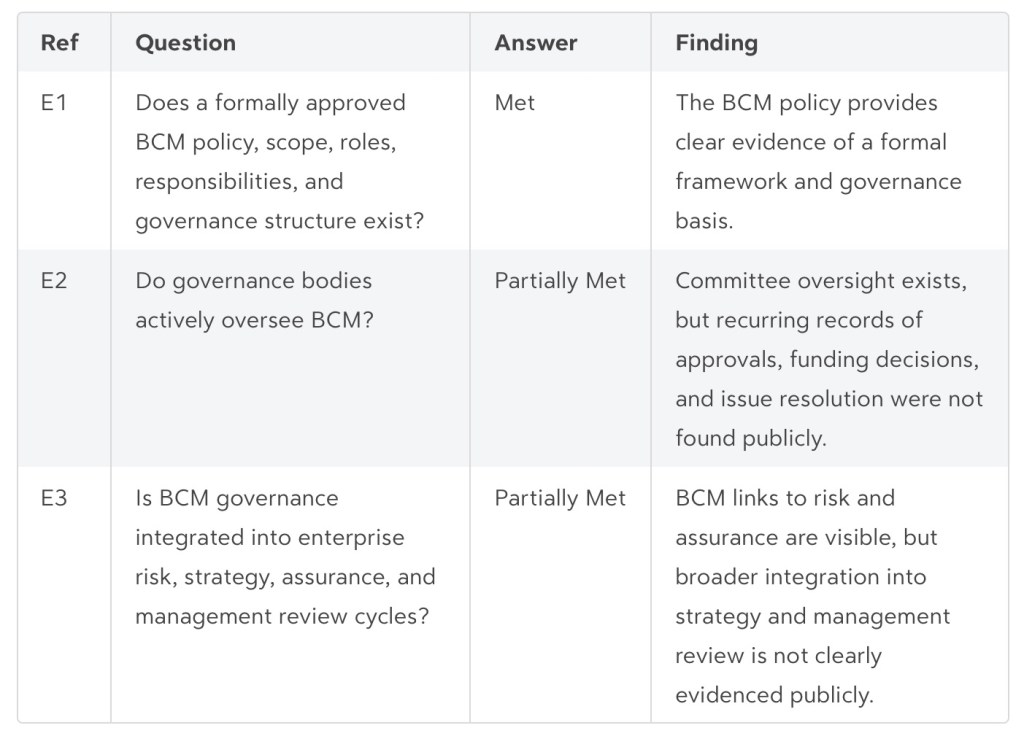
BCM Program & Governance
Current: P (Ad hoc)
Assessment note: Formal policy and governance intent are in place, and committee oversight structures are visible. Evidence of repeated BCM decisions, resourcing, issue escalation, and integration into management review is limited in the public record.
Business Impact Analysis & Risk Assessment
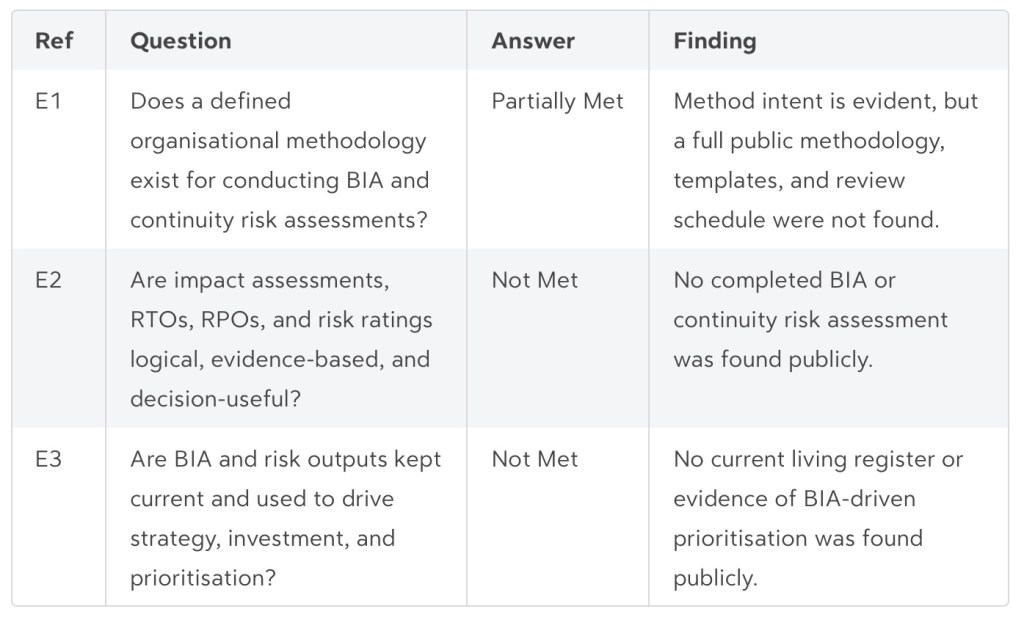
Current: P (Ad hoc)
Assessment note: The policy and risk material indicate that BIA and risk processes exist, but the core working artefacts were not publicly available.
BCM Strategies & Solutions
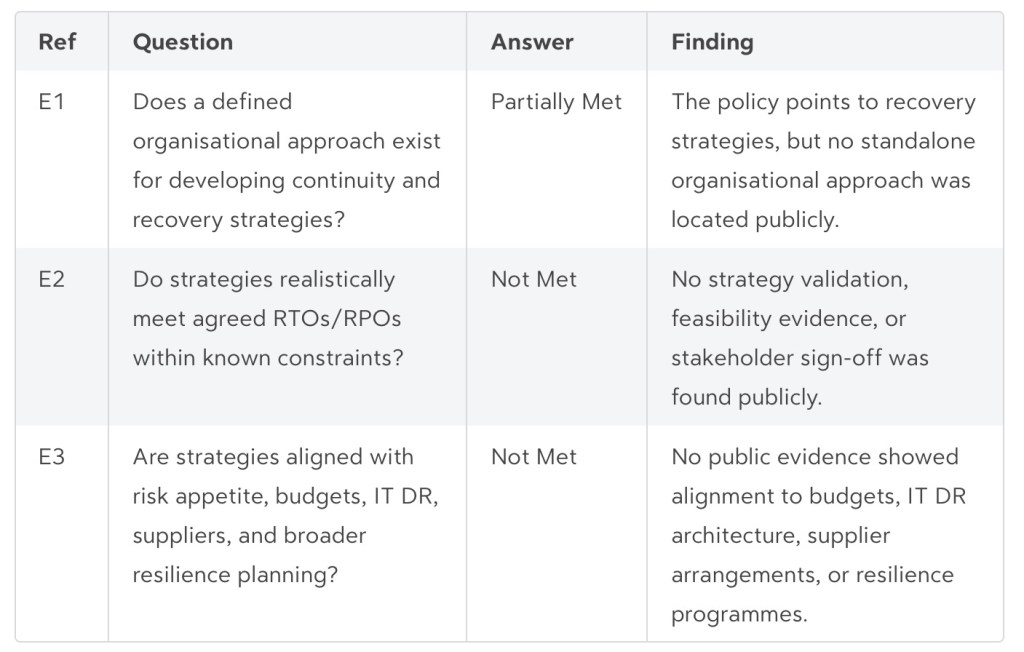
Current: P (Ad hoc)
Assessment note: Recovery strategies are referred to in the policy, but the actual strategy evidence is not public.
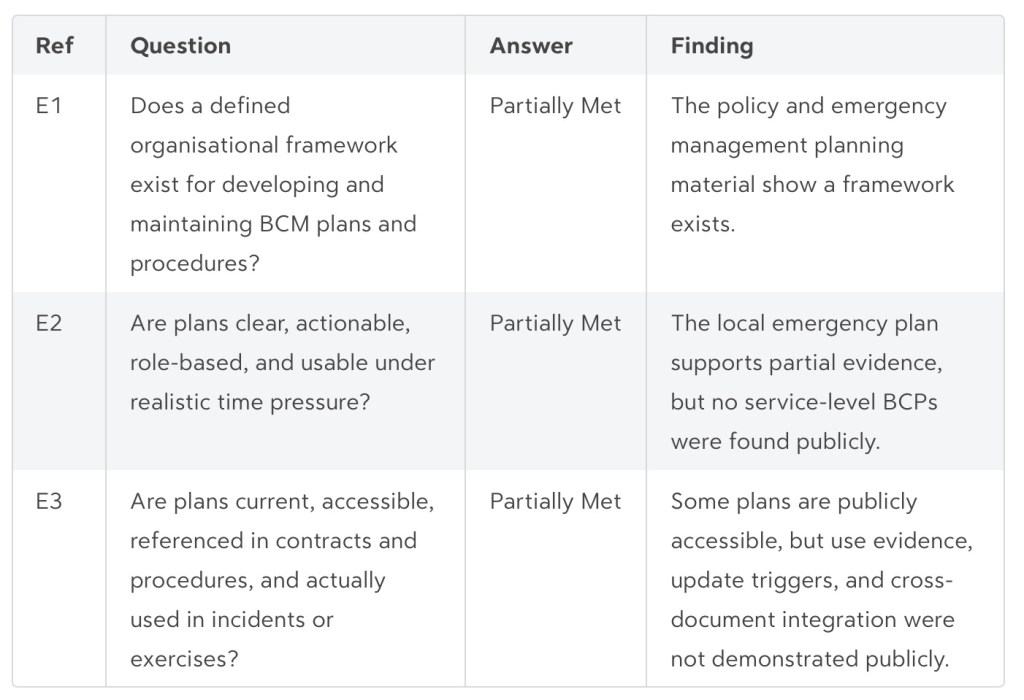
BCM Plans & Procedures
Current: P (Ad hoc)
Assessment note: There is evidence of a planning framework and at least one incident or emergency planning document, but not enough to confirm broader plan quality and maintenance.
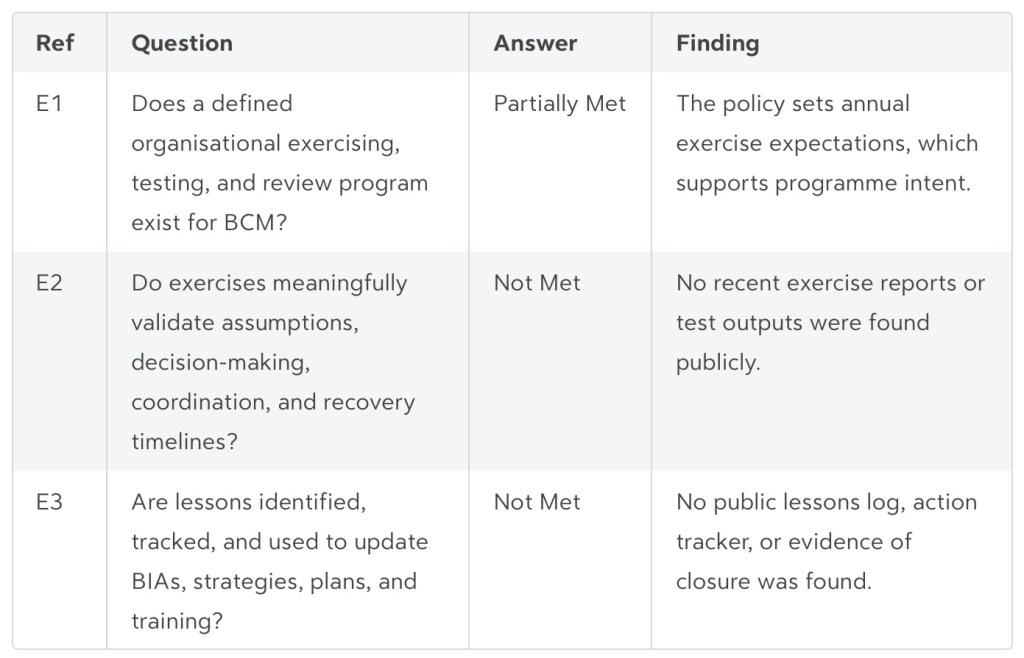
Exercising, Testing & Maintenance
Current: P (Ad hoc)
Assessment note: The programme expects exercising, but the evidence of actual testing and lessons is not public.
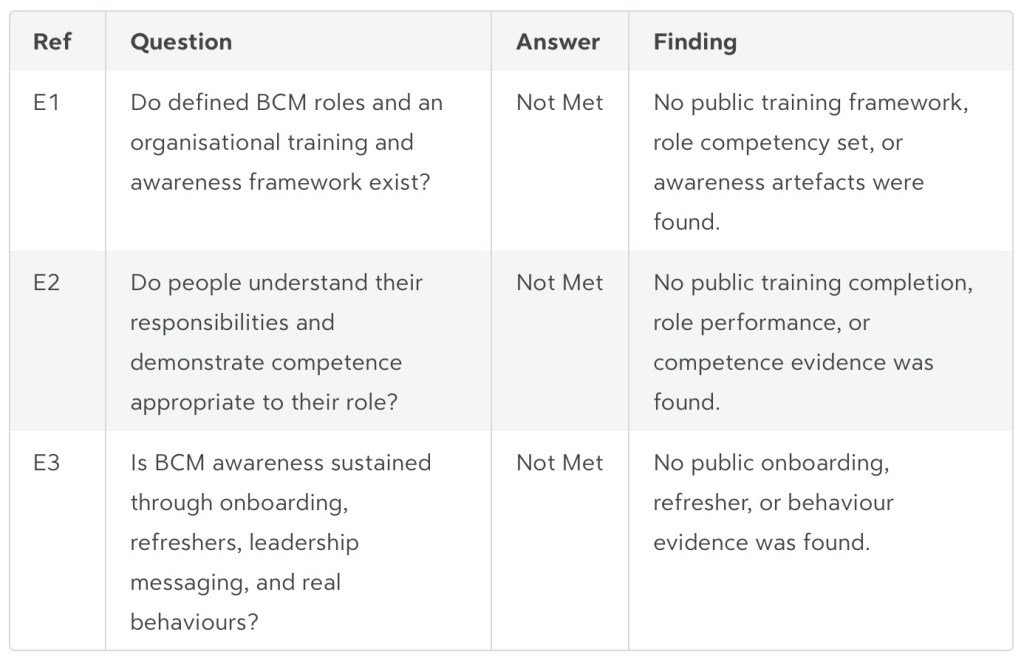
Culture, Training & Awareness
Current: N (Absent)
Assessment note: No public evidence was found to show a BCM training and awareness capability.
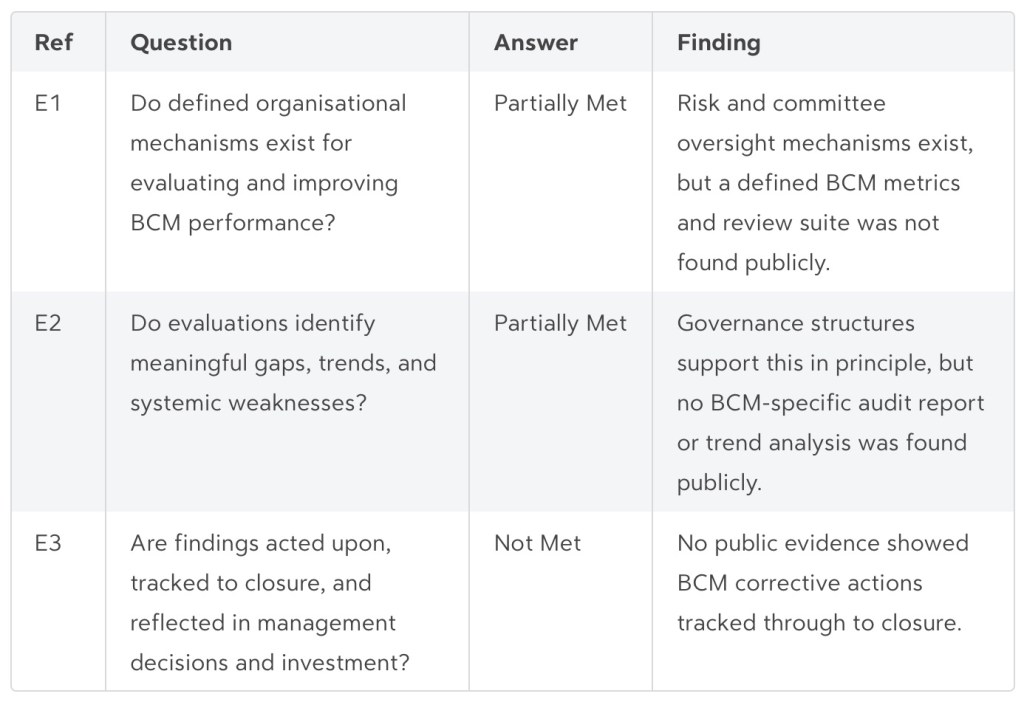
Performance Evaluation & Continuous Improvement
Current: P (Ad hoc)
Assessment note: Wider governance and assurance mechanisms exist, but BCM-specific evaluation evidence is limited.
Strengths
A formal BCM policy exists and appears integrated with wider governance and risk arrangements.[3]
Emergency management arrangements are documented through the Local Emergency Management Plan.[2]
Audit and risk committee structures provide a visible oversight pathway for BCM-related matters.[4][3]
Gaps
No public completed BIAs, service-level BCPs, continuity risk assessments, or current enterprise risk register were found.
No public exercise reports, post-incident reviews, training records, or lessons-action logs were found.[1]
Public evidence does not demonstrate sustained E3 integration into management review, investment, performance, or continuous improvement cycles.[1]
Enterprise oversight mechanisms exist, but no BCM-specific audit report, metrics pack, management review minutes, or action-closure evidence was found publicly. [3][4]
Key findings
- The strongest capability area is governance, because the entity has a formal BCM policy and visible risk and oversight structures.
- The weakest capability area is culture, training, and awareness, because no supporting public evidence was found.
- Across most domains, the main gap is not policy intent but lack of public operational evidence such as completed BIAs, validated strategies, service-level plans, exercise reports, training records, and corrective action logs.
Overall judgement
Bayside Council is a good public example of a continuity programme with visible policy and governance foundations, but the public evidence set is insufficient to demonstrate a fully defined or operational capability under the report’s necessary-and-sufficient E1/E2/E3 standard.[3][2][1]
This entity is a credible example of a continuity programme with basic design elements in place, but it does not meet the evidence threshold for a defined or operational programme on publicly available material alone. Internal records may support a higher rating, but they were not available for this review.
Sources
[1]
[2] [PDF] BAYSIDE Local Emergency Management Plan 2021 https://www.bayside.nsw.gov.au/sites/ default/files/2024-06/BaysideEMPLAN.pdf
[3] [PDF] Audit, Risk & Improvement Committee Terms of Reference 22 May … https:// http://www.bayside.nsw.gov.au/sites/default/files/2024-07/ Audit_Risk_and_Improvement_Committee_(ARIC)_Terms_of_Reference.pdf
[4] [PDF] Agenda of Risk & Audit Committee – 27 September 2018 https://www.bayside.nsw.gov.au/ sites/default/files/2018-09/ Risk%20and%20Audit%20Committee%20Agenda%2027%20September%202018.pdf
[5] [PDF] Business Continuity Management Policy | Bayside Council https://www.bayside.nsw.gov.au/ sites/default/files/2020-05/Business%20Continuity%20Management%20Policy.pdf

 John Salter Consulting Services