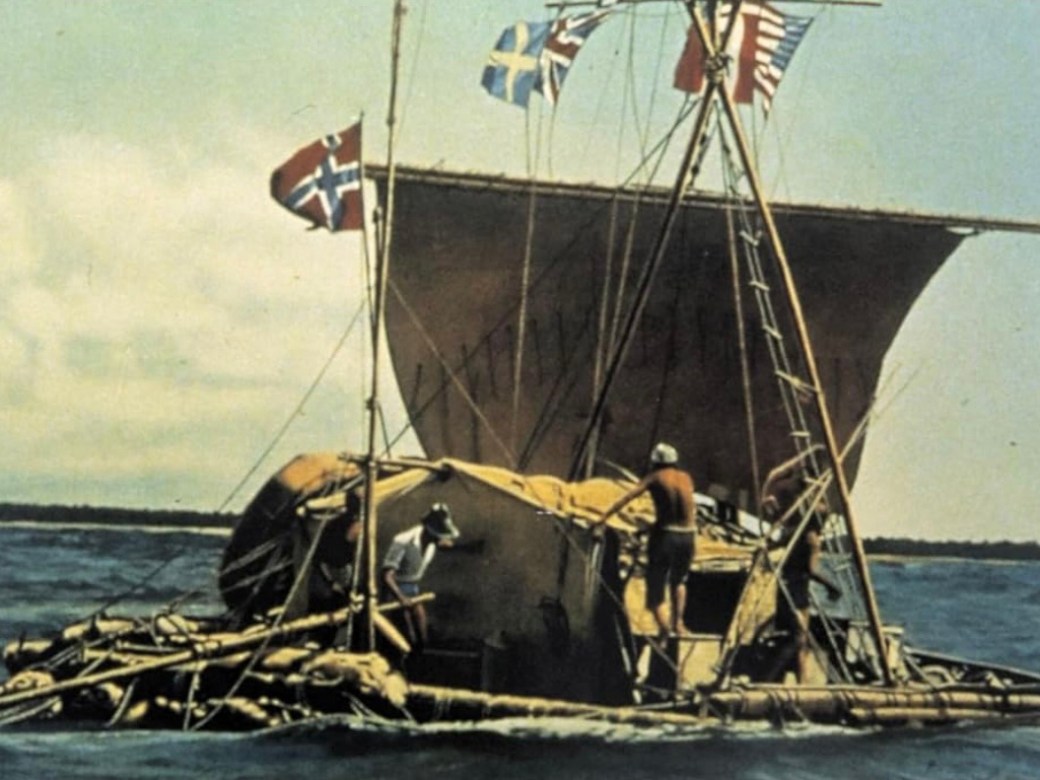
I recall with fondness being absolutely absorbed by the story of the Kon Tiki expedition. I could be found in the high school library with my face buried in the pages … when I probably ought to have been in class. For me, it stands as an example of how “single exposures” can significantly shape and impact the way you think.
I suggest you can treat the Kon Tiki expedition as a compact story of how fragile capability, clear intent, and adaptive learning combine into resilience under prolonged stress.[1][2][3]
Capability and maturity metaphor
A small, minimally “engineered” raft and crew deliberately sail into extreme uncertainty for 101 days, relying on simple but coherent capabilities that strengthen under pressure rather than collapse.[3][4][1] You can link this directly to capability-based definitions of organizational resilience: anticipating the crossing, coping with storms, damage and drift, and adapting operating routines over the journey.[7]
Elements of resilience mapped to Kon Tiki
- Purpose and narrative: Heyerdahl’s explicit aim was to demonstrate that a primitive balsa raft using period materials could cross from Peru to Polynesia, not to run a pleasure cruise. That hypothesis acts like a strategic intent or “design premise” for an organization: it aligns choices, justifies risk, and gives meaning to hardship.[2][4][5]
- Designing for environment, not comfort: The raft was built from balsa logs and natural-fibre lashings, with no metal hull, because Heyerdahl wanted it to behave like pre-Columbian craft and to work with Pacific currents and swells. Organizationally, this is resilience through fit-to-context: structures that flex with the operating environment instead of trying to overpower it.[4][1][2][3]
- Initial fragility, emergent strength: Early expert predictions were that the lashings would wear through, the raft would break up, or it would drift aimlessly for years. In practice, as the ropes swelled with seawater, they tightened and the raft became more coherent; a “barely viable” configuration matured into a robust platform under real conditions. That is a strong metaphor for capability maturity: crude, loosely coupled practices that, subjected to consistent load, tighten, integrate, and stabilise.[6][3][4]
- Improvisation and bricolage: The crew continually repaired lashings, managed a problematic steering oar, and adjusted sail and rigging as weather and sea state changed. This aligns with resilience literature around improvisation, bricolage, and “situation-specific responses” as core to coping and adaptation, not as signs of immaturity.[7][8][3][6]
- Tolerance of slow feedback and lag: It took 97–101 days to confirm whether the whole hypothesis was valid when they finally reached the Tuamotus. That long lag between action and definitive feedback looks a lot like strategic transformation: you must maintain conviction and disciplined practice despite ambiguous, noisy short-term signals.[1][3][4]
- Safe-enough failure: The expedition ended by running aground on a reef at Raroia; the raft was damaged but the crew made safe landfall with no fatalities. In resilience terms, this is “successful failure”: the system can absorb a terminal event without catastrophic loss of life or core purpose.[3][4][1]
How you might use this in your workplace
- As a visual: a simple Kon Tiki route line with “maturity waypoints” (concept, prototype, early storms, mid-ocean repairs, first sight of land, reef impact/landing) annotated with resilience capabilities at each stage.[4][1][3]
- As a narrative case: contrasting “designing a steel ship for comfort and speed” (efficiency, optimization, low variance) with “building a balsa raft that can ride out whatever the Pacific throws at it” (robustness, adaptability, graceful failure).
If you tell this story to a leadership group, what’s the main capability you’d want them to see themselves in: the courage to launch, the willingness to learn mid-ocean, or the ability to land safely even if they hit the reef first?
Sources
[1] Kon-Tiki expedition – Wikipedia https://en.wikipedia.org/wiki/Kon-Tiki_expedition
[2] Kon-Tiki | Explorer, Pacific Ocean, Thor Heyerdahl https://www.britannica.com/topic/Kon-Tiki-raft
[3] Kon-Tiki Expedition: Thor Heyerdahl’s Epic Crossing of … https://www.worldhistory.org/Kon-Tiki_Expedition/
[4] Kon-Tiki ekspedisjonen — Kon-Tiki museetwww.kon-tiki.no › heyerdahls-expeditions › kon-tiki https://www.kon-tiki.no/en/heyerdahls-expeditions/kon-tiki
[5] Thor Heyerdahl’s Kon-Tiki Expedition: Across the Pacific by Raft https://runawayjuno.com/runaway-tales/thor-heyerdahls-kon-tiki-expedition-across-the-pacific-by-raft/
[6] Voyage of the Kon-Tiki Part I: a most challenging hypothesis | TOTA https://www.tota.world/article/2317/
[7] [PDF] Organizational resilience: a capability-based conceptualization https://d-nb.info/1178203778/34
[8] Kon Tiki: The Epic Raft Journey Across the Pacific | Full Documentary https://www.youtube.com/watch?v=gvBYfba8nv8
[9] Kon-Tiki expedition – Wikipedia https://en.wikipedia.org/wiki/Kontiki
[10] UN Organizational Resilience Maturity Model https://unsceb.org/un-organizational-resilience-maturity-model
[11] Kon-Tiki https://remosince1988.com/blogs/stories/kon-tiki
[12] Kon Tiki — A Beautiful Voyage … Into Divine Madness | by Sydney … https://blogs.sydneysbuzz.com/kon-tiki-a-beautiful-voyage-into-divine-madness-ce9682c593e5
[13] Developing organisational resilience https://knowledge.aidr.org.au/resources/ajem-oct-2017-developing-organisational-resilience-organisational-mindfulness-and-mindful-organising/
[14] This is the story of a man behind a bold idea https://www.kon-tiki.com.au/the-kon-tiki-story/
[15] How the Voyage of the Kon-Tiki Misled the World About Navigating … https://www.smithsonianmag.com/smithsonian-institution/how-voyage-kon-tiki-misled-world-about-navigating-pacific-180952478/

 John Salter Consulting Services