Metric: Voluntary turnover in critical roles
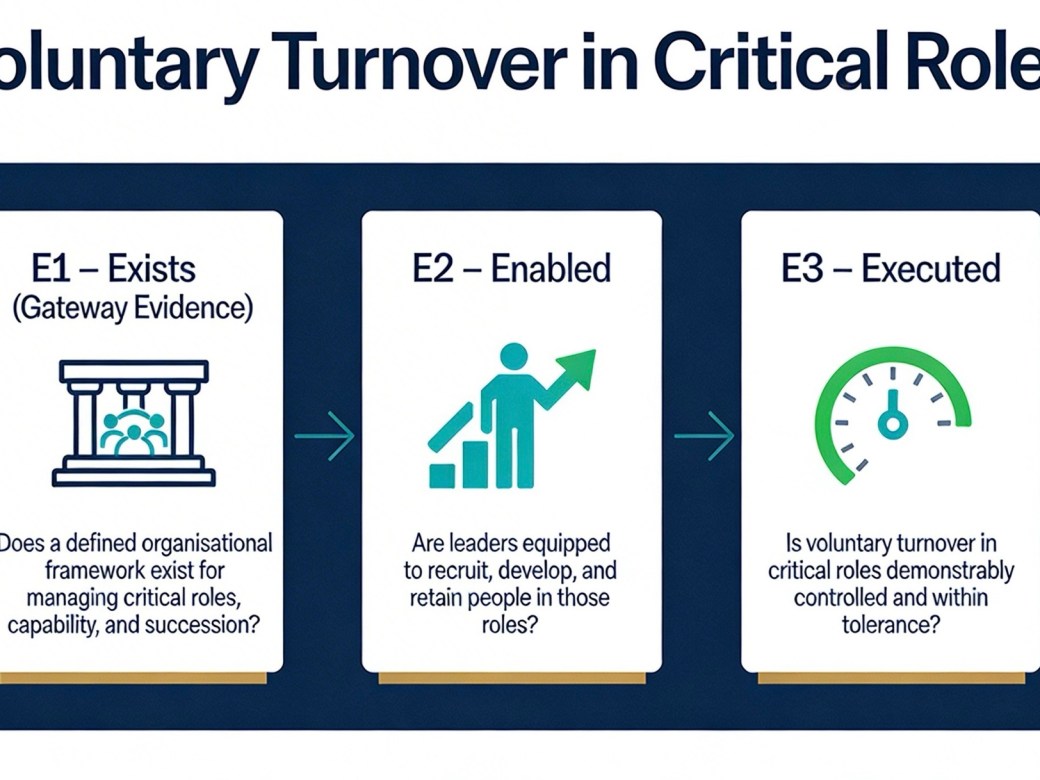
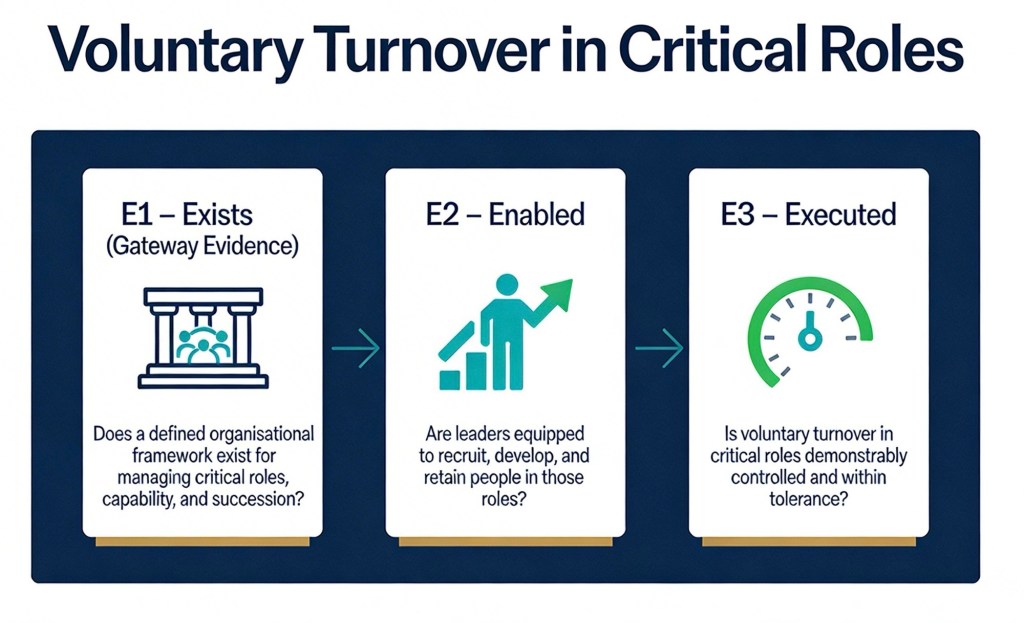
E1 – Exists (Gateway Evidence)
Does a defined organisational framework exist for managing critical roles, capability, and succession?
E2 – Enabled
Are leaders equipped to recruit, develop, and retain people in those roles?
E3 – Executed
Is voluntary turnover in critical roles demonstrably controlled and within tolerance?
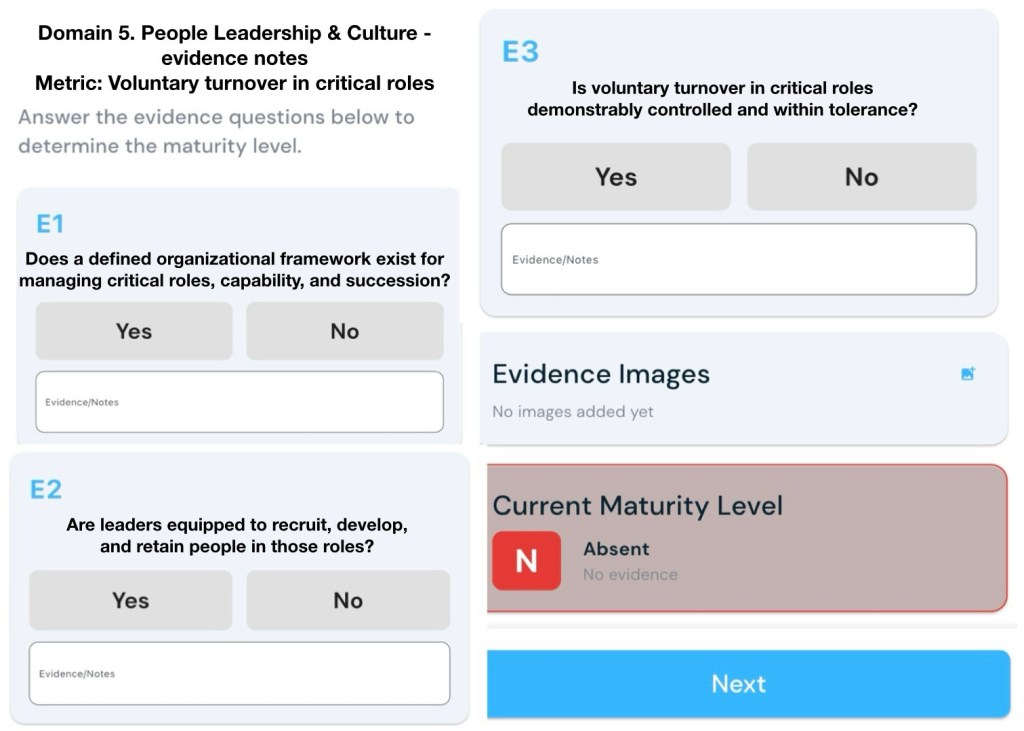
You can think of the assessment as asking: “Can we show there is a clear framework, that leaders are equipped to use it, and that the turnover outcome is actually under control?” Below are examples of evidence and notes that would typically support each level.
E1 – Exists (framework in place)
You are showing that there is a defined organisational framework for identifying critical roles, defining capabilities, and planning succession.
Typical evidence
- Policy or framework documents
- Workforce or talent management framework that defines “critical roles” and how they are identified (e.g., by impact on strategy, risk if vacant, scarcity of skills).[1][2]
- Succession planning policy or guidelines describing processes, accountabilities, review cadence, and governance (e.g., HR leads, business leaders own, board oversight).[3][4][5][1]
- Critical roles inventory
- A current list or heatmap of critical roles across the organisation, signed off by the executive team.
- Criteria or scorecard used to classify roles as “critical” (impact, difficulty to replace, specialised knowledge).[2][6]
- Capability and success profiles
- Role profiles or “success profiles” for critical roles, describing required technical, leadership, and behavioural capabilities.[4][1][2]
- Succession planning artefacts
- Succession planning matrix or 9‑box type outputs: for each critical role, rated successors, readiness (ready now/1–2 years), and risk indicators.[5][7]
- Governance and risk documentation
- HR or People & Culture governance papers describing how critical roles and succession plans are reviewed (e.g., annual talent review, board people committee).
- Risk register entries noting loss of incumbents in critical roles as a strategic or operational risk and referencing the succession framework.[3]
Assessment notes (E1)
- Framework is documented, communicated, and approved by the executive.
- Critical roles are identified using agreed, repeatable criteria, not ad‑hoc opinion.[6][1][2]
- At least one organisation-wide cycle of identification and succession mapping has been completed (even if maturity is early).
- Clear ownership: HR defines the process; line leaders own role identification and succession inputs.[4][6]
E2 – Enabled (leaders equipped)
Here you are testing whether leaders are actually enabled and expected to recruit, develop, and retain talent in critical roles, using the framework.
Typical evidence
- Capability‑building for leaders
- Training programs or toolkits on: succession planning, talent reviews, interviewing for critical roles, development planning, retention conversations, and inclusive talent decisions.[8][6][4]
- Attendance/coverage data showing a meaningful proportion of leaders have completed these programs.
- Processes and tools embedded in BAU
- Standard templates for succession plans, individual development plans (IDPs), and talent review packs.[5][4]
- Regular talent and succession review meetings at business unit and executive level, with schedules and minutes.
- Leader accountability measures
- KPIs or scorecards for people leaders that include: critical‑role fill time, internal promotion rates into critical roles, percentage of critical roles with ready successors, engagement/manager‑effectiveness scores, and voluntary turnover in their teams.[7][9][10][5]
- Links between these KPIs and performance reviews or incentives.
- Development and pipeline activity
- Evidence of targeted development for successors (stretch assignments, mentoring, rotations, formal learning) aligned to success profiles.[2][6][4]
- Data showing percentage of critical roles filled internally vs externally and time‑to‑productivity for new incumbents.[8][5]
- Recruitment enablement
- Clear, up‑to‑date job descriptions and criteria for critical roles shared with recruitment partners.
- Use of structured, capability‑based selection methods (e.g., behavioural interviewing against success profiles).[6][2]
Assessment notes (E2)
- Leaders understand which roles are critical and why, and can access practical tools to manage them.
- People leadership expectations for critical roles are formalised in role descriptions and performance objectives.[4][6]
- There is evidence that leaders are using the framework (e.g., completed talent grids, quality of IDPs, documented talent discussions), not just that it exists.
E3 – Executed (turnover controlled and in tolerance)
Here you are demonstrating that voluntary turnover in critical roles is measured, analysed, and kept within clearly defined tolerance levels.
Typical evidence
- Clear metric definition and tolerance bands
- Documented definition of voluntary turnover in line with HR standards (resignations initiated by employees, excluding redundancies, retirement, etc.).[11][12][13]
- Agreed tolerance or target ranges for voluntary turnover in critical roles (e.g., “aim 5–10% for critical roles, with red threshold above X%”), ideally informed by internal and external benchmarks.[9][10][14][5]
- Regular reporting and segmentation
- Periodic (e.g., monthly/quarterly) reporting of voluntary turnover specifically for critical roles, separate from general turnover.
- Segment analysis: by role, business unit, tenure band, performance level, and manager to identify hotspots and patterns.[10][9][8]
- Trend and benchmark analysis
- Multi‑period trends (12–24 months) showing turnover in critical roles is stable or improving and remains within defined tolerance.
- Where rates exceeded tolerance in prior periods, documented actions and subsequent improvement.[9][10][5][8]
- Root‑cause insight
- Exit interview or survey themes specifically for critical‑role leavers (e.g., pay, manager relationship, career path, workload) and correlation with other people metrics (engagement, compa‑ratio, workload).[10][9]
- Manager‑level heatmaps highlighting outliers and follow‑up with leaders whose teams show high critical‑role attrition.[8][9]
- Demonstrated control actions
- Examples of targeted interventions where critical‑role turnover spiked (e.g., adjusted pay bands, changed managers, redesigned roles, improved onboarding) and the documented impact on turnover.[9][10][8]
- Evidence that succession plans have been activated smoothly when critical‑role incumbents left: time to fill, business continuity, and performance of successors.[5][4]
Assessment notes (E3)
- Voluntary turnover in critical roles is not just measured but actively managed through interventions, with an explicit “within tolerance” definition and thresholds.[10][5][9]
- Data shows that critical‑role turnover is lower than or at least no worse than general turnover and is consistent with target ranges and market context.[14][9][10]
- Leadership discusses critical‑role turnover and succession regularly (e.g., in quarterly business reviews or people committee meetings), and decisions are recorded.
Putting it together – example assessment notes
When documenting your assessment, it can help to write brief, evidence‑based statements such as:
- “A documented enterprise‑wide succession and critical‑role framework has been approved by the Executive and applied in the last annual talent review (E1).”[1][3][4][5]
- “People leaders have been trained in succession planning and are held to KPIs on internal promotion and voluntary turnover; over 80% of critical roles now have at least one identified successor (E2).”[7][6][5][8]
- “Voluntary turnover in critical roles has averaged 7% over the past 12 months against a tolerance band of 5–10%, with clear root‑cause analysis and targeted actions where hotspots arose (E3).”[14][9][10]
Sources
[1] Talent Management Framework: succession planning https://www.uhb.nhs.uk/hr/talent-management/succession-planning/
[2] Definition of a critical role in succession planning – SkillPanel https://skillpanel.com/blog/definition-critical-role-succession-planning/
[3] Microsoft Word – Succession Planning – Support (Green Book) Staff 5.24.25 FINAL BF https://bedsfireresauth.moderngov.co.uk/documents/s7016/Item%2011d%20Succession%20Planning%20-%20Support%20Green%20Book%20Staff%205.24.25%20AC%20FINAL%20BF.pdf
[4] Free succession planning… https://www.aihr.com/blog/succession-planning/
[5] 10 Succession Planning Metrics You Should Know – AIHR https://www.aihr.com/blog/succession-planning-metrics/
[6] Succession and leadership planning that drives organisational … https://downloads.manpowergroup.com.au/succession-and-leadership-planning-that-drives-organisational-success
[7] Succession Planning: Tackling 3 Critical Challenges | Brian Heger https://www.brianheger.com/succession-planning-tackling-3-critical-challenges-brian-heger/
[8] HR case study turnover: How firm cut attrition 30% https://www.upscend.com/blogs/hr-case-study-turnover-how-firm-cut-attrition-30
[9] Voluntary Turnover Rate | HR Strategy Playbook https://umbrex.com/resources/company-analysis/human-resources/voluntary-turnover-rate/
[10] 12 Employee Turnover and Retention KPIs to Measure in 2025 … https://www.netsuite.com/portal/resource/articles/human-resources/employee-turnover-kpis-metrics.shtml
[11] What is Voluntary Turnover? Definition, Causes, and Calculation https://www.aihr.com/blog/voluntary-turnover/
[12] Top HR Metrics for Strategic Workforce Decisions – Visier https://www.visier.com/blog/top-10-strategic-hr-ta-metrics/
[13] Voluntary Turnover Rate: Meaning, Formula, and How to Reduce It https://taggd.in/hr-glossary/voluntary-turnover-rate/
[14] 25 Essential HR Metrics and KPIs You Need to Track https://www.subscribe-hr.com.au/blog/25-hr-metrics-and-kpis
[15] How to Calculate Voluntary Turnover Rate as an HR Metric | Acorn https://acorn.works/blog/voluntary-turnover-rate

 John Salter Consulting Services