📈 Assessment Criteria and Evidence by Process Category
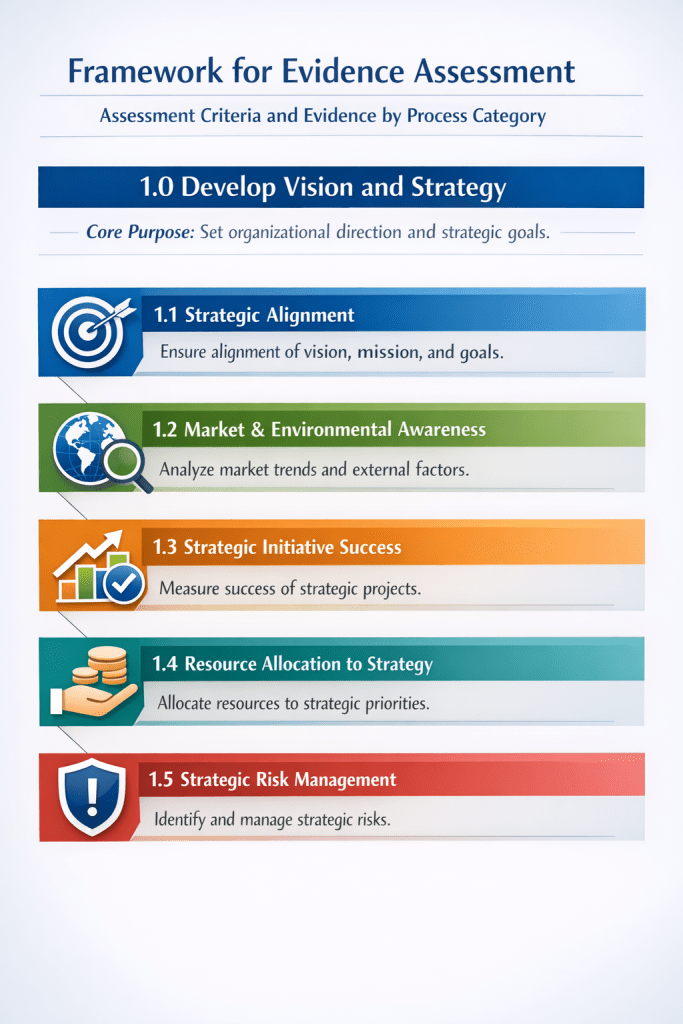


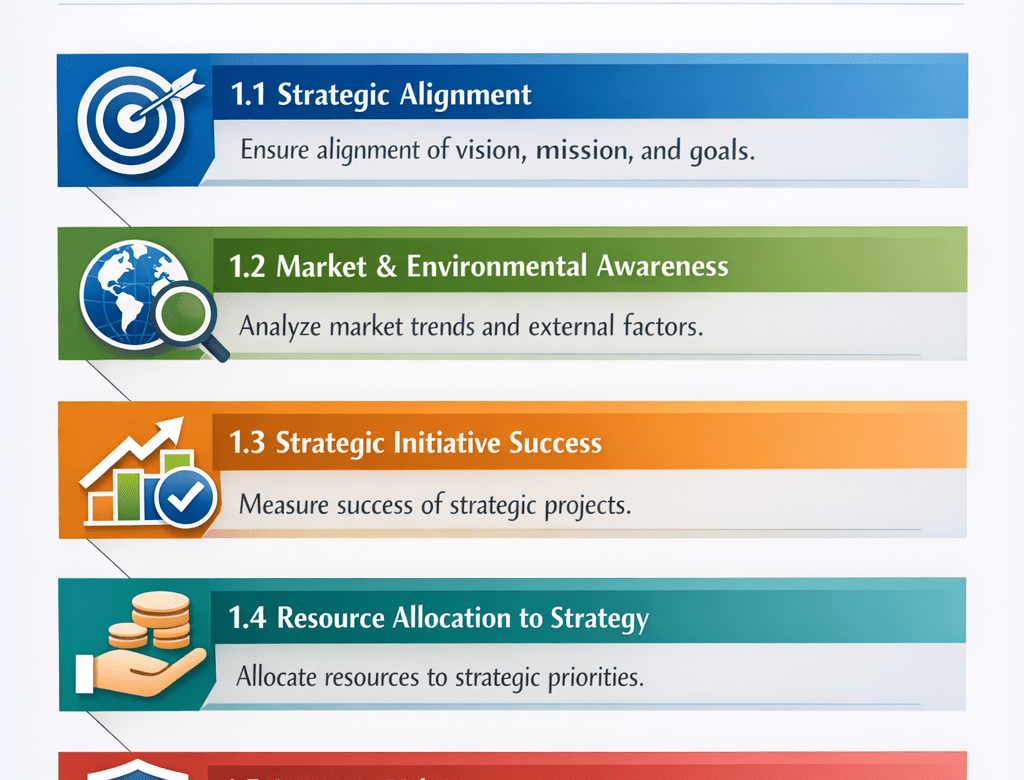
1.1 Strategic Alignment
· Evidence to Seek: Documented strategic plans, cascaded department/team objectives, communication materials.
· Sufficient Evidence: A high-quality strategy map or objective tree showing a clear, logical cascade from vision to actionable team goals (Moderate). Validation through employee surveys showing >80% understanding of how their work contributes to strategy elevates it to High.

1.2 Market & Environmental Awareness
· Evidence to Seek: PESTLE/SWOT analysis reports, competitor analysis, market research data.
· Sufficient Evidence: A systematic review of internal and external data sources conducted within the last fiscal year, with documented assumptions and identified implications for strategy (Moderate to High).

1.3 Strategic Initiative Success
· Evidence to Seek: Initiative charters, milestone reports, post-implementation reviews, benefit realization reports.
· Sufficient Evidence: Post-implementation review reports for >70% of major initiatives from the past 3 years, showing measured outcomes against original business cases (Moderate). Benchmarking success rates against industry data elevates it to High.

1.4 Resource Allocation to Strategy
· Evidence to Seek: Capital and operational budgeting documents linked to strategic themes.
· Sufficient Evidence: Financial audit trail demonstrating that >60% of discretionary capital spend is allocated to projects tagged with specific strategic objectives (Moderate).

1.5 Strategic Risk Management
· Evidence to Seek: Risk registers, mitigation plans, scenario analysis documents.
· Sufficient Evidence: A living risk register reviewed quarterly by senior leadership, with clear ownership and mitigation actions for top-5 strategic risks (Moderate).
2.0 Develop and Manage Products and Services
Core Purpose: Manage the portfolio and execute the development lifecycle.
2.1 Portfolio Health
· Evidence to Seek: Portfolio dashboards, product P&L statements, ROI calculations.
· Sufficient Evidence: A portfolio performance report showing the percentage of products/services meeting revenue and profitability targets, with trend analysis over time (Moderate).
2.2 Development Process Efficiency
· Evidence to Seek: Project timelines, stage-gate review reports, time-to-market metrics.
· Sufficient Evidence: Controlled internal benchmarking comparing time-to-market and R&D spend efficiency across different product lines or teams (High).
2.3 Quality of Outputs
· Evidence to Seek: Prototype test results, first-pass yield rates, customer validation feedback, patent filings.
· Sufficient Evidence: Standardized test reports from the last 5 development projects showing that >90% of defined quality and specification criteria were met before launch (Moderate).
2.4 Requirements Management
· Evidence to Seek: Market requirement documents (MRD), product requirement documents (PRD), change request logs.
· Sufficient Evidence: An audit trail for a sample of major features showing a clear link from customer/market input to final technical specifications (Moderate).
2.5 Lifecycle Management
· Evidence to Seek: Product roadmaps, sunset/retirement plans, upgrade paths.
· Sufficient Evidence: A governed roadmap process documented for all major product lines, with scheduled reviews and clear decision criteria for maintenance and retirement (Moderate).
3.0 Market and Sell Products and Services
Core Purpose: Understand the market, drive demand, and execute sales.
3.1 Market Insight Accuracy
· Evidence to Seek: Market research reports, win/loss analysis, sales forecast accuracy reports.
· Sufficient Evidence: Quarterly analysis comparing forecasted market share or sales against actual results, with a documented variance analysis and accuracy rate >75% (Moderate).
3.2 Marketing Campaign Effectiveness
· Evidence to Seek: Campaign dashboards, cost-per-lead (CPL), customer acquisition cost (CAC), conversion rates.
· Sufficient Evidence: A/B testing or multi-variate test reports for major campaigns demonstrating a statistically significant lift in key metrics (High).
3.3 Sales Force Productivity
· Evidence to Seek: Sales per rep, quota attainment rates, pipeline conversion rates.
· Sufficient Evidence: Comparative cohort analysis of high vs. average performers to identify success-driving activities and processes (Moderate to High).
3.4 Pricing Strategy Effectiveness
· Evidence to Seek: Price realization reports, competitive pricing analysis, elasticity studies.
· Sufficient Evidence: A pricing model validated by comparing its predicted volume/revenue impact against actual results from price changes in at least 3 product segments (Moderate).
3.5 Channel & Partner Performance
· Evidence to Seek: Partner scorecards, channel sales data, joint business plans.
· Sufficient Evidence: Partner performance dashboards for top channels showing agreed-upon KPIs, with formal quarterly business reviews conducted (Moderate).
4.0 Manage Supply Chain for Physical Products
Core Purpose: Plan, source, make, and deliver physical products.
4.1 End-to-End Plan Reliability
· Evidence to Seek: S&OP meeting minutes, forecast accuracy metrics, inventory turnover rates.
· Sufficient Evidence: Time-series data showing a reduction in the mismatch between supply plan and actual demand (e.g., reduction in excess inventory or stockouts) over the last 6 quarters (Moderate).
4.2 Supplier Performance
· Evidence to Seek: Supplier scorecards, on-time delivery (OTD) rates, quality acceptance rates.
· Sufficient Evidence: Scorecards for strategic suppliers (>80% of spend) showing performance against contractually agreed OTD, quality, and cost metrics, with formal review cycles (Moderate).
4.3 Production Efficiency & Quality
· Evidence to Seek: Overall Equipment Effectiveness (OEE), first-pass yield, scrap/rework rates.
· Sufficient Evidence: Controlled benchmarks of OEE or unit cost against industry peers through databases like APQC’s (High).
4.4 Logistics Excellence
· Evidence to Seek: On-time in-full (OTIF) delivery to customers, freight cost as % of revenue, warehouse capacity utilization.
· Sufficient Evidence: Customer OTIF score tracked and reported weekly, with root cause analysis conducted for misses and a positive trend over time (Moderate).
4.5 Supply Chain Resilience
· Evidence to Seek: Risk assessments for key nodes, alternate sourcing plans, inventory safety stock calculations.
· Sufficient Evidence: A simulation or stress test report for the top-3 identified supply chain risks, demonstrating the network’s ability to maintain >70% service level under disruption (Moderate).
5.0 Deliver Service (For Service-Based Offerings)
Core Purpose: Plan, assign, and execute service delivery.
5.1 Service Delivery Planning
· Evidence to Seek: Resource forecasts, workforce schedules, capacity utilization reports.
· Sufficient Evidence: Scheduling accuracy reports showing that planned resource allocation matched actual demand within a 10% variance for >80% of service periods (Moderate).
5.2 Execution Quality
· Evidence to Seek: Standard operating procedures (SOPs), quality audit results, rework rates.
· Sufficient Evidence: Internal audit results showing >90% adherence to key SOPs across delivery teams, with a closed-loop corrective action system (Moderate).
5.3 Service Capacity Management
· Evidence to Seek: Demand patterns, average handle time, backlog reports.
· Sufficient Evidence: Analysis showing that service capacity (people, tools) is adjusted in response to forecasted demand changes with a lead time that prevents significant backlog or idle time (Moderate).
5.4 Service Delivery Technology Effectiveness
· Evidence to Seek: System uptime logs, user satisfaction surveys, process automation rates.
· Sufficient Evidence: Technology ROI analysis showing that tools (e.g., field service apps, scheduling software) have reduced administrative time or improved first-time fix rates as projected (Moderate).
5.5 Cost of Service Delivery
· Evidence to Seek: Cost per service event, cost per transaction, budget vs. actual reports.
· Sufficient Evidence: Trend analysis of cost per transaction/event over the last 8 quarters, correlated with changes in volume and efficiency initiatives (Moderate).
6.0 Manage Customer Service
Core Purpose: Support customers post-sale and manage the relationship.
6.1 Issue Resolution Efficiency
· Evidence to Seek: First contact resolution (FCR) rate, average handle time (AHT), case backlog.
· Sufficient Evidence: Correlation analysis showing that improvements in FCR or AHT (due to training, knowledge base) lead to measurable increases in customer satisfaction (CSAT) or reductions in repeat contacts (High).
6.2 Customer Satisfaction & Effort
· Evidence to Seek: CSAT, Net Promoter Score (NPS), Customer Effort Score (CES) surveys.
· Sufficient Evidence: Representative survey data (e.g., >15% response rate) collected consistently, showing trends over time and segmented by key customer groups (Moderate).
6.3 Knowledge Management
· Evidence to Seek: Knowledge base usage stats, deflection rate (web self-service), agent feedback on content.
· Sufficient Evidence: Usage analytics showing that the knowledge base is the top source consulted by agents, with a monthly review process to update content based on search failures or new issues (Moderate).
6.4 Service Recovery Effectiveness
· Evidence to Seek: Escalation rates, escalation resolution time, compensation logs.
· Sufficient Evidence: Closed-case review of escalated issues showing that >90% have a documented root cause and that corrective actions to prevent recurrence are tracked to completion (Moderate).
6.5 Customer Relationship Growth
· Evidence to Seek: Cross-sell/up-sell rates from service interactions, customer lifetime value (CLV) trends.
· Sufficient Evidence: Tracking data demonstrating that a defined percentage of satisfied customers (from survey follow-ups) accepted offers for additional products/services (Moderate).
7.0 Develop and Manage Human Capital
Core Purpose: Plan, acquire, develop, and retain workforce talent.
7.1 Workforce Planning Alignment
· Evidence to Seek: Workforce plans, skills gap analyses, headcount forecasts vs. actuals.
· Sufficient Evidence: A skills inventory and gap analysis updated annually, explicitly linked to strategic goals, with a hiring/development plan to close priority gaps (Moderate).
7.2 Talent Acquisition Quality
· Evidence to Seek: Time-to-fill, quality of hire (e.g., performance ratings after 1 year), sourcing channel effectiveness.
· Sufficient Evidence: Predictive validity study of hiring assessments/interviews, showing a statistically significant correlation with subsequent on-the-job performance ratings (High).
7.3 Employee Development Impact
· Evidence to Seek: Training participation rates, pre/post-assessments, application of learning on the job.
· Sufficient Evidence: Level 3 (Application) evaluation data for key development programs, showing that >70% of participants apply new skills on the job, with manager verification (Moderate).
7.4 Performance Management Effectiveness
· Evidence to Seek: Goal completion rates, calibration session notes, turnover rates among high performers.
· Sufficient Evidence: Analysis showing a clear differentiation in rewards, promotions, and development opportunities between top-rated and low-rated performers (Moderate).
7.5 Employee Engagement & Retention
· Evidence to Seek: Engagement survey results, voluntary turnover rates, exit interview analysis.
· Sufficient Evidence: Engagement survey results with >80% participation, showing clear action planning at the team/department level based on results, and follow-up pulse surveys showing improvement in targeted areas (Moderate).
8.0 Manage Information Technology
Core Purpose: Manage IT strategy, development, and operations.
8.1 IT-Business Alignment
· Evidence to Seek: IT strategy document, project portfolio aligned to business objectives, stakeholder satisfaction surveys.
· Sufficient Evidence: A governed project portfolio where 100% of major initiatives have a documented business case approved by business sponsors, reviewed annually (Moderate).
8.2 Project Delivery Performance
· Evidence to Seek: On-time, on-budget, and scope delivery rates; benefits realization.
· Sufficient Evidence: Performance data for the last 10 major projects showing a >75% success rate against the triple constraint (time, budget, scope), with a standardized methodology used (Moderate).
8.3 Service Reliability & Performance
· Evidence to Seek: System availability/uptime, mean time to repair (MTTR), incident tickets.
· Sufficient Evidence: Service level agreement (SLA) compliance reports showing >99% achievement for critical systems over the past year, with a downward trend in severe incidents (Moderate).
8.4. Security & Risk Management
· Evidence to Seek: Security audit reports, vulnerability scan results, penetration test results, patching compliance rates.
· Sufficient Evidence: Independent third-party audit reports (e.g., ISO 27001, SOC 2) with no major non-conformities, and patching compliance for critical systems >95% (High).
8.5 Technology Value & Innovation
· Evidence to Seek: IT spend as % of revenue, business process automation rates, adoption rates of new tools.
· Sufficient Evidence: Business case tracking showing that at least 60% of annual IT capex is allocated to projects with a clear innovation or efficiency ROI, with post-implementation reviews conducted (Moderate).

The quality of evidence for business process performance can be categorized into four main levels, adapted for an organizational context:
High: Evidence from controlled benchmarking against industry standards (e.g., using APQC’s metrics) or from well-designed internal time-series analyses showing a clear link between process changes and outcomes.
Moderate: Evidence from internal comparative analysis (e.g., between departments or product lines) or from validated business cases with documented assumptions and realized benefits.
Low: Evidence from single-instance performance reports, unvalidated internal surveys, or descriptive case studies without comparative data.
Very Low: Evidence based solely on anecdotal feedback or unsubstantiated expert opinion.
(Sufficient evidence typically requires a body of information rated at least “Moderate.” For critical strategic decisions, “High” quality evidence is necessary.)

 John Salter Consulting Services