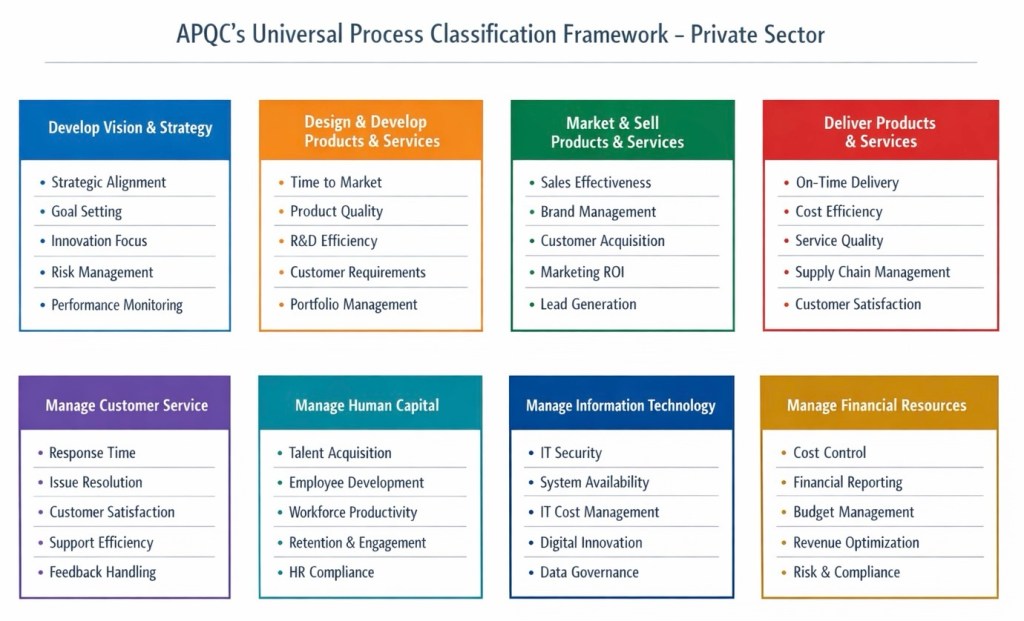
These categories represent the highest-level view of an end-to-end enterprise. The assessment criteria are key performance indicators (KPIs) that organizations typically use to measure the effectiveness, efficiency, and output quality of each process category.
Key Application: This framework allows organizations to map their processes, identify gaps, and benchmark performance against industry standards using these common criteria, driving focused improvements in process maturity and overall business performance.

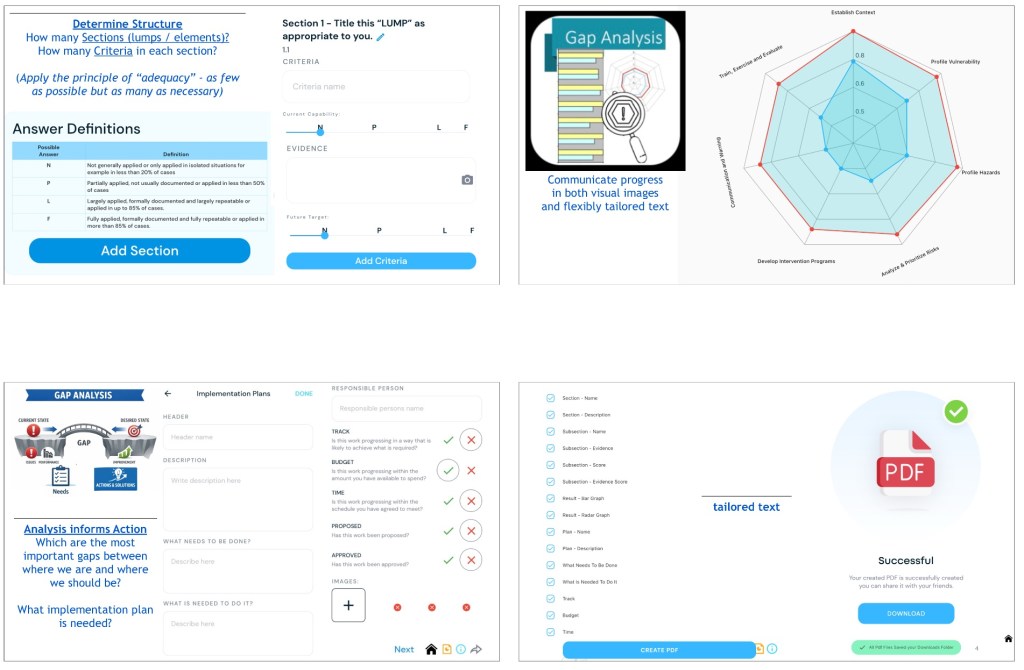
The text below can be considered for editing and using in the Gap Analysis app.

1 Develop Vision and Strategy
Processes to define the organization’s purpose, long-term direction, and enable strategic decision-making.
Top 5 Assessment Criteria:
- Achievement of Strategic Goals: Percentage of defined strategic objectives (e.g., market entry, new product lines) met within the planning cycle.
- Market Share Growth/Position: Change in market share or competitive ranking attributed to strategic choices.
- Return on Strategic Investments (ROSI): Financial and non-financial return on key strategic initiatives (e.g., M&A, major CapEx).
- Stakeholder Alignment: Internal (board, leadership) and external (investor) confidence in the strategy, often measured by surveys.
- Strategic Planning Cycle Efficiency: Time and resource cost to produce an actionable, data-informed strategic plan.
2 Develop and Manage Products and Services
Processes to research, portfolio manage, design, develop, and launch new offerings.
Top 5 Assessment Criteria:
- Time-to-Market: Average cycle time from concept/ideation to commercial availability.
- Innovation Revenue Impact: Percentage of total revenue from products/services launched in the last 3-5 years.
- Development Cost vs. Budget: R&D and design spending variance against planned investment.
- Launch Success/Quality Rate: Measured by customer acceptance, defect rates at launch, or achievement of first-year sales targets.
- Portfolio Vitality Ratio: Proportion of projects in the pipeline representing incremental vs. transformative innovation.
3 Market and Sell Products and Services
Processes to understand the market, create demand, and execute the sales transaction.
Top 5 Assessment Criteria:
- Sales Growth & Win Rate: Year-over-year revenue increase and percentage of qualified leads/proposals that convert to sales.
- Customer Acquisition Cost (CAC): Total sales and marketing cost per new customer acquired.
- Sales Pipeline Velocity: The speed at which opportunities move from creation to closure.
- Brand Strength & Market Reach: Measured by awareness surveys, digital engagement metrics, or channel penetration.
- Marketing Return on Investment (MROI): Revenue attributable to marketing campaigns relative to their cost.
4 Deliver Products and Services
The core operational processes to plan, source, make, and fulfill customer orders (Supply Chain & Operations).
Top 5 Assessment Criteria:
- Perfect Order Fulfillment (On-Time, In-Full, No Errors): The primary measure of operational reliability.
- Total Delivered Cost / Cost of Goods Sold (COGS): Efficiency of the end-to-end production and delivery cost structure.
- Order-to-Cash Cycle Time: The speed and efficiency of the entire workflow from customer order to payment receipt.
- Asset Utilization & Inventory Turns: Efficiency in using physical assets (plant, equipment) and working capital (inventory).
- Operational Quality Yield: Internal defect rates, scrap, and rework costs.
5 Manage Customer Service
Processes to provide post-sale support, manage customer relationships, and enhance retention.
Top 5 Assessment Criteria:
- Customer Satisfaction (CSAT) & Net Promoter Score (NPS): Direct measures of customer loyalty and experience.
- First-Contact Resolution (FCR) Rate: Percentage of customer inquiries resolved in the first interaction.
- Average Service Resolution Time: Mean time to resolve a customer issue from open to close.
- Customer Retention/Churn Rate: Percentage of customers retained over a specific period.
- Cost per Service Interaction: Operational efficiency of the service delivery function.
6 Develop and Manage Human Capital
Processes to recruit, develop, engage, and retain the workforce.
Top 5 Assessment Criteria:
- Employee Engagement Score & Voluntary Turnover Rate: Measures of workforce commitment and stability.
- Talent Pipeline Health: Time-to-fill critical positions and strength of succession plans for key roles.
- Training Effectiveness & Skills Progression: Impact of development programs on performance and promotion readiness.
- Productivity per Full-Time Equivalent (FTE): Revenue or output relative to headcount.
- Diversity, Equity, and Inclusion (DEI) Metrics: Representation across levels and inclusivity survey scores.
7 Manage Information Technology (IT) and Knowledge
Processes to plan, develop, maintain, and secure information assets, systems, and intellectual capital.
Top 5 Assessment Criteria:
- IT System/Application Availability & Reliability: Uptime percentage and mean time between failures (MTBF).
- IT Project Performance: Percentage of projects delivered on-time, on-budget, and meeting scope/requirements.
- Total Cost of IT Ownership (Relative to Revenue or Peers): Efficiency of IT spending.
- Data Quality & Security Posture: Accuracy and usability of data; number/severity of security incidents.
- Business User Satisfaction with IT Services: Internal customer feedback on support and system effectiveness.
8 Manage Financial and Physical Resources
Processes to plan, allocate, and steward financial assets, facilities, and other capital resources.
Top 5 Assessment Criteria:
- Financial Plan/Budget Variance: Accuracy of forecasting and adherence to financial plans.
- Return on Invested Capital (ROIC) / Return on Assets (ROA): Effectiveness in generating returns from financial and physical assets.
- Working Capital Efficiency (e.g., DSO, DIO, DPO): Metrics like Days Sales Outstanding that show cash flow management.
- Cost of Finance Function: Efficiency of the financial operations (e.g., cost to process a payment, close the books).
- Regulatory Compliance Rate (Tax, Reporting): Timeliness and accuracy of mandatory financial filings and obligations.

 John Salter Consulting Services