Given ISO 9001:2026 will incorporate extra depth for leadership, culture, risk–opportunity, digital and climate themes, how popular is the domain model (below) likely to be with the current USA leadership?

Below is a domain model one could turn into a capability assessment framework (maturity grid, heat map, etc.).[1][2][3][4]
1. Context, Stakeholders and Strategic Alignment
Assess whether the QMS is anchored in real context, stakeholders and strategy, including climate and resilience.[3][4][1]
Core capability domains:
- Organizational context and climate factors (including climate change and sustainability in context analysis).[4][1]
- Interested parties and requirements (customers, regulators, supply-chain, community, climate-related expectations).[2][3]
- QMS scope and architecture (process approach, boundaries, interfaces, digital/AI-enabled processes).[3][4]
- Strategic alignment and quality objectives integration into business planning.[5][1]
Example maturity question: “To what extent are quality objectives derived from and reviewed against business strategy and climate/sustainability drivers?”[1][4]
2. Leadership, Governance and Culture
The 2026 revision strengthens leadership accountability, ethical culture and governance, so this domain becomes more explicit.[6][7][2][5]
Core capability domains:
- Leadership commitment and role modelling of a quality and ethics culture (top management behaviour, decisions, priorities).[2][5]
- Quality policy and governance (policy aligned with context and strategy; oversight bodies, decision forums).[1][3]
- Roles, responsibilities and authorities (clear, practiced, and effective delegation for QMS performance).[8][3]
- Culture, values and awareness (awareness now includes values and culture, not just procedures).[2]
Example maturity question: “How consistently do leaders take decisions that prioritise long‑term customer value and ethical behaviour over short‑term local optimisation?”[5][2]
3. Risk, Opportunity and Change Planning
ISO 9001:2026 is expected to clarify risk vs opportunity and strengthen planning for change and resilience.[4][5][1][2]
Core capability domains:
- Integrated risk and opportunity management (systematic analysis and evaluation, not just lists; equal discipline for opportunities).[1][2]
- Resilience and continuity considerations (ability of processes and supply chain to withstand disruption).[4]
- Climate and sustainability risks/opportunities explicitly considered in planning activities.[4][1]
- Change planning (structured planning, communication and review of changes to processes, tech, structure).[3][2]
Example maturity question: “To what extent are risks, opportunities and planned changes linked to defined controls, owners, and measurable effects on QMS objectives?”[2][1]
4. Resources, People, Knowledge and Digital Enablement
This domain captures people, infrastructure, knowledge and the increasingly explicit digital/AI aspects.[9][2][4]
Core capability domains:
- People capability, competence and engagement (skills, training, empowerment, participation).[3][2]
- Infrastructure and work environment (physical, technological, and digital workplaces fit for purpose).[3][4]
- Organizational knowledge management and learning (retention, application, sharing, and learning beyond basic product conformity).[2][4]
- Digital and data capabilities (AI, automation, analytics, digital services, and data integrity in cloud environments).[10][9][4]
- Documented information lifecycle in digital environments (creation, control, security, usability, signatures, traceability).[4][3]
Example maturity question: “How deliberately is organizational knowledge (people + data + digital systems) captured, curated and reused to improve processes and products?”[2][4]
5. Customer, Market and Supply‑Chain Management
ISO 9001 has always been customer‑centric; 2026 strengthens communication, contingency, and supply‑chain alignment.[3][4][2]
Core capability domains:
- Customer insight and communication (requirements, expectations, feedback via multiple channels).[2][3]
- Offer and contract management (product/service definition, review, and agreement, including digital offerings).[4][3]
- Contingency and customer communication in disruptions (informing customers about contingency plans).[4][2]
- Supplier and external provider management (alignment with customers’ and interested parties’ requirements, supply‑chain risk).[2][4]
- Management of customer/external property and data (including digital assets and information security controls).[8][2]
Example maturity question: “How proactively are supply‑chain risks and contingencies communicated to customers and integrated into contracts and SLAs?”[4][2]
6. Operational Design, Control and Improvement
This is the classic “8.x operations” domain, but extended to digital products/services and automated monitoring.[9][3][4]
Core capability domains:
- Process architecture and control (end‑to‑end process design, interfaces, criteria, controls for both physical and digital services).[3][4]
- Design and development management (including software, digital platforms, AI‑enabled functions, and iterative/Agile approaches).[10][9][4]
- Production, service provision and change control (execution discipline, change impact assessment, configuration control).[8][3]
- Monitoring and measurement methods, including automated and real‑time data (sensors, dashboards, analytics).[9][4]
- Post‑delivery and lifecycle activities (after‑sales support, updates, digital releases, warranty, recalls).[8][3]
Example maturity question: “To what extent are operational controls and monitoring designed using real‑time data and feedback loops across the full product or service lifecycle?”[9][4]
7. Performance Insight, Review and Learning
The 2026 draft emphasises richer performance evaluation, explicit audit objectives, and stronger management review linkage to improvement.[1][3][2]
Core capability domains:
- Performance measurement and analytics (selection, analysis and evaluation of process, product, and customer metrics).[3][2]
- Customer satisfaction insight using diverse channels (surveys, complaints, returns, digital signals).[2][3]
- Internal audit programme effectiveness (risk‑based, with clear objectives and follow‑through).[3][2]
- Management review discipline (inputs reflect context, interested parties, changes; outputs drive action and strategy updates).[2][3]
Example maturity question: “How consistently do management reviews integrate changes in interested parties, context and performance data into concrete, tracked improvement decisions?”[3][2]
8. Improvement, Innovation and Corrective Action
ISO 9001:2026 clarifies that continual improvement must address suitability, adequacy and effectiveness, not only nonconformity.[1][2]
Core capability domains:
- Continual improvement system (structured pipeline of ideas, from opportunities and lessons learned through to implemented changes).[1][2]
- Corrective action and problem‑solving (root cause analysis, systemic fixes, verification of effectiveness).[8][3]
- Innovation and opportunity management (opportunities treated as strategic tools, not ad‑hoc suggestions).[4][2]
- Periodic challenge of QMS suitability and adequacy (does the QMS still fit the evolving business and digital model?).[1][2]
Example maturity question: “How often does the organization deliberately reassess whether its QMS is still suitable, adequate and effective for its evolving business model and technologies?”[1][2]
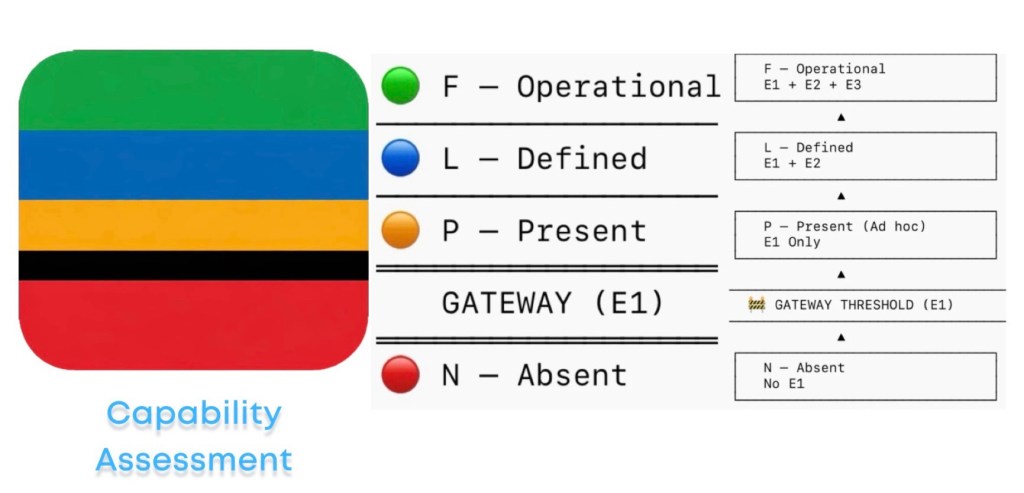
E1 E2 E3 evidence questions by domain
Sources
[1] ISO 9001:2026 Revision: Key Changes, Timeline & Transition Guide https://www.9001simplified.com/learn/next-iso-9001-revision.php
[2] ISO 9001:2026 Revision – Key Changes and How to Prepare https://advisera.com/articles/iso-9001-2026-revision-key-changes/
[3] ISO 9001:2015 Requirements – Summary of Each Section https://the9000store.com/iso-9001-2015-requirements/
[4] ISO 9001:2026 Draft Update: What’s Changing & How to Prepare https://www.glocertinternational.com/resources/articles/iso-9001-2026-changes-and-transition/
[5] ISO 9001:2026 Is on the Horizon: Key Changes and How to Prepare … https://www.linkedin.com/pulse/iso-90012026-horizon-key-changes-how-prepare-early-sjmze
[6] ISO 9001:2026 – Preparing for the Next Generation of Quality … https://compliantltd.com/insights/updated-iso-management-system-2026/
[7] Prepare for ISO 9001:2026 | Governance Platform – Zebsoft https://zebsoft.co.uk/iso-9001-2026-preparation-platform/
[8] ISO 9001 2015 requirements, quality management systems – PQB https://www.pqbweb.eu/page-iso-9001-2015-requirements-quality-management-systems.php
[9] ISO 9001:2026 – Key Updates and Transition Guidance – SGS https://www.sgs.com/en-au/showcases/iso-9001-2026-key-updates-and-transition-guidance
[10] ISO 9001:2026 Update: Key Changes and Transition Timeline https://www.linkedin.com/posts/asimbaig_quality-professionals-get-ready-for-iso-9001-activity-7420533763798888448-kyIv
[11] ISO 9001 Quality Management Systems Revision – CQI | IRCA https://www.quality.org/article/iso-9001-quality-management-systems-revision-0
[12] Preparing for ISO 9001:2026. Here’s everything you need to know. https://citationgroup.com.au/resources/preparing-for-iso-90012026-heres-everything-you-need-to-know/
[13] [PDF] Clauses of the new ISO 9001:2015 standard – Qudos Management https://www.qudos-software.com/image/data/downloads/QudosArticle-NewISO9001clauses-Sept2014.pdf
[14] Understanding the 2026 Revision of ISO 9001 | Christopher Paris https://www.linkedin.com/posts/oxebridge_understanding-the-2026-revision-of-iso-9001-activity-7396177729001254912-1QQ9
[15] ISO 9001:2026 is coming! What’s new and how to prepare? https://www.woodwing.com/blog/iso-9001-2026-is-coming-how-to-prepare

 John Salter Consulting Services