You can support each level (E1–E3) with very specific documentary evidence and interview notes tied directly to how objectives are set, owned, measured, and used in decision‑making.[1][2][3]
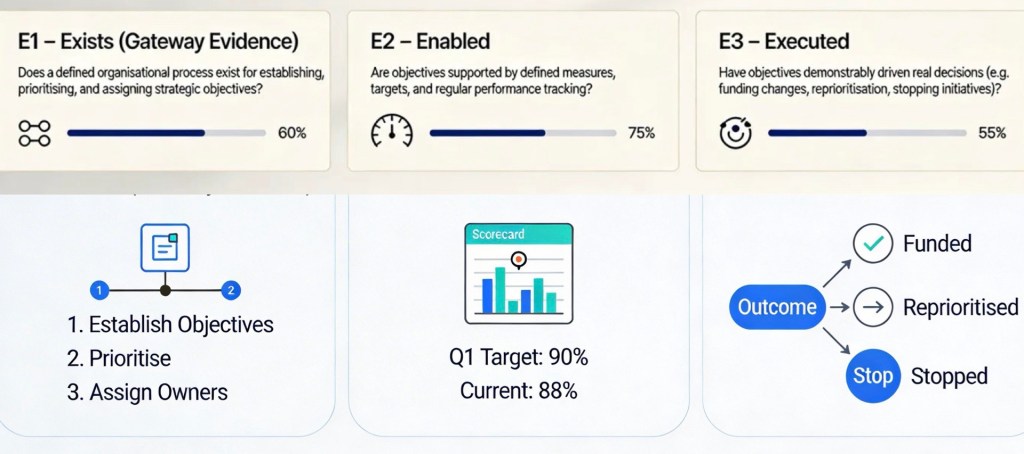
E1 – Exists (defined process)
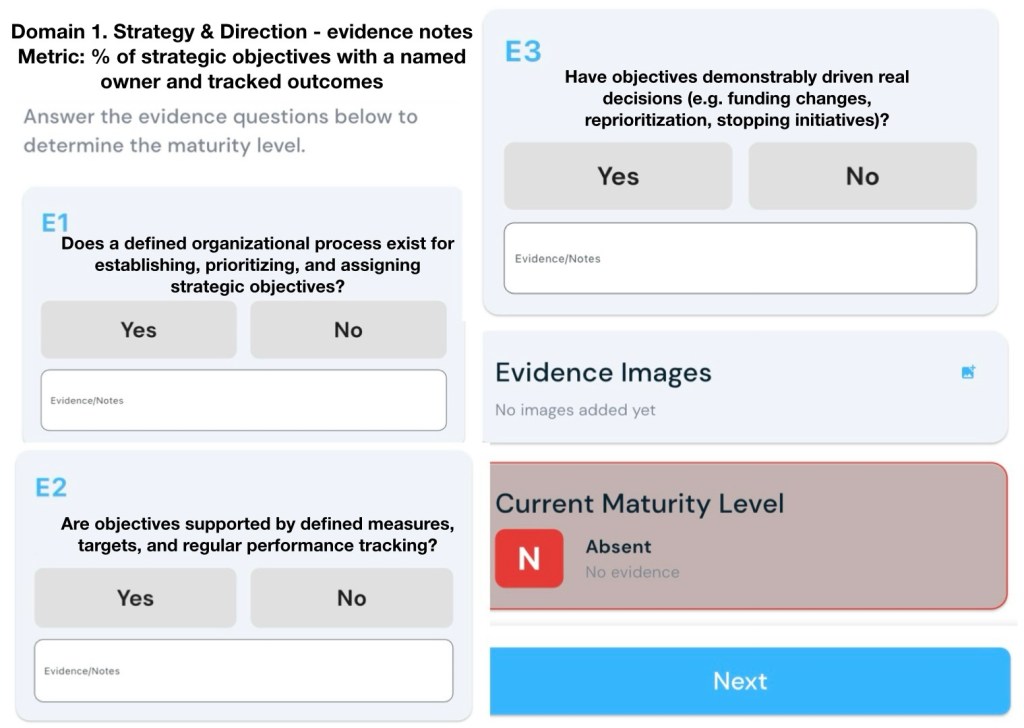
Assessment question: Does a defined organisational process exist for establishing, prioritising, and assigning strategic objectives?
Evidence you would look for:
- Approved strategic plan or corporate plan that explains how objectives are developed, prioritised, and cascaded (e.g. planning cycle diagram, role of Exec/Board, consultation steps).[4]
- Documented methodology or framework (e.g. use of Balanced Scorecard, OKRs, or internal strategy framework) describing how strategic priorities are selected and reviewed.[3][5]
- Governance artifacts:
- Terms of reference for a strategy committee or executive leadership team specifying responsibility for setting and approving strategic objectives.[4]
- Policy or procedure for strategic planning and performance management (including how objectives are added, changed, or retired).[3][4]
- Objective registers or strategy maps that clearly list all strategic objectives in a single, controlled source.[6][7]
- Evidence that each objective has an explicitly named single owner (person or role) documented in the plan, roadmap, or register.[8][1]
Example notes you might record:
- “Organisation uses a documented three‑year planning cycle approved by the Board; process describes environmental scan, prioritisation criteria and Executive endorsement.”[4]
- “All 14 strategic objectives are recorded in the corporate plan; each has a named Executive owner listed next to the objective.”[8]
- “There is a written ‘Strategy and Performance Policy’ defining responsibilities for setting, updating and retiring strategic objectives.”[3]
For the metric “% of strategic objectives with a named owner and tracked outcomes”, E1 evidence mainly proves there is a consistent way to create objectives and assign owners; you may calculate the percentage but do not yet require strong measures or tracking to rate E1 as met.[1][8]
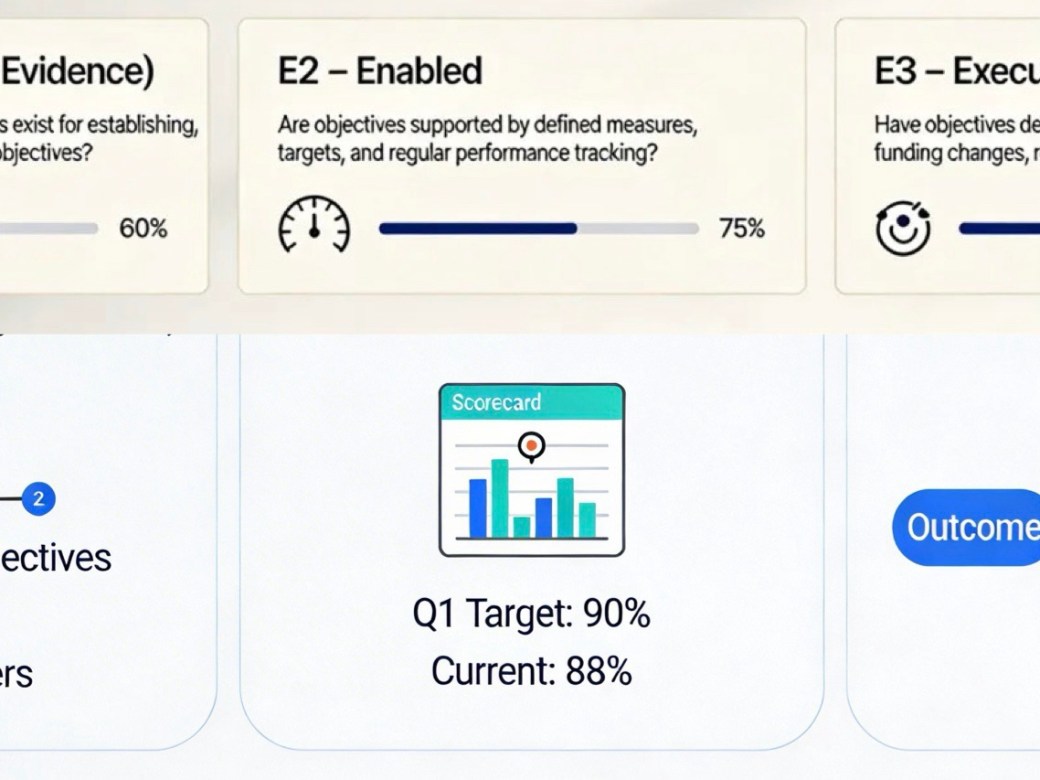
E2 – Enabled (measures, targets, tracking)
Assessment question: Are objectives supported by defined measures, targets, and regular performance tracking?
Evidence you would look for:
For each (or nearly all) strategic objectives, there is at least one KPI or measure, with:
- Clear definition (what is measured, how calculated, and data source).[9][6]
- Baseline and target (X to Y by date).[2][5]
- Named data/measure owner, distinct from or in addition to the objective owner.[10][8]
- Performance reports or dashboards showing:
- Regular (e.g. monthly/quarterly) updates on each objective’s KPIs.[2][3]
- Use of traffic lights or trend indicators to show status against target.[3]
- Coverage across the whole set of strategic objectives, not just operational metrics.[7]
- Evidence of an agreed reporting calendar and forum (e.g. Executive performance review meeting, Board performance report) where these objectives and KPIs are reviewed.[2][3]
- Data quality / KPI governance elements: data definitions, responsibilities for data collection, and sign‑off before reporting.[10][4]
Example notes you might record:
- “12 of 14 strategic objectives have at least one KPI with a defined measure, target and baseline; documented in the performance framework.”[5][6]
- “Quarterly strategy performance report to Executive includes all strategic objectives with RAG status, trend over last four quarters, and commentary by objective owner.”[2][3]
- “KPI governance procedure allocates accountability for data collection and target ownership for each strategic measure.”[10][4]
For the metric, at E2 you would usually expect to see a high percentage (e.g. >80–90%) of objectives that have:
- A named owner, and
- At least one KPI tied to that objective, with a target and regularly updated results in the reporting system.[5][1][2]
E3 – Executed (used in real decisions)
Assessment question: Have objectives demonstrably driven real decisions (funding, reprioritisation, stopping initiatives)?
Evidence you would look for:
- Documented decision records explicitly referencing objective performance, such as:
- Executive or Board minutes where under‑ or over‑performance against strategic objectives leads to changes in funding, scope, or timelines.[2][3]
- Business cases or investment proposals that show alignment to specific strategic objectives and refer to KPI results to justify investment or disinvestment.[6][9]
- Records of initiatives being stopped, scaled back, or accelerated because their contribution to a strategic objective was not supported by data or was outperformed by alternatives.[11][2]
- Performance review packs that include “management response” or “action taken” sections linked directly to objective status (e.g. “Objective 3 off track; reallocated FTE from Initiative X to Y”).[11][2]
- Evidence of target resets or strategy refresh driven by KPI trends (e.g. revising objectives, changing targets based on benchmarking, or adjusting measures where they are not useful).[6][10]
- Examples where performance insights have shaped priorities across portfolios, not just within a single project (e.g. rebalancing portfolio from growth to customer experience due to NPS and churn metrics against relevant objectives).[12][11]
Example notes you might record:
- “Board minute 12/2025: Under‑performance on ‘Improve customer retention’ objective (NPS and churn KPIs) used as basis to increase CX program funding by $2m and pause two lower‑impact marketing initiatives.”[12][2]
- “2024–25 budget pack contains a section mapping investments to strategic objectives and referencing prior‑year KPI results for each objective.”[9][11]
- “Strategy refresh 2025 updated three objectives and retired one, explicitly citing three years of KPI data and benchmarking as rationale.”[6][10]
For the metric, at E3 you are looking not only at the percentage but at the use of that information: a high proportion of objectives where owners actively propose and implement actions in response to the tracked outcomes, with traceable decisions and changes.[11][10][3]
How to phrase assessment notes for the metric
When you record the assessment against “% of strategic objectives with a named owner and tracked outcomes”, you might write:
- E1: “A corporate planning process is documented and followed; 100% of strategic objectives are listed in the corporate plan with a named Executive owner, but measures and targets are incomplete for some objectives.”[1][5]
- E2: “92% of strategic objectives have a named owner, at least one defined KPI, baseline and annual target; performance is reported quarterly to the Executive in a consolidated dashboard.”[5][8][2]
- E3: “Performance against strategic objectives is routinely discussed in Executive and Board forums, and there are multiple documented examples in the past 12–18 months where objective‑level results have led to funding reallocations, initiative stoppages and reprioritisation.”[11][3][2]
These types of evidence and notes will make the maturity rating transparent and auditable while directly aligning to the intent of the metric.
Sources
[1] Operational objectives https://monday.com/blog/project-management/business-objectives/
[2] 6 Ways to Measure Your Strategic Plan – Dame Leadership https://www.dameleadership.com/research-and-insights/6-ways-to-measure-your-strategic-plan/
[3] [PDF] How to Assess Your Strategic Management Maturity https://balancedscorecard.org/wp-content/uploads/2022/08/How-to-Assess-Your-Strategic-Management-Maturity-August-2022.pdf
[4] a case study on integrated performance management maturity … https://reference-global.com/download/article/10.2478/tjeb-2023-0007.pdf
[5] Strategic Goal Examples for Use in Your Strategic Plan and … https://www.smestrategy.net/blog/strategic-goals-examples-kpi-measurements-strategy-and-business-planning
[6] http://www.kippy.cloud › post › how-to-measure-strategic-objectives-a-compreh… https://www.kippy.cloud/post/how-to-measure-strategic-objectives-a-comprehensive-guide
[7] Performance Reporting Assessment Model – Maturity Matrix https://www.anao.gov.au/work-program/performance-reporting-assessment-model-maturity-matrix
[8] KPIs Meaning + 27 Examples of Key Performance Indicators https://onstrategyhq.com/resources/27-examples-of-key-performance-indicators/
[9] Objectives, Measures, Targets, And Initiatives – FasterCapital https://fastercapital.com/topics/objectives,-measures,-targets,-and-initiatives.html
[10] Insights from the Field: Performance Management Maturity … – GPAUNIT https://gpaunit.org/insights/performance-maturity-5-perspectives-insights
[11] KPIs and KEIs: Tracking Strategic Planning Effectiveness | TSI https://www.thestrategyinstitute.org/insights/kpis-and-keis-tracking-strategic-planning-effectiveness
[12] Choosing The Best Strategic Metrics for Success|Profit.co https://www.profit.co/blog/kpi-library/choosing-the-best-strategic-metrics-for-success/
[13] 7 Strategic Objectives Examples to Drive Business Success https://www.clearpointstrategy.com/blog/56-strategic-objective-examples-for-your-company-to-copy
[14] Understanding strategic goals – with 25 examples | BBC Maestro https://www.bbcmaestro.com/blog/understanding-strategic-goals
[15] What Are Strategic Objectives? How To Write Them + Examples https://www.cascade.app/blog/strategic-objectives

 John Salter Consulting Services