The K.I.S.S. Principle (Keep It Short and Simple) reminds us to focus on the “necessary and sufficient”. An important “fit for purpose” principle which encourages focus, which we bring to the capability framework, the associated assessment criteria – and prompts.
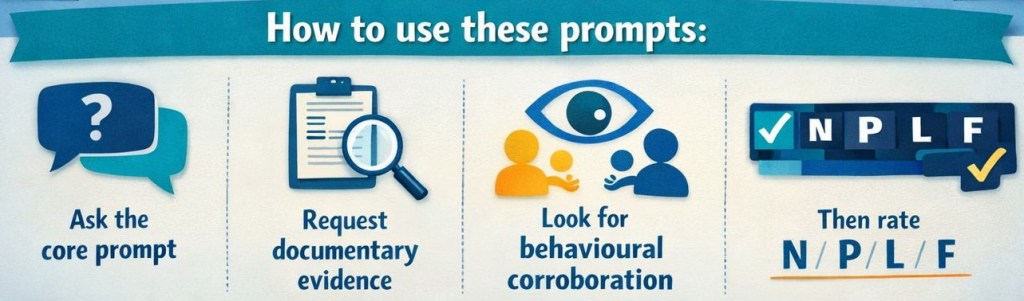
1. Develop Vision & Strategy
⚖️ Criterion: Strategic objectives drive actual resource allocation decisions.
📎 Audit evidence prompts
• Show where strategic objectives are explicitly referenced in recent capital, budget, or workforce allocation decisions.
• Provide examples where funding or priorities were changed due to a shift in strategy.
• Demonstrate how underperforming strategic initiatives were modified, defunded, or stopped.
🚩 Red flags
• Strategy decks without corresponding investment movements
• “Business as usual” budgets despite strategic change
2. Develop & Manage Products & Services
⚖️ Criterion: Offerings move predictably from concept to market using a repeatable lifecycle.
📎 Audit evidence prompts
• Describe the standard lifecycle used to take products/services from idea to launch.
• Provide evidence that this lifecycle has been applied consistently across multiple initiatives.
• Show forecast vs actual performance for time, cost, and launch outcomes.
🚩 Red flags
• One-off success stories
• Different teams using incompatible approaches
3. Market & Sell Products & Services
⚖️ Criterion: Demand can be forecast and influenced with reasonable accuracy.
📎 Audit evidence prompts
• Provide demand forecasts and corresponding actual outcomes over multiple periods.
• Demonstrate how marketing or pricing actions changed demand patterns.
• Show how forecast accuracy is reviewed and improved.
🚩 Red flags
• Forecasts produced but not trusted or used
• Sales described as “unpredictable by nature”
4. Deliver Products & Services
⚖️ Criterion: Customer commitments are met reliably without extraordinary effort.
📎 Audit evidence prompts
• Provide performance data showing on-time, in-full delivery against customer commitments.
• Show how delivery performance is monitored and exceptions handled.
• Demonstrate that reliability does not depend on informal escalation or heroics.
🚩 Red flags
• Reliance on key individuals to “save” delivery
• Frequent emergency workarounds
5. Manage Customer Service
⚖️ Criterion: Customer issues are resolved in a way that reduces future demand for service.
📎 Audit evidence prompts
• Show how customer issues are categorised, analysed, and tracked over time.
• Provide evidence of root-cause fixes and subsequent reduction in repeat issues.
• Demonstrate linkage between service insights and upstream process improvements.
🚩 Red flags
• High activity with no reduction in repeat contacts
• “Closing tickets” mistaken for learning
6. Develop & Manage Human Capital
⚖️ Criterion: The organisation can reliably put the right skills in the right roles when needed.
📎 Audit evidence prompts
• Provide workforce plans aligned to strategic and operational needs.
• Show time-to-fill data for critical roles and evidence of succession coverage.
• Demonstrate how skills gaps are identified and proactively addressed.
🚩 Red flags
• Chronic vacancies in key roles
• Capability gaps discovered only after failure
7. Manage IT & Knowledge
⚖️ Criterion: Information systems and data can be depended on for critical business decisions.
📎 Audit evidence prompts
• Identify which systems and data are relied upon for key business decisions.
• Show evidence of data quality controls and system reliability for those decisions.
• Demonstrate that leadership uses these systems without parallel “shadow” tools.
🚩 Red flags
• Critical decisions made outside core systems
• Widespread spreadsheet reconciliation
8. Manage Financial & Physical Resources
⚖️ Criterion: Capital is allocated and reallocated based on performance and expected value.
📎 Audit evidence prompts
• Provide examples of investment decisions adjusted due to performance outcomes.
• Show how expected value or return was assessed before allocation.
• Demonstrate that underperforming assets or initiatives are actively corrected or exited.
🚩 Red flags
• Budget roll-forwards regardless of results
• Inability to stop failing investments

 John Salter Consulting Services