… but hopefully NOT simplistic.
The K.I.S.S. Principle (Keep It Short and Simple) reminds us to focus on the “necessary and sufficient”. An important “fit for purpose” principle which encourages focus.
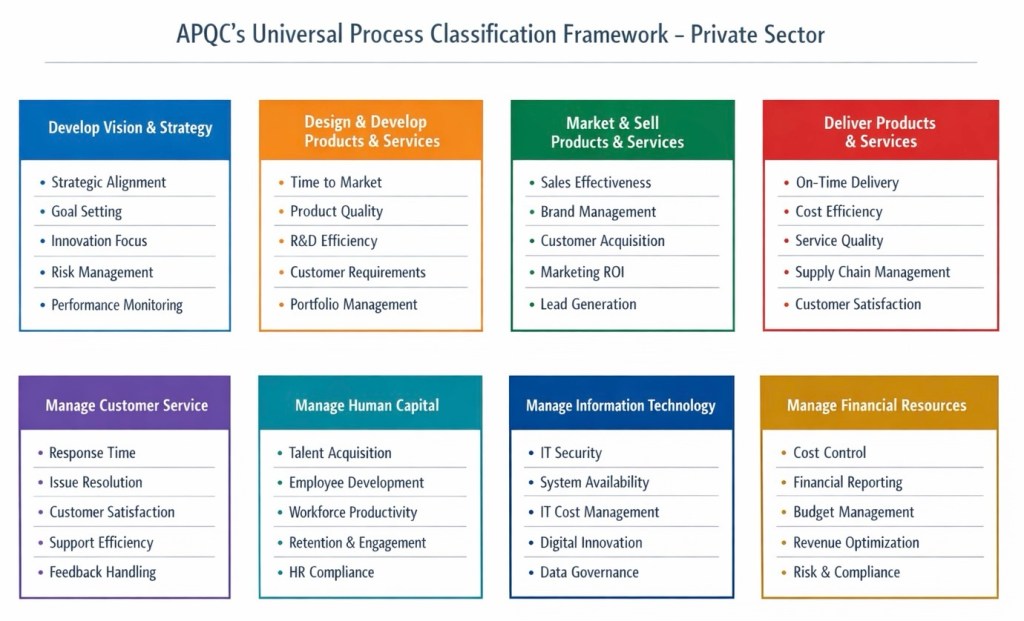
1. Develop Vision & Strategy
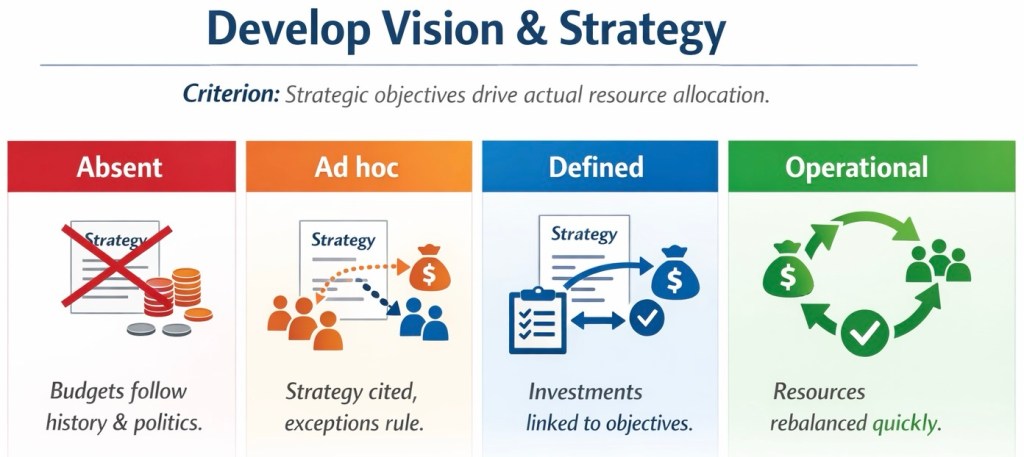
Criterion: Strategic objectives consistently drive actual resource allocation decisions.
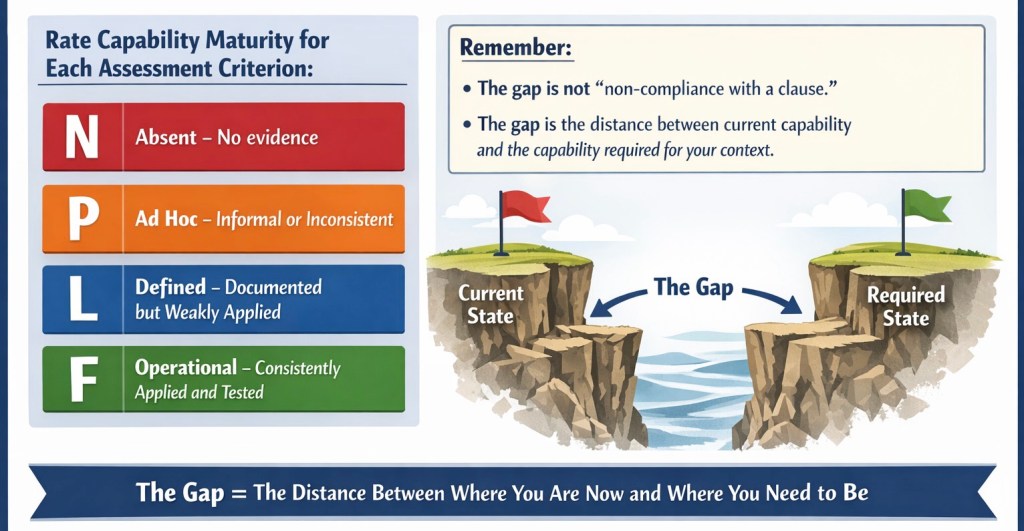
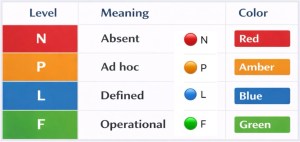
Level – Description
N 🔴 Absent
Resources are allocated by history, politics, or crisis. Strategy statements exist (or not), but they have no observable effect on budgets, staffing, or priorities.
P 🟠 Ad hoc
Strategy is referenced in some decisions, but exceptions dominate. Resource shifts occur occasionally and inconsistently, often after problems emerge.
L 🔵 Defined
Most major investments and priorities are explicitly linked to strategic objectives. Trade-offs are documented and reviewed on a set cycle.
F 🟢 Operational
Capital, people, and attention are routinely reallocated as strategy evolves. Underperforming initiatives are stopped or reshaped without delay.
⸻
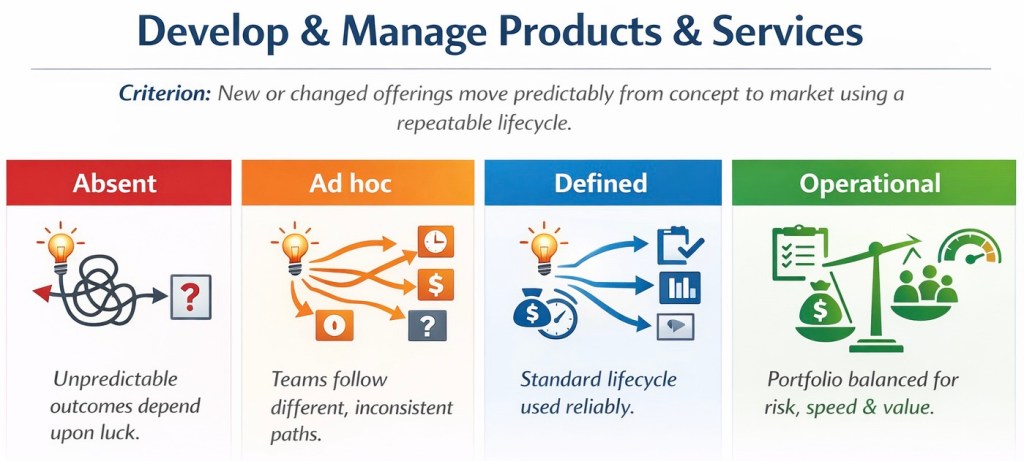
2. Develop & Manage Products & Services
Criterion: New or changed offerings move predictably from concept to market using a repeatable lifecycle.
Level – Description
N 🔴 Absent
Product outcomes are unpredictable. Delivery depends on individuals and luck; no common lifecycle exists.
P 🟠 Ad hoc
Some structure exists, but teams follow different approaches. Timelines, costs, and outcomes vary widely.
L 🔵 Defined
A standard lifecycle is used consistently. Time, cost, and quality outcomes are generally reliable.
F 🟢 Operational
Delivery performance is forecastable and optimised. The portfolio is actively balanced for risk, speed, and value.
⸻
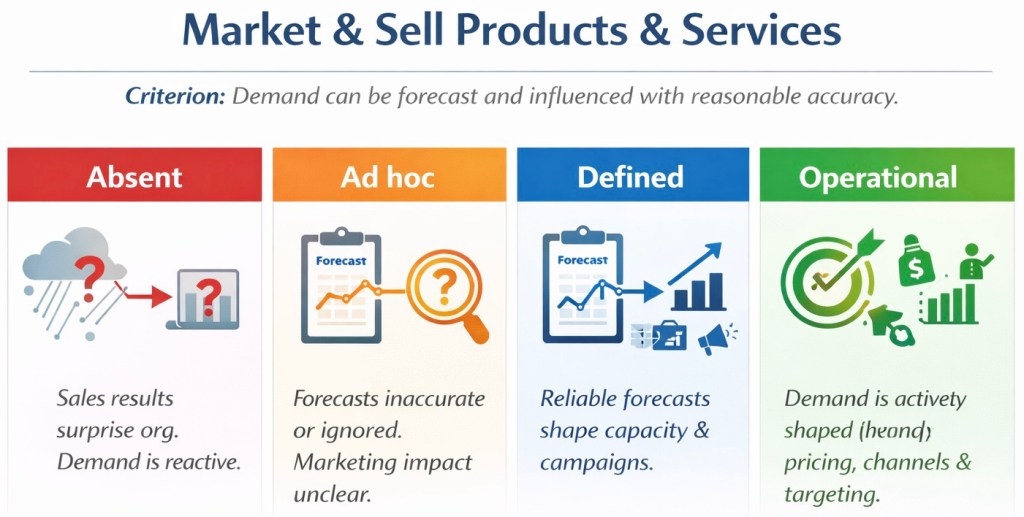
3. Market & Sell Products & Services
Criterion: Demand can be forecast and influenced with reasonable accuracy.
Level – Description
N 🔴 Absent
Sales results regularly surprise the organisation. Demand is largely reactive and poorly understood.
P 🟠 Ad hoc
Forecasts exist but are frequently inaccurate or ignored. Marketing impact is unclear.
L 🔵 Defined
Demand forecasts are generally reliable and used to plan capacity, inventory, and campaigns.
F 🟢 Operational
Demand is actively shaped through pricing, channels, and targeting. Forecast accuracy is continuously improved.
⸻
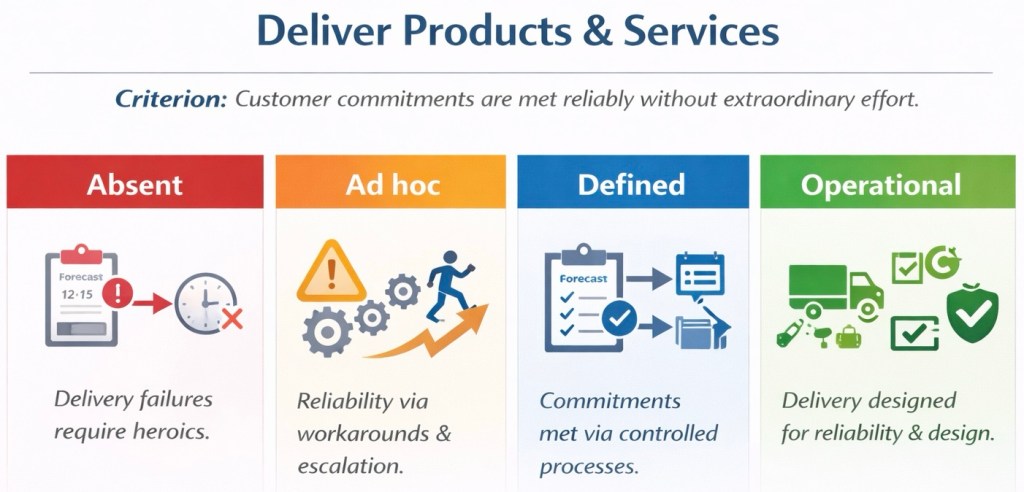
4. Deliver Products & Services
Criterion: Customer commitments are met reliably without extraordinary effort.
Level – Description
N 🔴 Absent
Delivery failures are common. Success depends on heroics and last-minute intervention.
P 🟠 Ad hoc
Reliability is achieved inconsistently through manual workarounds and escalation.
L 🔵 Defined
Commitments are met consistently through defined, controlled processes.
F 🟢 Operational
Delivery is reliable, resilient, and efficient by design. Exceptions are rare and well managed.
⸻
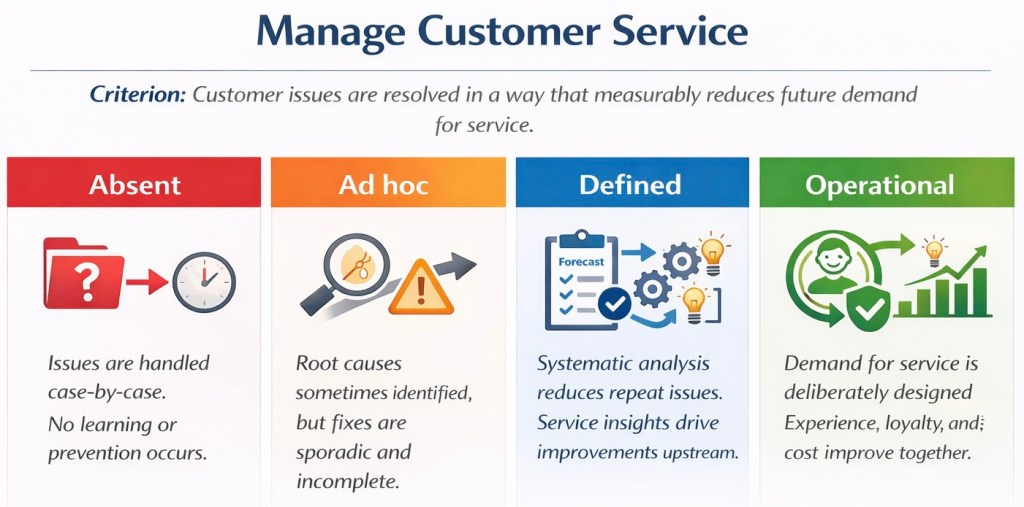
5. Manage Customer Service
Criterion: Customer issues are resolved in a way that measurably reduces future demand for service.
Level – Description
N 🔴 Absent
Issues are handled case-by-case. No learning or prevention occurs.
P 🟠 Ad hoc
Root causes are sometimes identified, but fixes are sporadic and incomplete.
L 🔵 Defined
Systematic analysis reduces repeat issues. Service insights drive improvements upstream.
F 🟢 Operational
Demand for service is deliberately designed down. Experience, loyalty, and cost improve together.
⸻
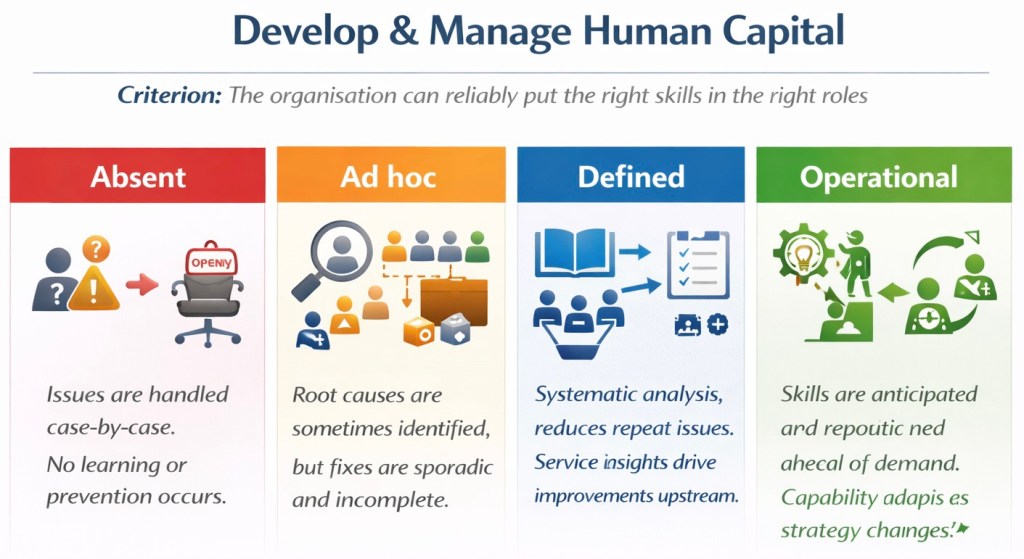
6. Develop & Manage Human Capital
Criterion: The organisation can reliably put the right skills in the right roles when needed.
Level – Description
N 🔴 Absent
Persistent skill gaps and misaligned roles. Critical positions remain vacant or mismatched.
P 🟠 Ad hoc
Some roles are filled well, others depend on chance or individual effort.
L 🔵 Defined
Workforce planning, development, and succession reliably support business needs.
F 🟢 Operational
Skills are anticipated and repositioned ahead of demand. Capability adapts as strategy changes.
⸻
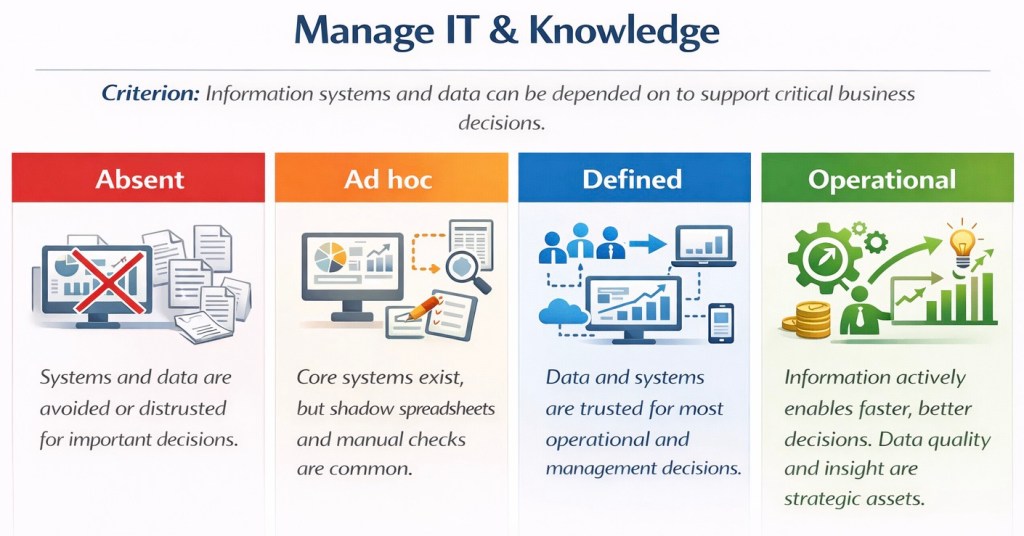
7. Manage IT & Knowledge
Criterion: Information systems and data can be depended on to support critical business decisions.
Level – Description
N 🔴 Absent
Systems and data are avoided or distrusted for important decisions.
P 🟠 Ad hoc
Core systems exist, but shadow spreadsheets and manual checks are common.
L 🔵 Defined
Data and systems are trusted for most operational and management decisions.
F 🟢 Operational
Information actively enables faster, better decisions. Data quality and insight are strategic assets.
⸻
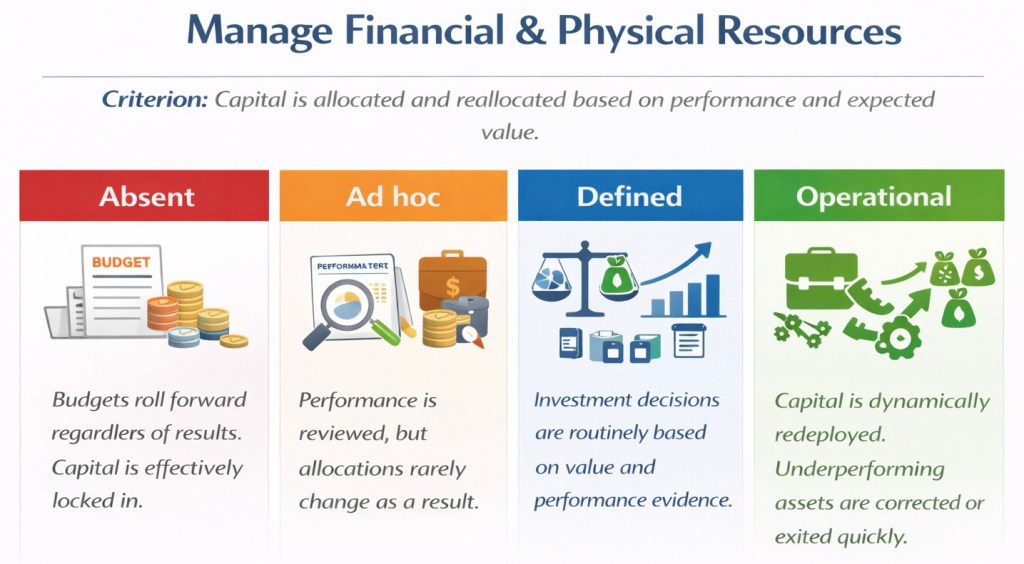
8. Manage Financial & Physical Resources
Criterion: Capital is allocated and reallocated based on performance and expected value.
Level – Description
N 🔴 Absent
Budgets roll forward regardless of results. Capital is effectively locked in.
P 🟠 Ad hoc
Performance is reviewed, but allocations rarely change as a result.
L 🔵 Defined
Investment decisions are routinely based on value and performance evidence.
F 🟢 Operational
Capital is dynamically redeployed. Underperforming assets are corrected or exited quickly.
⸻
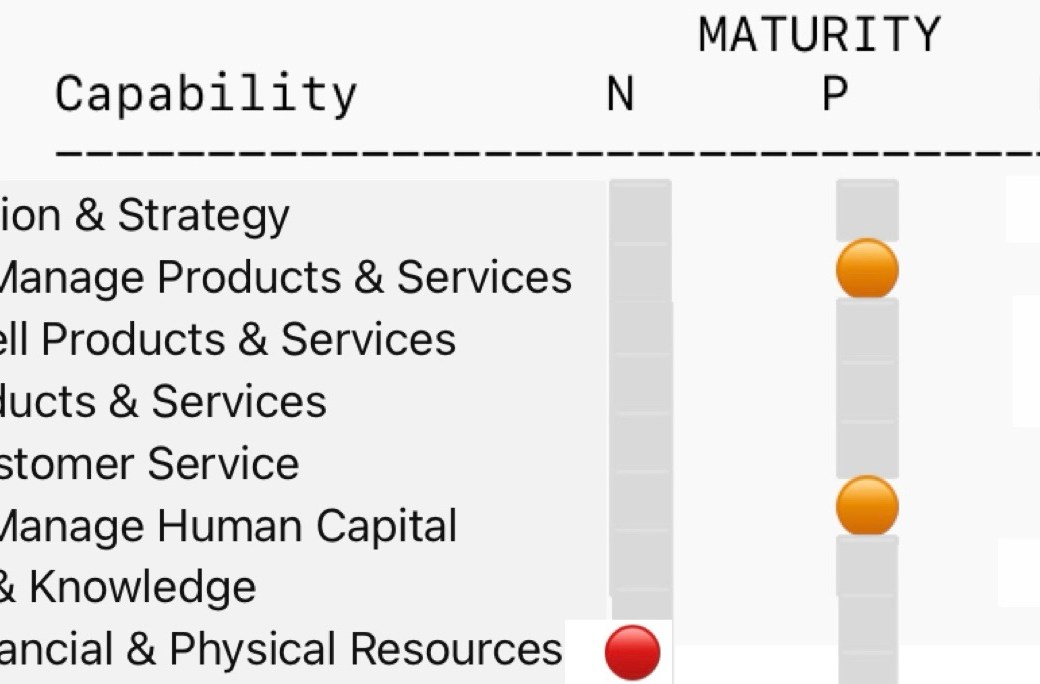
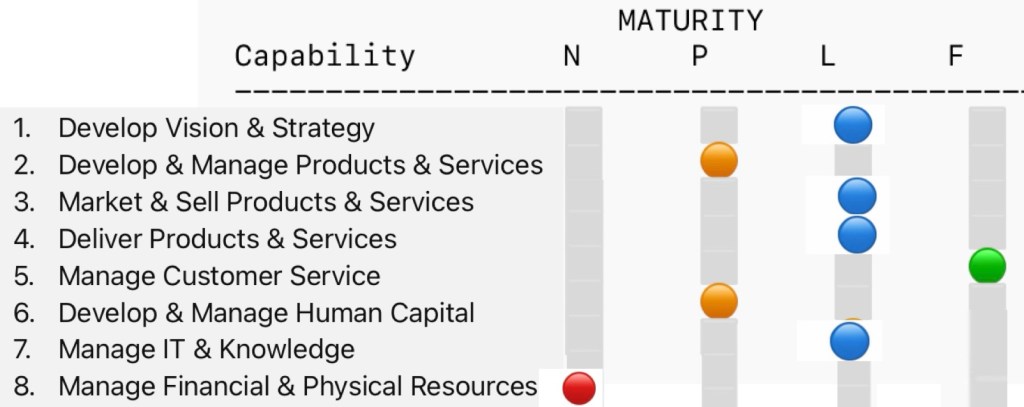
The Capability Heatmap app will be populated with the APQC data above, but will be flexible, allowing more, less or different elements to be edited and populated by the user to reflect context.


 John Salter Consulting Services